
The dry sift is one of the purest types of CBD hash there is: trichomes separated from the bud through screens of different micron sizes, without water, without heat and without solvents. The result is a sandy, golden pollen that keeps the original terpenes and cannabinoids of the plant intact — the closest method to how hash has been made for over a thousand years in the Rif mountains, only mechanised.
In this guide you'll learn what dry sift is, how it's made step by step, which microns determine its quality (the famous 6-star system) and the differences with bubble hash, ice-o-lator and other hash types. At the end, we'll explain how we make ours — our CBD Pollen Dry Sift at Cannactiva.
The 4 key ideas
- Dry sift is a pure trichome concentrate in pollen form, obtained by sieving dry cannabis buds through screens of different micron sizes. No water, no heat, no solvents — one of the most natural types of hash that exists.
- The modern technique was created by Mila Jansen in Amsterdam in 1994, when she introduced the first commercial Pollinator. Until then, almost all the hash sold in Europe was imported from Morocco.
- Quality depends on the micron size of the screen: meshes between 73 and 120 microns form the "gold zone" (6 and 5 stars), where the cleanest, most aromatic trichomes fall.
- Because no water or heat is applied, dry sift preserves the cannabis terpene profile intact — a much more faithful aroma of the original strain than any solvent-extracted hash.
What is dry sift pollen?
Dry sift pollen (also known as kief, and historically called kif in Morocco) is the oldest and purest way of making hash: separating trichomes from dry buds by hand or with a rotating drum, sifting them through screens of different micron sizes. No water, no heat, no solvents — just mechanical friction that lets the resin fall through the mesh. The result is a fine, sandy powder of a golden blonde colour, similar to flower pollen (hence the name, although it has nothing to do with botanical pollen).
What sets it apart from the other types of hashish is that it preserves the original aromatic profile of the plant intact. Other methods use ice water, heat or pressure, which carry away or volatilise some terpenes along the way. With dry sift, what falls onto the mesh is practically a "snapshot" of the aroma the bud had when it was harvested.
The protagonists of the process are the glandular trichomes — those sticky stalked heads (technically capitate-stalked) that glisten on mature buds. They are the plant's "chemical factories": they concentrate more than 90% of the cannabinoids and terpenes.
Each head measures between 20 and 120 microns in diameter, and that figure is the key to the entire process: because plant material is much larger, fine meshes let trichomes pass through while retaining the leaf and stem above.
History of dry sift: from Moroccan kif to the Pollinator
The original Moroccan kif (from the 18th century onwards) wasn't the dry sift we know today: it was a mixture of cannabis and finely chopped black tobacco, smoked in a long wooden and clay pipe called the sebsi. The name comes from the Arabic kayf (كَيْف), meaning "pleasure" or "well-being" — the state the mixture induced. The word entered Western literature early: it already appears in An Account of the Empire of Marocco (1809) by James Grey Jackson, and in T.W. Coakley's novel Keef: A Life-Story in Nine Phases, published in Boston in 1897 — the first English novel devoted entirely to the subject.
The dry sift as a technique — sieving the dry flower over fine silks to separate the trichomes — is far more recent than it's usually told. It reached the Moroccan Rif in the 1960s and 70s, brought by the Western travellers of the hippy hashish trail who carried the sieving techniques from Lebanon and Afghanistan. Before then, Morocco consumed kif (the mixture with tobacco) and the hashish circulating in the country was imported from Lebanon and Egypt. From the 70s onwards, Morocco adopted the technique on a massive scale and became the leading producer of European hash.
Mila Jansen and the invention of the Pollinator (1992-1994)
In 1992, Mila Jansen — Dutch, known as the Hash Queen — had an epiphany in front of her clothes dryer: the rotating motion of the drum was exactly the same movement she made by hand to release trichomes. She adapted an old dryer with a mesh inside and, in November 1994, she introduced the first commercial Pollinator at the High Times Cannabis Cup in Amsterdam.
It was the first device in history to mechanise trichome separation — what previously took a full day by hand could now be done in minutes. This gave birth to nederhash (pressed Dutch hash). Mila would later found the Pollinator Company and, at the end of the decade, also invented the Ice-O-Lator, the first bubble hash bag system.
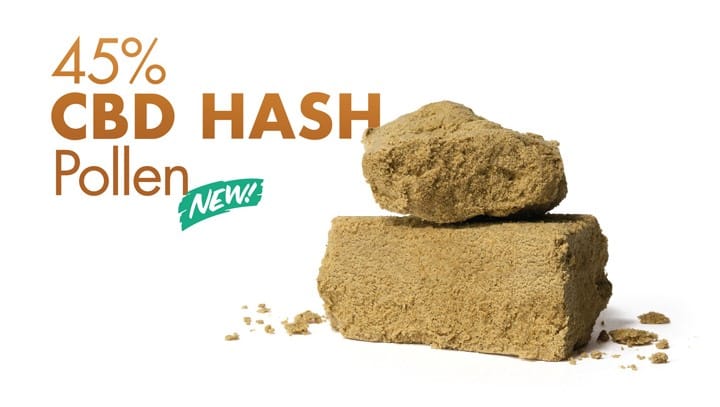
Cannactiva's flagship CBD resins: CBD Pollen Dry Sift 45% (dry-sieved, loose pollen), Original 45% CBD Hash (same pollen, pressed in the Afghan-Pakistani tradition), Bubble Hash 45% CBD (ice-water extraction) and the CBD Hash Pack that brings the three together in a single bundle. All made with artisanal methods that allow us to reach 45% CBD compared with the 18-25% of standard pollen on the market.
How dry sift hash is made step by step
The process is mechanically simple but technically demanding: any small mistake (moisture, temperature, aggressive friction) contaminates the pollen with plant matter and drops the final quality by several stars.
Starting material: trichomes, not whole buds
Although it can be done with whole buds, master hashishin prefer trim (the small leaves and offcuts left over from manicuring) and loose kief. Sifting whole buds is wasteful: much of the trichome layer stays trapped in the plant matter; with trim we make the most of what would otherwise be discarded.
The 6 steps of professional dry sift:
- 1. Material selection: well-cured cannabis, rich in mature trichomes. The more visible they are (milky-amber colour, not transparent), the better the result.
- 2. Pre-freezing: the material is placed in the freezer for a few hours (ideally between -18 °C and -25 °C). The cold makes trichome stalks brittle, so they snap off with a dry tap instead of being crushed.
- 3. Multi-level dry sieving: the material is tipped onto a stack of screens of different micron sizes. Professionals use a rotating Pollinator-style drum; at home, flat meshes shaken by hand or with gentle vibration.
- 4. Capture by microns: trichome heads (20-120 μm) pass through the screens depending on their size. Each sieve collects a different "quality" — we explain the 6-star system below.
- 5. Collection and visual cleaning: the pollen is scraped up with a spatula, inspected under a microscope or loupe, and visible plant fragments are discarded.
- 6. Pressing (optional) and curing: many consumers keep it as powder to preserve purity. Others press it lightly into a hash plate. Subsequent curing (weeks in an airtight jar, in the dark, 18-20 °C) develops the aromatic profile.
Because no solvents, heat or water are used at any point, the pollen keeps the full cannabinoid and terpene profile of the original cannabis flowers. This is what is technically called a solventless extract.
Dry sift types and quality: the 6-star system
In the world of solventless hash there is a universal quality scale known as the star system, which goes from 1 to 6 according to the purity of the pollen collected. The variable that determines it is the micron size of the screen the material falls through:
- 6 stars — 73-90 μm — Full melt sift: melts and vapourises almost completely, leaving no residue.
- 5 stars — 90-120 μm — "Gold Zone" with maximum terpene expression: melts with bubbling, leaves very little residue. Ideal for rosin.
- 3-4 stars — 120-160 μm — Traditional hash, classic block: partially melts, creamy texture.
- 1-2 stars — >160 μm or <45 μm — Material for infusions: burns without melting well, leaves ash.
A professional setup stacks at least four sieves: first a 220 μm one that acts as a "guard" (catches leaves and stems), then a middle 150 μm (medium debris), a 90-120 μm (the gold zone, where 5-6 star pollen falls) and a 45 μm one for the fine remnants.
That's why when you see "Dry Sift 5★" or "Full Melt 6★" on an artisanal label, it's not marketing — it's the micron size of the mesh and the percentage of intact heads that ended up in that batch.
What is "full melt" dry sift (6 stars)
When a dry sift reaches 6 stars it's also called full melt or full melt hash: when heated it melts and vapourises almost completely, leaving no ash or plant residue. It's the technical pinnacle of artisanal pollen.
A high-quality pollen like our CBD Pollen Dry Sift at Cannactiva aims for the balance between purity and terpenes: the finest microns give more purity; the middle ones, more flavour.
Differences between dry sift, bubble hash, ice-o-lator and charas
The major families of solventless hash share the same goal — separating trichomes from the bud — but they reach it via very different paths. And so are the results.
The dry sift is the method this post is about: dry sieving, no water and no heat, which preserves the terpene profile intact. The pollen stays loose and sandy, ready to use as it is or to be pressed into a block.
The bubble hash also relies on cold, but uses water and ice. The material is agitated in a bag with ice and water: the cold makes trichomes brittle and the water drags them into bags of different microns that filter them progressively. The result is a wet paste that is later dried or pressed, with a cleaner, "greener" flavour — water takes some hydrosoluble terpenes with it, but you gain in visual purity.
The ice-o-lator is bubble hash taken to its finest version. It uses Mila Jansen's patented micron-bag system and a much more controlled technique, frequently reaching full melt grades (5-6 stars). The final product tends to be blonder, more concentrated and significantly more expensive than a craft bubble hash.
The charas, on the other hand, comes from India and Nepal and breaks with everything above: the resin is separated by rubbing the live plant between the hands until the palms are covered in a dark paste, which is then shaped into balls. The result is a fattier, more spicy and intense hash, quite different from any European method.
Beyond these four there is also the Afghan-Pakistani hash, another centuries-old school that starts the same way as dry sift (dry sieving) but then presses the pollen with heat and pressure, producing the classic dark, aromatic "chocolate" blocks. Our Original 45% CBD Hash follows exactly that tradition: sieved through 70-micron screens and pressed by hand, with the resinous profile characteristic of Afghan-style hash.
If you want to dive deeper into the differences between pollen and other types of hash, we have a dedicated post: differences between hashish and pollen.
Our full CBD hash range by extraction method: CBD Pollen Dry Sift (dry sieving), Original CBD Hash (sieved and pressed in the Afghan tradition), Bubble Hash 45% CBD (ice-water extraction) and Iceolator 60% CBD (the premium version of bubble hash made with micron bags, full melt quality).
How to consume dry sift
Dry sift accepts almost any form of consumption, but some methods do it more justice than others. Since its great virtue is the full aromatic profile, controlled heat is what brings out the best of it:
- Vapourisation: the cleanest method. At 170-190 °C, terpenes release their full expression without combustion. There are vaporisers specifically designed for hash and rosin with a ceramic mesh.
- Pipe or bong without tobacco: straight into the bowl, with a metal screen underneath so it doesn't fall through. The powder melts and adds flavour without complete combustion.
- Mixed in a tobacco-free joint: the most common method in Europe. When mixed with tobacco, part of the pollen's aromatic profile gets masked by the smoke of the cigarette.
- Edibles: dry sift can be infused into fats (butter, oil). It must first be decarboxylated (110 °C × 30 min) to activate the cannabinoids.
- Dabbing: only recommended if it is 6 stars (full melt). Otherwise, it leaves residue.
Storage: how not to ruin a good pollen
Dry sift is delicate: terpenes are volatile, cannabinoids oxidise with light and heat, and humidity causes mould. The optimal conditions are simple but strict:
- Temperature: between 4 and 15 °C. The fridge works; the freezer only for long-term storage (>6 months) and always in double airtight to prevent condensation when taking it out.
- Relative humidity: 55-62%. Below that it dries out and turns into aroma-less powder; above it, mould.
- Light: zero. UV degrades cannabinoids very quickly. Use opaque glass jars or a metal tin.
- Oxygen: minimum. An airtight jar, ideally with a humidity card (Boveda or equivalent).
- Time: when properly stored, a dry sift keeps quality for 12-18 months. After 2 years it loses terpenes noticeably, although cannabinoids remain active.
A simple rule: if you open the jar and it smells of neutral dry grass instead of the original strain, that pollen has lost its sparkle. It still works, but it's no longer a 5-star piece.
5 factors that determine the quality of dry sift
The final quality of the pollen depends on five linked variables. If one fails, the others can't compensate:
- Quality of the source plant: healthy, well-cured buds with visible, mature trichomes (milky-amber colour, not transparent or brown).
- Sieving method: calibrated screens, multi-level, gentle agitation without harsh friction. Excessive rubbing breaks trichomes and adds plant wax.
- Uniformity of the collected trichomes: a quality pollen has homogeneous colour (clean gold, without green or grey patches) and a sandy texture, not clumpy.
- Storage conditions: see the section above — temperature, humidity, darkness, airtight.
- Preserved terpene profile: good dry sift smells exactly like the bud it comes from, only much more concentrated.
Our CBD Pollen Dry Sift at Cannactiva
At Cannactiva we craft our CBD Pollen Dry Sift 45% the same way Mila Jansen did in her first Pollinator back in 1994: rotating drum, cold, fine screens, patience. No water, no heat, no solvents. It's a slow process that can't be rushed.
The result is a golden blonde pollen, with a sandy texture, an earthy aroma with fresh citrus hints — the characteristic profile of quality hemp when it's dry-sieved without losing a single terpene along the way. Buds grown naturally and sustainably, without pesticides or chemicals. Its 45% CBD content is almost double that of the standard pollen on the market (18-25%), at a reasonable price because we produce it ourselves.
If you're interested in dry sift it's probably because you're looking for exactly that — a natural product, made the right way, no shortcuts. If you want to explore the rest of the family, our CBD Hash Pack brings together our three flagship hash types (pollen dry sift, original pressed hash and bubble hash) in a single bundle.
Frequently asked questions about dry sift
What effects does CBD dry sift produce?
The typical effects of concentrated CBD: physical relaxation, relief from muscle tension and a calming sensation without the high. The pollen's terpene profile, kept intact by dry sieving, amplifies those effects through synergy (the so-called "entourage effect").
Is the "kief" from the grinder the same as dry sift?
They share an origin — both are trichomes separated from the bud — but they're not the same thing. Dry sift is sieved through fine meshes (45-120 microns) that only let mature trichomes pass: the result is a near-pure, golden blonde pollen. The kief from the grinder is collected through a much coarser mesh (above 150 microns), so it carries plant matter with it: it has a greenish-yellow colour, far lower potency and a more "herbal" aroma. On the star system it would correspond to a 1-2★, whereas a good dry sift sits at 5-6★.
Will CBD dry sift show positive on a drug test?
CBD Pollen contains traces of THC, in line with European regulations on industrial hemp. Drug tests can detect cannabinoid traces even from legal products. If you're going to take a workplace or roadside test, it's advisable to stop consumption days or weeks beforehand.
How much pollen comes from 1 kg of flower?
The typical yield of dry sift is between 5% and 15% of the starting dry flower weight, depending on the variety's trichome richness and the skill of the extractor. That means 1 kg of flower yields between 50 and 150 g of pollen — and the difference between those two extremes is the mark of a good hashishin.
What's the price of good CBD pollen?
In the legal European market, a quality CBD dry sift typically costs around €3-15 per gram depending on the cannabinoid percentage, the quantity (bulk discount) and the purity (stars). Our CBD Pollen Dry Sift 45% sits in a very competitive price range because we produce it directly ourselves.
Our recommendation
If you've never experienced dry sift, start with the pure format — the CBD Pollen Dry Sift 45% at Cannactiva — to understand what the plant smells like when it's concentrated without being touched. If you already know the world of hash and want to compare textures, the CBD Hash Pack gives you the three classic formats (pollen dry sift, original pressed hash and bubble hash) in a single delivery.
The 45% CBD Dry Sift Pollen and all Cannactiva products are intended for external use only. They are not regulated for human consumption by inhalation; they are sold as aromatic or collectible products under European industrial hemp regulations.


