
If you've made it this far, you're most likely asking something very specific: how many drops of CBD should I take? It's the number one question for beginners, and the answer is that there is no universal dosage: the ideal amount depends on your weight, the strength of your CBD oil, your goal and how your body responds.
The good news is that working out your CBD dosage is simpler than it seems. In this guide we give you the practical side —how many drops, how many mg of CBD, a dosage-by-drops table— and we back it up with the doses that have been used in real studies. Let's begin.
This is an informational article and is not intended to treat, cure or diagnose any illness or symptom. In most European countries, over-the-counter CBD oils are neither medicines nor food supplements and are sold for external use in accordance with European legislation. Consult your doctor if you have a medical condition or any doubts about using CBD.
How many drops of CBD should I take?
The right question isn't so much "how many drops" as "how many milligrams (mg) of CBD": one drop doesn't deliver the same amount in a 5% CBD oil as in a 20% one. The drop is just the carrier; what counts is the mg of CBD it contains. Pay attention to what strength of CBD oil you're using.
At present, there is no single dose that works equally for everyone: CBD can act differently depending on the person and there are no established guidelines on the optimal CBD dosage.
Reference doses from studies and user experience
In scientific studies, widely varying doses have been used depending on the case (1-4); from 25 to 175 mg per day up to 300 mg on a one-off basis (5).
According to cannabis industry sources, professionals suggest starting from 10-20 mg of CBD per day, and keeping that amount for around a week before adjusting it. Others propose starting with 30-50 mg on a one-off basis, to observe the response. But there are no clinical studies backing all these starting figures, they are based on over-the-counter (OTC) use and on the subjective sensations of users, so they cannot be considered a scientific source, a recommendation or a prescription.
How to calculate your CBD dosage: from milligrams to drops
Calculating your CBD dosage takes two simple steps: first you need to know how many milligrams (mg) of CBD you need, and then you translate them into CBD drops, based on the strength of your CBD oil. It also matters whether you use it occasionally (at a specific moment, usually higher doses) or regularly (as part of a daily routine).
How many mg of CBD are in a drop
How do you work out how much CBD your oil contains? The calculation is simple: a full pipette equals 1 ml = approx. 20 drops, so the only thing that changes is how much CBD each drop carries depending on the strength.
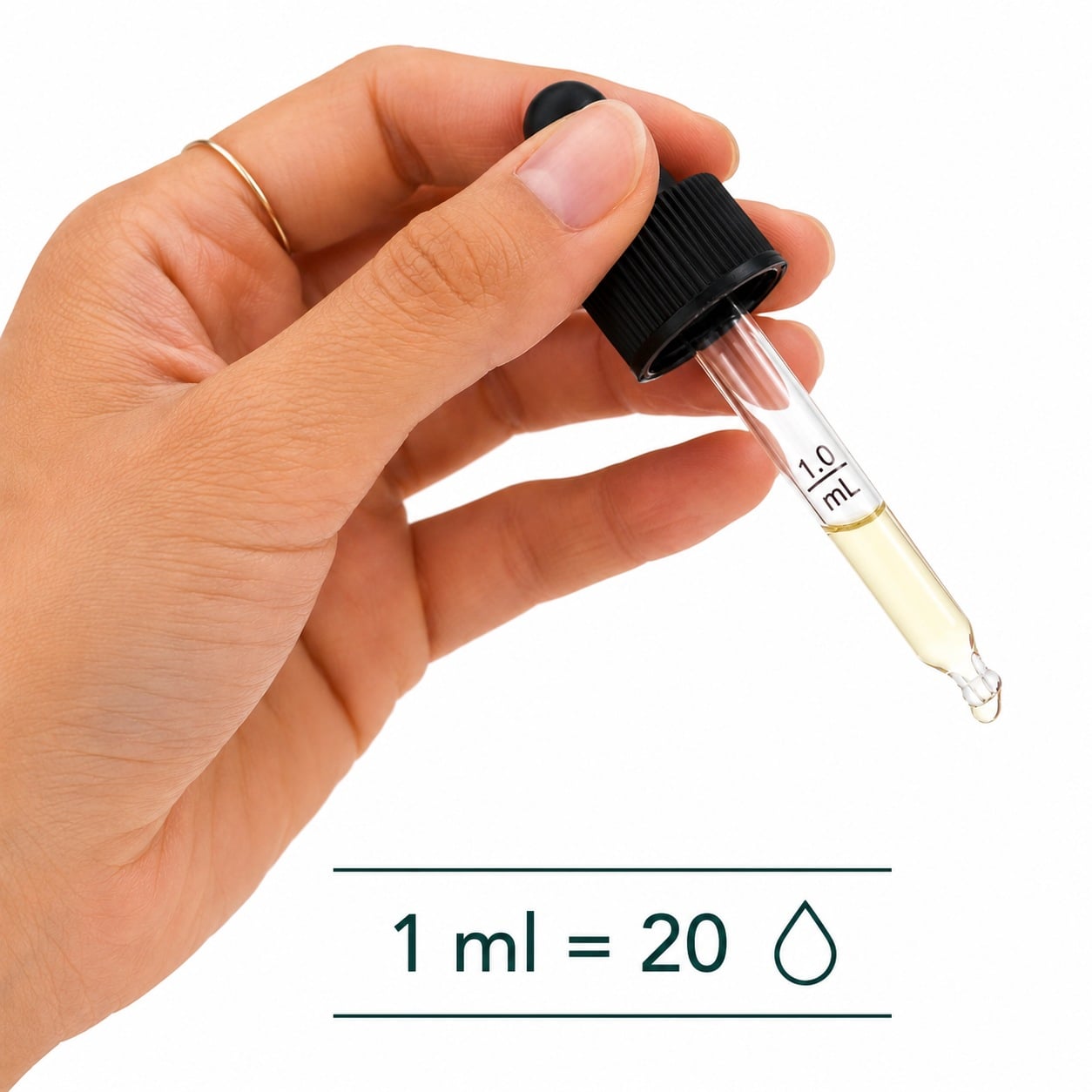
Table: CBD dosage based on CBD oil strength
Strength | Total CBD (10 ml) | mg per drop | Drops (10 mg) | Drops (25 mg) |
|---|---|---|---|---|
5% | 500 mg | ~2.5 mg | 4 | 10 |
10% | 1000 mg | ~5 mg | 2 | 5 |
20% | 2000 mg | ~10 mg | 1 | 2-3 |
30% | 3000 mg | ~15 mg | 1 | 2 |
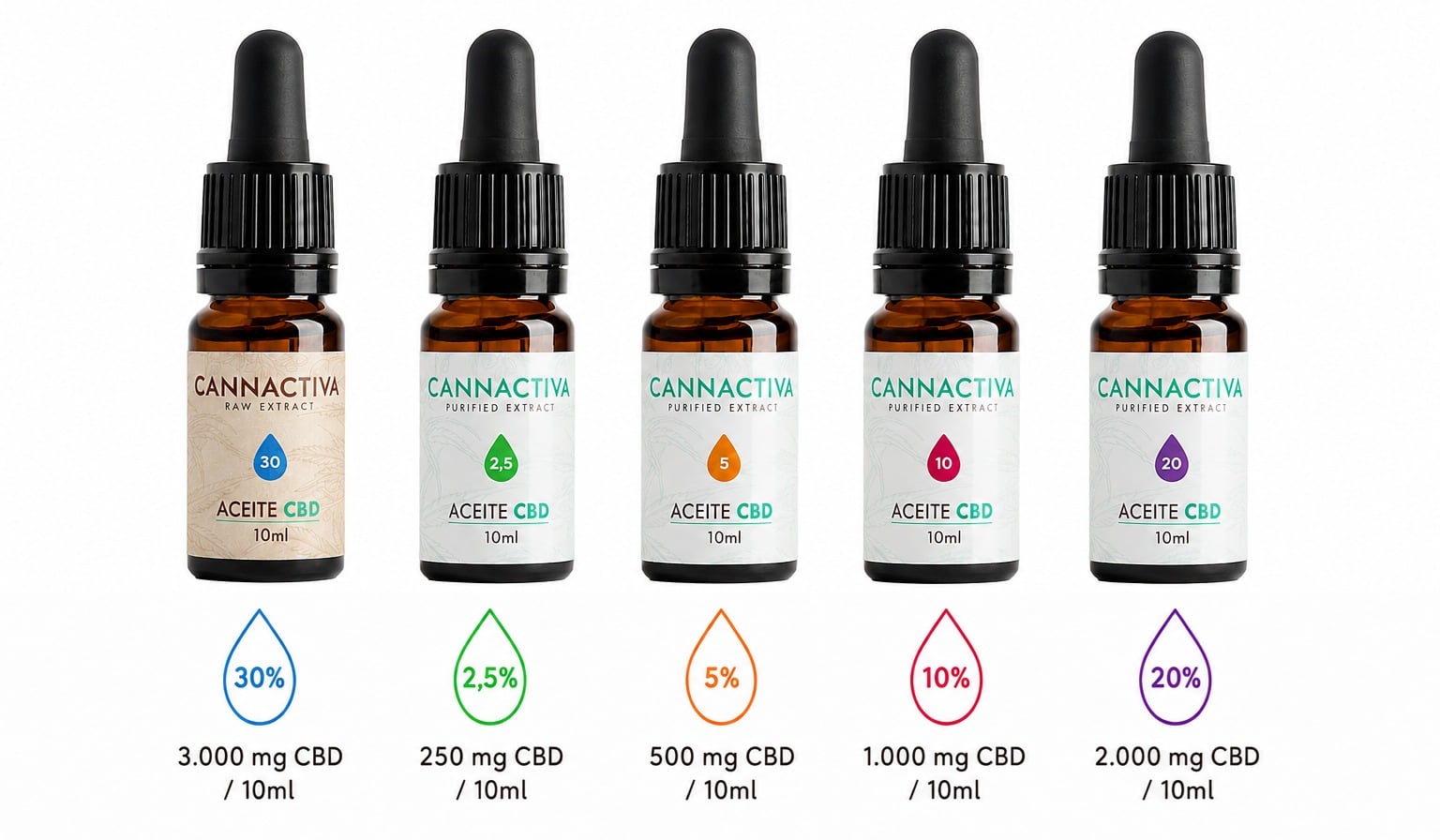
What matters is the total mg of CBD; the number of drops is worked out afterwards. If you're unsure which CBD oil strength to choose, we explain it in our guide on the different CBD oil concentrations.
CBD dosage by study and goal
Although every case is individual, these are the CBD doses that have been used in the scientific literature for different goals. They serve as information, a rough reference, but they can in no case be used as a prescription or medical guideline. As for over-the-counter CBD products, it should be made clear that these are not regulated as medicines or food supplements, so their authorised use in most European countries is external. There is still no consensus on optimal CBD doses, and any treatment should be supervised by a healthcare professional.
Goal | Indicative range (studies) |
|---|---|
Anxiety and stress | ~300 mg for acute/one-off use (5, 6) |
Sleep and rest | 25-175 mg/day (8) |
Pain | clinical and broad: from ~150 up to 1500 mg/day depending on the case (1-4) |
CBD dosage for anxiety and stress
Using CBD for anxiety is one of the best-documented cases, and also one that best shows that with CBD the dose doesn't work in a linear way: more CBD doesn't always give better results.
In a clinical trial with 57 healthy volunteers undergoing a public-speaking test, 300 mg of CBD reduced anxiety, whereas 150 mg and 600 mg did not achieve the same effect: the middle point was the most effective (5).
By contrast, in patients with social anxiety disorder, a single 600 mg dose did reduce anxiety compared with placebo (6). In a more recent study, with 63 people prone to worry, 300 mg a day for 2 weeks reduced the physical symptoms of anxiety (not mental worry), while a low 50 mg dose had no effect (7).
Overall, studies use high and heterogeneous doses. More information in CBD for anxiety.
CBD dosage for sleep and rest
In a large clinical case series with 103 patients, CBD was used in doses of 25 to 175 mg per day (most started at around 25 mg). During the first month, sleep scores improved in 66.7% and anxiety scores in 79.2% of patients, although the sleep improvement fluctuated over time (8).
The most recent controlled trials show that with 150 mg every night for 2 weeks in people with insomnia, no clear improvement in insomnia severity was seen compared with placebo, although there was an improvement in objective sleep efficiency and wellbeing (9). We expand on this in CBD for sleep.
CBD dosage for pain
For pain, clinical research has used higher CBD doses than in the previous cases. Within that clinical context, they tend to be grouped into three levels:
- Low level, up to ~150 mg/day: has shown benefit for chronic pain (and mental health), with good tolerability (1).
- Moderate level, 150-500 mg/day: has been investigated for acute and neuropathic pain, both in a single dose (2) and in treatments lasting several weeks, with a better effect when combined with THC (3).
- High level, 500-1500 mg/day: typical of clinical settings for severe pain; for example, 600 mg/day for 8 weeks (4). Very high doses can also affect the liver when combined with medication.
In other words, these are figures from clinical studies, not everyday use: even the "low level" (up to 150 mg/day) is far above the starting guidance we saw at the beginning. There is no standard dose for pain; we cover it in depth, with the studies, in CBD dosage for pain.
How do you find the optimal CBD dosage?
The optimal CBD dosage is determined individually and gradually. The most widely accepted method is to start with a low dose and increase it little by little —known as start low, go slow— until you find the amount that works best for each person.
The start-low-go-slow method step by step
- Start low. Begin with a low or intermediate dose. High doses are not recommended to start with.
- Be consistent. Use that same dose for at least 7 days (ideally 1-2 weeks). CBD doesn't always act instantly: part of its effect is noticed with sustained use.
- Increase in small increments. If you don't notice what you're looking for, increase little by little, waiting one or two weeks between increases, and observe how you respond.
- Find your sweet spot and don't exceed it without reason. When you hit the dose that works for you, stay there. Going higher doesn't guarantee more effect —in fact, it may reduce it— and if any discomfort appears, lower the dose.
Keeping a small log (dose, time and how you feel) during the first few weeks will help you calibrate much faster.
How and when to take CBD drops
The most common way to use CBD oil is sublingually: you place the drops under the tongue and hold them there for 60 to 90 seconds before swallowing, to aid absorption through the mucous membrane. As for the time of day, it depends on your goal: for relaxation or rest many people save it for the late afternoon or evening, while for daytime use it can be split into several doses. You can explore the options further in our guide on how to consume CBD and on sublingual CBD oil.
Reminder: Cannactiva CBD oils are products for external use.
How long does CBD take to be felt?
The time it takes to be noticed depends mainly on the method of consumption:
- Sublingual CBD (CBD oil): is usually felt within 15 to 45 minutes and its effect lasts several hours.
- Topical (creams, balms): acts locally on the area of application, usually within a few minutes.
- Inhaled/vaporised: is the fastest method (minutes), but also the shortest-lasting.
If you want to dig deeper, we cover it in how long CBD lasts and how long it takes to work.
What factors influence your dose
Although the tables give a good starting point, your optimal dose depends on several personal factors:
- Weight and body composition.
- Metabolism (each body processes CBD at its own pace).
- Goal (occasional relaxation isn't the same as ongoing use).
- Tolerance and prior experience with CBD.
- Strength and type of CBD oil: two CBD oils can have different effects because of the differences between full spectrum, broad spectrum and isolate.
Adverse effects of an excessive CBD dose
According to the World Health Organization, CBD is, in general, safe and well tolerated (10), but overdoing it brings no extra benefit and can lead to unwanted effects, such as:
- Fatigue or excessive drowsiness
- Changes in appetite
- Dry mouth
- Gastrointestinal discomfort (diarrhoea)
- A slight drop in blood pressure
Special care is needed in people with illnesses or who take medication: CBD can change the rate at which drugs are cleared and increase their side effects or toxicity. So if you take medication, it's wise to consult a professional first. More information in CBD and medications.
Why doesn't more CBD always work better?
With CBD, raising the dose doesn't always increase its effects. CBD's effect follows a bell-shaped curve (known as the biphasic effect): the benefit grows with the dose up to an optimal point and, beyond that, decreases again. That's why the goal isn't to take "a lot of CBD", but to find your sweet spot.
A frequently cited example is that, in CBD studies on anxiety, a 300 mg dose of CBD reduced stress, while 150 mg and 600 mg did not achieve the same effect. Neither too little nor too much: the middle point was the most effective (5).
We discuss this phenomenon in more depth (the mechanism, the receptors involved and why it also happens with THC) in our article on the biphasic effect of CBD.
CBD dosage for pets
The dose for animals isn't calculated the same way as for people: it's adjusted to the animal's weight (mg/kg) and should always be discussed with the vet. In studies with cats, for example, doses of around 4 mg/kg per day have been used, starting low and monitoring the response for about 14 days, with caution due to liver enzymes (cats metabolise CBD differently). You'll find specific guidance in our guides on CBD for dogs and its dosage and CBD for cats: uses and benefits.
Frequently asked questions about CBD dosage
How many drops of CBD should I take a day?
There's no official guideline or established standard dose. The ideal is to start slowly and observe how it makes you feel. Based on your body's response, adjust the dose after a week. There's no established protocol —there are no studies backing a starting figure— and it depends on each person and on whether use is occasional or regular.
What is the CBD dosage for anxiety?
In studies on acute anxiety, high one-off doses have been used (around 300 mg), but for everyday use it's advisable to start low and adjust. More information in CBD for anxiety.
How many drops of CBD for sleep?
For rest, ranges of 25 to 175 mg per day have been used, most in the lower part. Start slowly, with around 20-25 mg in the late afternoon or evening, and adjust. Also pair it with a healthy sleep routine. More information in CBD for sleep.
Does CBD have side effects?
It's generally considered safe and well tolerated, but taking too much brings no extra benefit and can cause mild effects such as drowsiness, dry mouth or digestive discomfort. Care is advised if you take medication. We cover them in CBD side effects.
Does CBD have contraindications?
CBD products are contraindicated during pregnancy and breastfeeding, in people with liver problems and in those taking medication that CBD may interact with. In those cases, always consult your doctor before using it. We detail this in CBD contraindications.
Which CBD oil strength should I choose as a beginner?
To start, a medium strength (10%) is usually enough, letting you adjust drop by drop comfortably. We help you decide in the guide to buying the best CBD oil.
How long does a bottle of CBD oil last?
A 10 ml bottle has about 200 drops. If you take 4 drops a day, it will last about 50 days; if you take 2, around 100 days. This lets you estimate your consumption based on the dose.
Conclusions
Finding your CBD dosage means looking for the amount of CBD best suited to your own needs. In general, it's recommended to start from a low dose and increase gradually in small increments. Stay at the point that works best for you.
Work out the mg from your CBD oil's strength, take your weight and your goal into account, and give it time. And, as always, consult a healthcare professional before adding CBD to your routine, especially if you take medication or have any symptom or illness.
This is an informational article that does not aim to prevent, diagnose or treat any illness. Its content may complement, but never replace, the diagnosis or treatment of any condition. In the European Union, over-the-counter CBD is pending approval as a food supplement and is marketed for external use. As in most European countries, Cannactiva products are not medicines and are intended for external use. Consult your doctor before using CBD.
Scientific references
- Henson, J. D., Vitetta, L., & Hall, S. (2022). Tetrahydrocannabinol and cannabidiol medicines for chronic pain and mental health conditions Inflammopharmacology, 30(4), 1167–1178.
- Arout, C. A., Haney, M., Herrmann, E. S., Bedi, G., & Cooper, Z. D. (2022). A placebo-controlled investigation of the analgesic effects, abuse liability, safety and tolerability of a range of oral cannabidiol doses in healthy humans British Journal of Clinical Pharmacology, 88(1), 347–355.
- Nielsen, S. W., et al. (2022). Oral cannabidiol for prevention of acute and transient chemotherapy-induced peripheral neuropathy Supportive Care in Cancer, 30(11), 9441–9451.
- Pramhas, S., et al. (2023). Oral cannabidiol (CBD) as add-on to paracetamol for painful chronic osteoarthritis of the knee: a randomized, double-blind, placebo-controlled clinical trial The Lancet Regional Health – Europe, 35, 100777.
- Linares, I. M., et al. (2019). Cannabidiol presents an inverted U-shaped dose-response curve in a simulated public speaking test Revista Brasileira de Psiquiatria, 41(1), 9–14.
- Bergamaschi, M. M., et al. (2011). Cannabidiol reduces the anxiety induced by simulated public speaking in treatment-naïve social phobia patients Neuropsychopharmacology, 36(6), 1219–1226.
- Gournay, L. R., et al. (2023). The effects of cannabidiol on worry and anxiety among high trait worriers: a double-blind, randomized placebo controlled trial Psychopharmacology, 240, 2147–2161.
- Shannon, S., et al. (2019). Cannabidiol in Anxiety and Sleep: A Large Case Series The Permanente Journal, 23, 18-041.
- Narayan, A., et al. (2024). Cannabidiol for moderate–severe insomnia: a randomized controlled pilot trial of 150 mg of nightly dosing Journal of Clinical Sleep Medicine, 20(5), 753–763.
- World Health Organization (2018). Cannabidiol (CBD) — Critical Review Report Expert Committee on Drug Dependence.


