
When choosing a CBD oil, one of the first questions is which percentage to pick: 2.5%, 5%, 10%, 20% or 30%. It is not always obvious which concentration suits you, how many mg per drop, or how many drops to take.
Does a higher concentration work better? How many milligrams of CBD does each drop contain? How do you convert from percentage to mg of CBD? What quality guarantees exist, and how do you know which percentage to choose?
In this guide we explain, clearly and practically, how CBD oil concentrations work, how to calculate the mg per drop and which CBD oil to choose based on your experience and the way you use it.
If you're still deciding which oil to buy, beyond the percentage it's worth looking at the type of extract, the quality and the certificate of analysis: we cover it in depth in our guide to buying CBD oil.
Key points:
- The oil's percentage tells you how many milligrams of CBD are in each drop.
- If you are starting out, choose a low percentage (5% or 10%) and increase it gradually.
- What matters is not the percentage but the milligrams of CBD you take.
- The best concentration is the one that fits your experience and how you use it.
What does the percentage of a CBD oil mean?
CBD-rich cannabis oil, or simply CBD oil, is one of the most widely used products for adding cannabidiol (CBD) to wellness routines. Many people wonder which percentage to choose, how many drops to use, how many mg per drop it contains or how often to take it.
The percentage is the amount of CBD dissolved in the oil
When we talk about the percentage of a CBD oil, we mean the amount of cannabidiol dissolved in the oil. It is important to remember that CBD oil is not pure CBD: it is a solution of hemp extract in a carrier oil such as hemp, olive or MCT oil (1). The higher the percentage, the higher the concentration. The type and quality of the carrier oil can vary between brands and affect both absorption and aroma.
The four ways of expressing concentration
Concentration is usually expressed in four ways: as a percentage (%), as total milligrams in the bottle, as mg/ml and as mg per drop (the most practical way to know how much you are taking).
Which percentages exist and what they are used for
Today there is a wide range of concentrations on the market, from mild oils (2% or 2.5%) to very strong options (20%, 30% and even higher in some countries).
Broadly speaking: a 2.5%-5% is very mild, useful for getting started or for pets; the 10% CBD oil is one of the most popular options; 15%-20% is a medium concentration for regular use; and 30% or more is a high concentration, for high needs or experienced users.
How to calculate the amount of CBD: from percentage to mg
Although it is confusing at first, the conversion is simple: the percentage indicates the mg of CBD per millilitre (mg/ml).
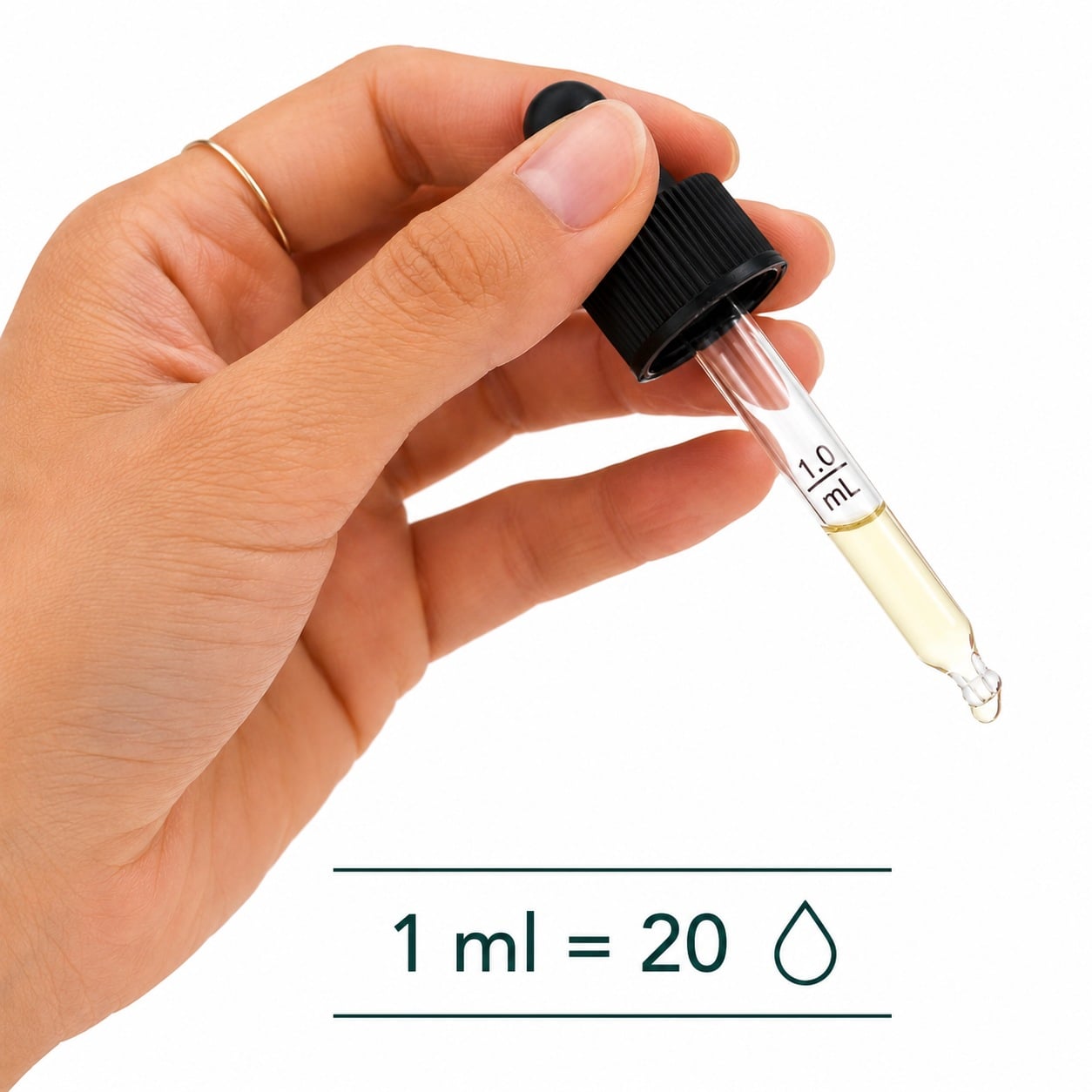
One ml is roughly equivalent to a full dropper or pipette (about 20 drops).
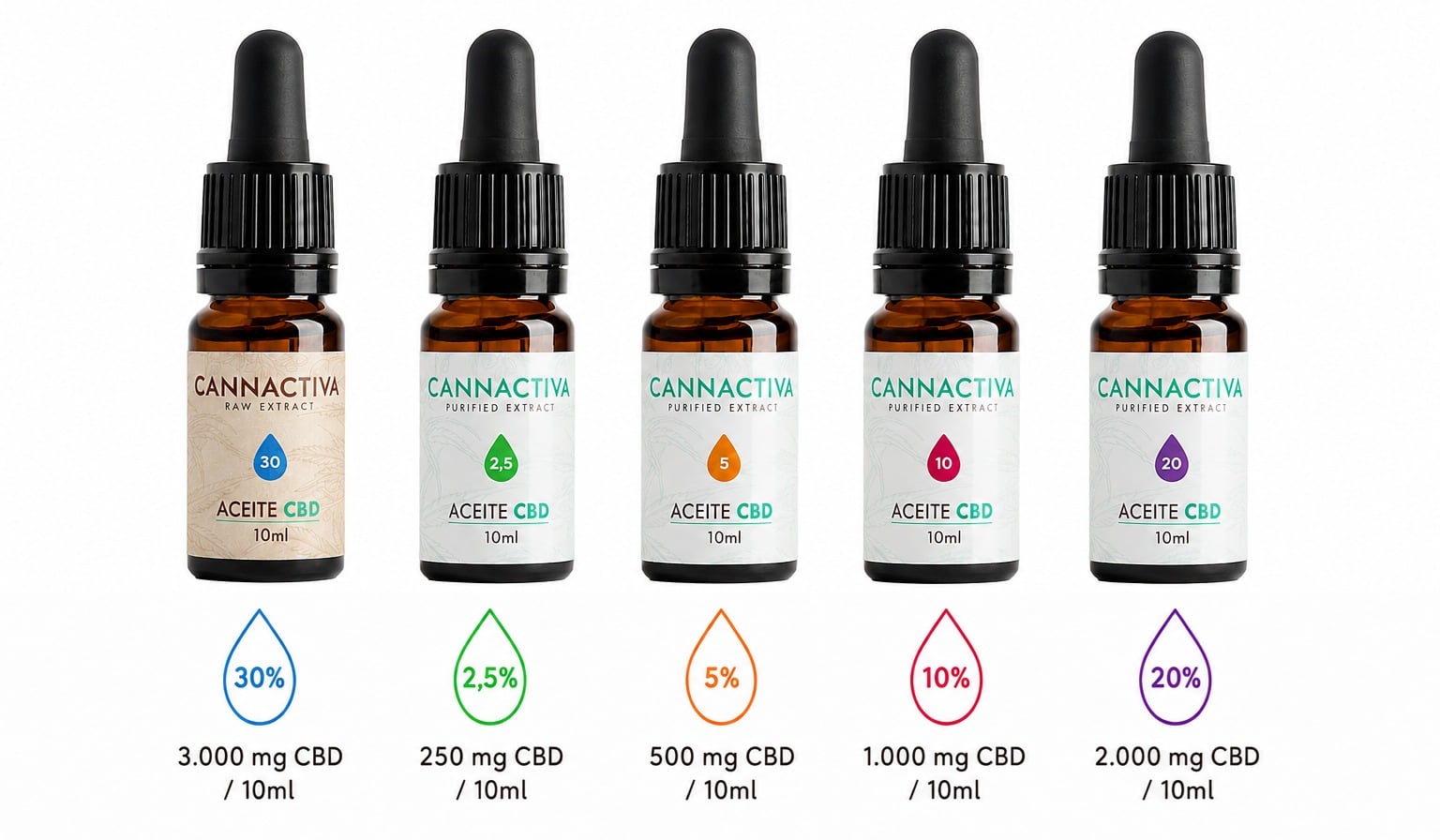
- CBD oil 2.5% = approx. 25 mg per ml (1 ml = 1 full pipette)
- CBD oil 5% = approx. 50 mg per ml
- CBD oil 10% = approx. 100 mg per ml
- CBD oil 20% = approx. 200 mg per ml
- CBD oil 30% = approx. 300 mg per ml
Since a bottle usually holds 10 ml, you just multiply the amount of CBD per millilitre (mg CBD/ml) by 10 to find the total mg in the bottle. For example, a 10 ml bottle of 10% CBD oil contains 1,000 mg of CBD in total.
How many mg of CBD are there per drop and in a pipette?
Many oils include a pipette or dropper to make dosing easier. A key fact: a full pipette or dropper equals 1 ml, and 1 ml is about 20 drops (this can vary slightly depending on the dropper and the viscosity). Once you know the mg per millilitre, you can work out the mg per drop: just divide the mg per millilitre by 20.
Concentration | mg per drop | mg per pipette (1 ml) |
|---|---|---|
30% | 15 mg | 300 mg |
20% | 10 mg | 200 mg |
10% | 5 mg | 100 mg |
5% | 2.5 mg | 50 mg |
2.5% | 1.25 mg | 25 mg |
How many mg of CBD do I need?
The ideal amount of CBD is very personal and variable. Objective factors play a role, such as weight and height, metabolism, individual sensitivity, tolerance, previous experience, the type of oil and even diet (2, 3). Some researchers have suggested that sex may also play a part: women possibly absorb more CBD and need a smaller amount than men (4).
Subjective factors also count: two similar people can feel different effects from the same amount, and even the same person may notice differences from one day to the next (5). That is why it is best to start with low amounts and keep them for one or two weeks before increasing them (6); many people do not “feel” the effect immediately even though the CBD is working.
Concentration | Drops for 25 mg | Drops for 50 mg |
|---|---|---|
5% | 10 | 20 |
10% | 5 | 10 |
20% | 3 approx. | 5 |
30% | 2 approx. | 3 approx. |
If you have a health condition or take medication, consult a healthcare professional.
How do I know which CBD oil concentration to buy?
The concentration to choose depends on several factors. Weight and height give some guidance (the more body mass, the more CBD is usually needed in relative terms), but that does not mean you should start with the highest one: many larger people do well with low or medium concentrations. Previous experience also counts: high concentrations are reserved for those who already know how they affect them.
If you want… | Concentration |
|---|---|
To start or fine-tune gradually | 2.5% - 5% |
A stable, versatile routine | 10% |
Regular use with more body | 20% |
Fewer drops for the same amount | 30% or more |
Types of extract: full spectrum, broad spectrum and isolate
Beyond concentration, there is an important difference in the type of extract (7). Full spectrum CBD includes cannabidiol along with other natural hemp compounds (terpenes and minor cannabinoids), and is highly valued for the so-called entourage effect, whereby the compounds work in synergy. There is also broad spectrum, similar to full spectrum but with no detectable THC. By contrast, oils made with CBD isolate contain pure cannabidiol, with no other cannabinoids or compounds.
You can read in detail about the differences between full spectrum, broad spectrum and isolate.
The aroma of CBD oil
Unrefined full spectrum oils have an intense, resinous aroma with bitter notes that some people find unpleasant. That is why most full spectrum CBD oils are purified or filtered, a process that removes waxes and bitter resins while keeping the cannabinoids but improving the aroma. For many people, that more neutral aroma makes it easier to stick with the routine.
Beyond the percentage: how to tell if a CBD oil is of good quality
The percentage tells you how much CBD there is, but not whether the oil is good. To assess quality, it is worth looking at several points:
- The type of extract (full spectrum, broad spectrum or isolate) and the carrier oil (hemp, olive or MCT), which affect absorption and aroma.
- The extraction method: CO2 extraction is one of the cleanest, because it leaves no solvent residues.
- Whether the product has laboratory analyses (the so-called certificate of analysis or CoA), which confirm the actual cannabinoid content.
A good CBD oil is transparent about its composition and its origin.
At Cannactiva we favour full spectrum because it preserves, alongside the CBD, the other natural cannabinoids and terpenes of hemp, which work in synergy thanks to the entourage effect.
High CBD percentages: who they are for
High percentages (the 20% CBD, or the 30% CBD) are designed for experienced users or those who prefer fewer drops for the same amount of CBD. Because they have a higher percentage, they concentrate more cannabidiol in each drop. If lower concentrations fall short for you, it makes sense to consider a higher one.
CBD oil and the law
CBD oil drops became popular years ago as a wellness product, and the rules have been changing ever since. In Spain and the European Union, CBD is obtained from authorised industrial hemp and the products are sold with a THC content below 0.3%.
At present, CBD oils are not regulated as medicines or as food supplements: they are awaiting assessment by EFSA, the European Food Safety Authority. In the meantime, they are over-the-counter products regulated for external use, and they are labelled as such.
As with any wellness product, if you take medication or have a health condition, the sensible thing is to discuss it with a healthcare professional before adding it to your routine.
Frequently asked questions
Does the CBD percentage affect side effects?
More than the percentage, what matters is the total amount of CBD consumed and individual sensitivity. An oil with a higher concentration does not cause more effects if you use fewer drops. Starting with low amounts and increasing gradually helps with better tolerance. You can find out more in our guide to CBD side effects.
Are all CBD oils with the same percentage the same?
No. Two oils with the same percentage can be very different. It depends on the quality of the raw material (the source hemp and how it is grown), the type of extract (full spectrum, broad spectrum or isolate), the carrier oil, the extraction method and the laboratory analyses. That is why the percentage is not the only indicator of quality.
Mistakes when choosing your CBD oil percentage
A common mistake is to think that the higher the concentration, the better. That is not the case: a higher percentage only provides more CBD per drop, but it does not make it “more effective” if it is not what you need. Using an unsuitable percentage is rarely a problem, but it can be inconvenient (a low one means lots of drops, and a high one makes fine-tuning harder if you lack experience); in most cases you just adjust the amount, without changing product.
Another mistake is switching CBD oil too often without giving it time. Whether you use it occasionally or regularly, it is worth keeping a stable routine long enough to assess the results patiently before changing.
And if you are torn between two percentages, start with the lower one: increasing the amount is easy. In short, the best concentration is not the highest but the one that suits you: the one that lets you reach the amount of CBD you are after, comfortably and with a quality product. If you would like a personalised recommendation, at Cannactiva we can help you choose.
Disclaimer
This article is for informational purposes only and does not constitute medical advice. The information provided here may complement, but never replace, the diagnosis or advice of a healthcare professional. If you take medication or have any health condition, consult a specialist before adding CBD to your routine. Cannactiva products are not medicines: they are sold for external use in accordance with European regulations. Research on CBD continues to evolve and new evidence may have emerged since the publication date.
References
- Muta, T., Khetan, R., Song, Y., & Garg, S. (2025). Optimising Cannabidiol Delivery: Improving Water Solubility and Permeability Through Phospholipid Complexation. International Journal of Molecular Sciences, 26(6), 2647.
- Silmore, L. H., Willmer, A. R., Capparelli, E. V., & Rosania, G. R. (2021). Food effects on the formulation, dosing, and administration of cannabidiol (CBD) in humans: A systematic review of clinical studies. Pharmacotherapy, 41(4), 405–420.
- Williams, N. N. B., et al. (2021). Comparison of Five Oral Cannabidiol Preparations in Adult Humans. Pharmaceuticals, 14(1), 35.
- Moazen-Zadeh, E., Chisholm, A., Bachi, K., & Hurd, Y. L. (2024). Pharmacokinetics of Cannabidiol: A Systematic Review and Meta-Regression Analysis. Cannabis and Cannabinoid Research, 9(4), 939–966.
- Wycoff, A. M., Metrik, J., & Trull, T. J. (2018). Affect and cannabis use in daily life. Drug and Alcohol Dependence, 191, 223–233.
- Halamish, N., Schleider, L. B., McGuire, S., & Novack, V. (2023). Can we predict the treatment doses of THC and CBD and does it matter? European Journal of Internal Medicine, 112, 100–108.
- Marinotti, O., & Sarill, M. (2020). Differentiating Full-Spectrum Hemp Extracts from CBD Isolates. Journal of Dietary Supplements, 17(5), 517–526.


