
Surely, you have ever found yourself looking at those sticky droplets that decorate the flowers of CBD flowers like precious dewdrops filled with a magical resin. As you may already know, these little dots that you can see with the naked eye are the trichomes of cannabis.
In today's post we explain the functions of these curious structures, how they work, why growers are attentive to their color change and many more curiosities. Grab your magnifying glass and join us on this exciting tour!
The 3 key ideas
- Trichomes are resinous, mushroom-shaped glands that cover the buds; this is where the plant synthesises the cannabinoids (THC, CBD) and the terpenes.
- There are three glandular types —bulbous, sessile capitate and stalked capitate—; only the capitate ones, at 50-100 µm, are visible to the naked eye.
- Their colour marks ripeness: translucent (immature), milky white (optimal harvest point) and amber (more relaxing effect).
What are cannabis trichomes?
Cannabis trichomes are tiny, translucent, crystalline structures found on the surface of cannabis plants. They coat the leaves and buds, as if they were a layer of dew. It is in these structures that the plant produces its aromatic and psychoactive compounds: terpenes and cannabinoids.
The etymological origin or meaning of "trichome" is related to hair. It comes from the Greek word "trichoma", which derives from "thrix, trichos", meaning "hair". The suffix "oma" is used to refer to a particular structure or formation, in this case, to describe the hair-like filamentous structures found on the surface of various plants, including cannabis.
Function of trichomes in plants
Trichomes are specialized structures that plants (of various species, not just cannabis) have developed to protect themselves from harsh environments and predators. Therefore, their functions are directly related to survival and adaptation to the environment.
Although the entire cannabis plant is covered with trichomes, glandular trichomes are found mostly on the buds or inflorescences of the plant, including the leaves of the buds or bracts (known as sugar leaves ). It is easy to understand why during plant reproduction, the appearance of trichomes covering the flowers and bracts of cannabis is impressive: it is a crucial moment in the life of the plant.
In female marijuana flowers, this overpopulation of trichomes is much more abundant than in male marijuana plants, since it is only in female flowers that the fruiting or seeding of the plant occurs (in fact, scientists are still studying how this sexual dimorphism occurs).
Hundreds of sticky chemical compounds are synthesized in the trichomes, and with their pointed shapes, they make it difficult for insects and other herbivores to access the leaves, stems, flowers or other parts of the plant, preventing possible damage. Thus, trichomes act as "guardians" of female cannabis flowers, protecting them so that they can develop their full splendor.
In fact, in the cannabis plant, trichomes are real "chemical traps", they act as a physical barrier and many cannabinoids and terpenes have demonstrated insecticidal properties. Predators are trapped, weakened, and unable to physically move around the plant. The trichome layer also protects the plant and its tissues against harmful UV rays.
Types of cannabis trichomes
The cannabis plant has two basic types of trichomes. The first are the non-glandular trichomes, which do not have the typical spherical head, are not secreting substances, and have the appearance of hairs. The second class is the glandular trichomes, which receive a great deal of interest from plant enthusiasts, as this is where phytocannabinoids and terpenes are produced.
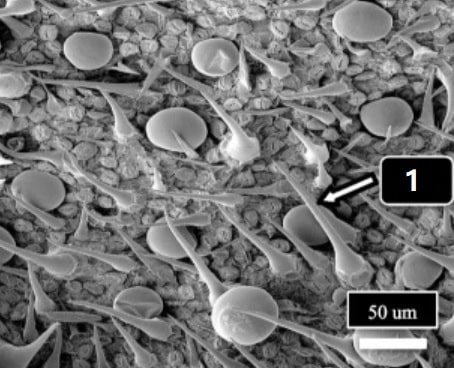
There are three types of glandular trichomes in cannabis plants. In order from smallest to largest, they are: bulbous trichomes, sessile capitate trichomes and capitate trichomes with peduncle.
Capitate trichomes
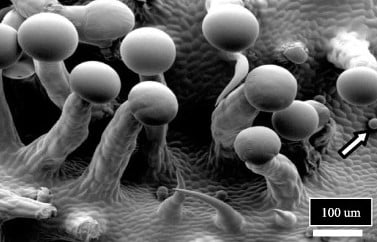
The capitate trichomes of cannabis are the largest and have a very characteristic shape, reminiscent of miniature mushrooms. With a diameter of 50-100 micrometers, stalked capitate trichomes are the only ones large enough to be observed with the naked eye.
These trichomes are mainly found in female flowers and play a crucial role in the production of pharmacologically active compounds in the cannabis plant. They are mainly found in the female flowers of cannabis and are the most advanced and efficient producers of cannabinoids and terpenes in the plant.
Sessile capitate trichomes
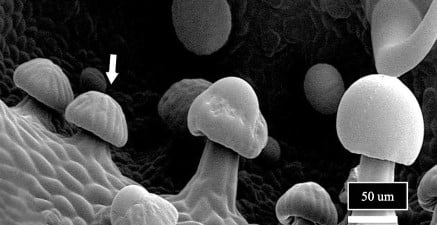
Sessile trichomes have a globular head similar to that of pedunculate trichomes but, as the name suggests, they are either stalkless (sessile), or have a very short stalk. In a magnified photograph, only the "cap" of the mushroom is visible. This type of trichomes is considered to be the precursor stage of immature pedunculate trichomes.
Bulbous trichomes
Finally, the smallest are the non-glandular trichomes. They can measure up to 10 microns wide, so they cannot be seen with the naked eye. They are less active than the previous ones and produce a limited amount of cannabinoids.
How does the synthesis of cannabinoids and terpenes occur in cannabis trichomes?
Currently, more than 110 types of cannabinoids and more than 120 terpenes have been identified in cannabis. And the most amazing thing is that all these chemical compounds in cannabis are produced in these tiny structures that are the trichomes. Cannabis flavonoids, on the other hand, although also produced in the trichomes, are more abundant in the leaves of the plant.
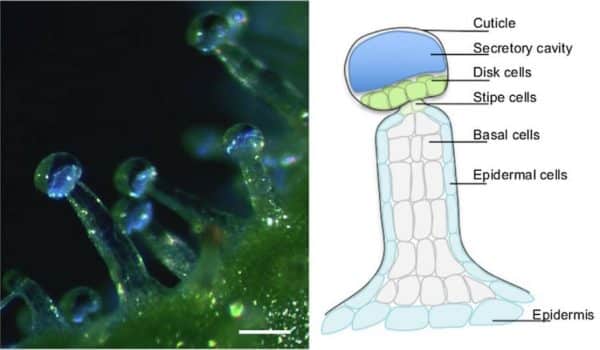
Within the trichomes, the synthesis of cannabinoids and terpenes occurs in the secretory disk cells, which line the base of the globular head of the trichome. It is in these cells where the enzymes responsible for the complex biochemical processes for the biosynthesis of cannabinoids are found. biosynthesis of cannabinoids and terpenes.
The secreted substances are stored in a subcuticular cavity, located above the secretory disc cells. This cavity changes from milky white to dark brown as the flowers mature, which is closely observed by growers.
Cannabinoid synthesis
In the case of cannabinoids, the main precursor is cannabigerolic acid (CBGA), also known as "the mother of cannabinoids" (or "the father of cannabinoids", according to others). It is formed through the biosynthesis pathway of mevalonic acid and olivetolic acid. From CBGA, different cannabinoids are produced in the trichomes in an acidic form. cannabinoids in acid form such as tetrahydrocannabinolic acid (THCA) and cannabidiolic acid (CBDA).
These acids are converted into the more active forms, such as tetrahydrocannabinol (THC). tetrahydrocannabinol (THC) and cannabidiol (CBD), through decarboxylation, which usually occurs by heating (like burning a joint). To a lesser extent, during the drying and curing of cannabis flowers.
Terpene synthesis
Like cannabinoids, terpenes are also synthesized in the secretory disc cells of the trichomes. Its biosynthesis is similar to that of cannabinoids, through the mevalonate pathway. This pathway produces isoprenoid precursors (such as geranyl pyrophosphate and farnesyl pyrophosphate), which are used by enzymes to produce different terpenes.
Terpenes are responsible for the characteristic aromas and flavors of cannabis strains and play an important role in the organoleptic and medicinal properties of the plant. There are many types of terpenes in nature, but mainly monoterpenes (myrcene, limonene, alpha and beta pinene, linalool, terpinolene) and sesquiterpenes (humulene, beta caryophyllene, bisabolol) are found in the cannabis plant.
How trichomes work: much more to discover
Although it seems all studied, research into the synthesis of cannabis compounds that occurs within the trichomes is just beginning. The production of substances such as THC and terpenes in the trichomes of the cannabis plant is influenced by different factors, both genetic and environmental. These include: the genetics of the plant, the maturation of the buds, the amount of light the plant receives, the temperature and humidity of the environment. These factors affect how plant genes are expressed (epigenetics) and how enzymes function in the trichomes.
It has also been determined that the buds at the top of the plant have higher amounts of cannabinoids and terpenes compared to flowers found in lower positions on the plant. This could be explained by differences in light and flower maturity.
Also of interest is the distribution of terpenoid content in the plant. Monoterpenes, such as limonene and alpha pinene, repel insects and are found in higher concentrations in the flowers, while sesquiterpenes, which are bitter to mammals, are more concentrated in the lower leaves of the plant. The proportion of monoterpenes and sesquiterpenes also determines the viscosity of the resin.
Discovering exactly how the production of cannabinoids and terpenes is regulated in the trichomes of cannabis is what most captivates the attention of growers and what breeding focuses on. If these unknowns can be unlocked, marijuana strains with "a la carte" aromatic and cannabinoid profiles could be created.
Trichome colors: the indication of harvesting time
The colors of the trichomes are an important indicator to determine the right time to harvest cannabis flowers. As the plant matures, the production of compounds progresses in a few days, and the trichomes change from translucent to milky white, then to opaque white and finally to an amber hue. These changes are closely watched by growers, as they provide valuable information on the optimal time to harvest.
Transparent trichomes
In the early stages of development, the trichomes are usually translucent or light-colored. At this stage, cannabinoids such as THC and CBD have not yet reached their maximum concentration.
White or milky trichomes
As the plant approaches maturity, the trichomes begin to become opaque and acquire darker tones, such as amber, gold or brown. This change in coloration indicates that the cannabinoids are reaching their maximum concentration, and that the inflorescences are reaching their peak of development.
The ideal time to harvest cannabis plants is when the trichomes reach a milky white and opaque color, a balance between opacity and transparency. This color indicates that cannabinoids and terpenes are at their optimal point to be harvested, in terms of quality and desired effects.
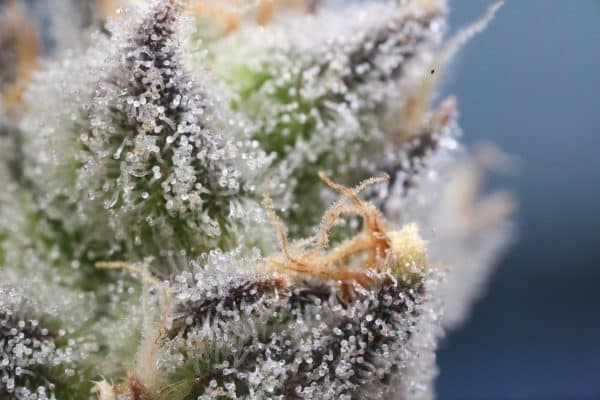
Amber trichomes
After the transformation from white to most of the trichomes with amber tones is complete, most harvesters spring into action as quickly as possible.
Amber-colored trichomes are said to indicate a higher proportion of cannabinoids and a more relaxing and psychoactive effect, while translucent or milky trichomes indicate a higher content of active cannabinoids and a more stimulating effect. In addition, the pistils or hairs found on the buds usually change color to orange or brown tones at senescence.
Don't miss our post about how to identify ripe trichomes in cannabis .
Handling of buds and post-harvest trichome care
One of the most attractive images for cannabis enthusiasts is a bud covered with sticky, resinous trichomes. But for this marvel to reach your hands in perfect condition, it is necessary to be very careful with the handling of the buds during and after harvest.
Trichomes are delicate and can break during harvesting, drying, curing and manicuring of the buds. When damaged, their phytochemical content, the precious aromas and cannabinoids, gradually evaporate, to the detriment of the quality of the buds. Keeping trichomes in a perfect state of preservation and storing the buds correctly is one of the biggest challenges for companies dedicated to high quality cannabis.
Freezing for better preservation of trichomes and their phytochemical content
If you are curious, here we mention one of the most advanced techniques: freezing, which stops the process of oxidation and evaporation of cannabinoids and terpenes, and preserves the cannabis compounds to the maximum until the moment of sale.
Recently, technologies have emerged in the cannabis industry that use freezing as a method for trichome separation and preservation. One of these technologies is Cryo Cure, which, by freezing at subcritical temperatures and controlled sublimation, avoids traditional drying and makes it possible to offer high quality buds in less time. This technology eliminates the risk of physical damage inherent in cutting, curing and drying techniques and allows for faster production. CryoMass is another machine that uses similar technology.
In short...
The trichomes and the life that goes on inside them are truly fascinating to cannabis and hemp enthusiasts. In these tiny sticky hairs lies pure alchemy, the chemical compounds of cannabis that we hold so dear. Knowing their nature, observing their color and shape changes, and taking care not to spoil them during harvest handling, is key to enjoying cannabis.
At Cannactiva we have done the work for you. You can find the best quality CBD flowers with potent trichomes at:
Frequently asked questions about trichomes
What is the difference between trichomes and terpenes?
Trichomes are the glands that act as the factory; terpenes are part of what is produced inside. Both the terpenes (responsible for the aroma) and the cannabinoids are synthesised in the trichomes. We explain it in differences between cannabinoids and terpenes.
Can trichomes be seen with the naked eye?
Only the stalked capitate trichomes, which measure between 50 and 100 micrometres. Sessile and bulbous trichomes are smaller and need a magnifying glass or microscope to be seen.
Which trichome colour indicates the right time to harvest?
Milky white marks the optimal point for a more balanced effect, while amber is associated with a more relaxing effect. You have the detail in how to identify mature trichomes.
References
- Tanney CAS, Backer R, Geitmann A, Smith DL. Cannabis Glandular Trichomes: A Cellular Metabolite Factory. Front Plant Sci. 2021 Sep 20;12:721986. doi: 10.3389/fpls.2021.721986. PMID: 34616415; PMCID: PMC8488169.
- Punja ZK, Sutton DB, Kim T. Glandular trichome development, morphology, and maturation are influenced by plant age and genotype in high THC-containing cannabis (Cannabis sativa L.) inflorescences. J Cannabis Res. 2023 Apr 4;5(1):12. doi: 10.1186/s42238-023-00178-9. PMID: 37016398; PMCID: PMC10071647.


