
The THC saliva test —also known as a roadside drug swab test— is the test Spain's traffic authority (DGT) uses on the road to detect tetrahydrocannabinol (THC) and other psychoactive substances. It detects THC, not CBD: cannabidiol (CBD) is not psychoactive and is not the substance the test looks for. Here you have all the legal information: how it works, how long THC stays in saliva, false positives, whether smoking CBD can trigger a positive, the penalties and what to do if you test positive.
In short:
- The saliva drug test detects THC, not CBD; it is qualitative (positive/negative) and does not measure the amount or your level of impairment.
- THC can stay in saliva from a few hours to 1–3 days (longer with frequent use).
- The saliva test is very sensitive: the legal traces of THC in CBD products can be enough to trigger a positive, especially with heavy or recent use.
- Testing positive at a DGT checkpoint means a €1,000 fine and up to 6 licence points. If you are sure you have not consumed THC, you can request a confirmatory blood retest (art. 14.5): these tests often come back positive in saliva but negative in blood, and the penalty is then dropped.
Please note this article is for information only and does not constitute legal advice. Every case depends on the context, the amount and the stage of the proceedings. If you are facing a penalty or have doubts about your situation, get informed with specialist cannabis lawyers in Spain.
What is a saliva drug test?
The roadside drug test is a saliva test that detects the presence of psychotropic substances, among them cannabis (THC), amphetamines, cocaine, methamphetamine, opiates and benzodiazepines. This traffic check was introduced in Spain in 2007 and its use has since spread to workplaces and other settings.
The THC saliva test works in a qualitative way (positive or negative) and does not quantify the amount in your body. It is commonly used at roadside checkpoints.
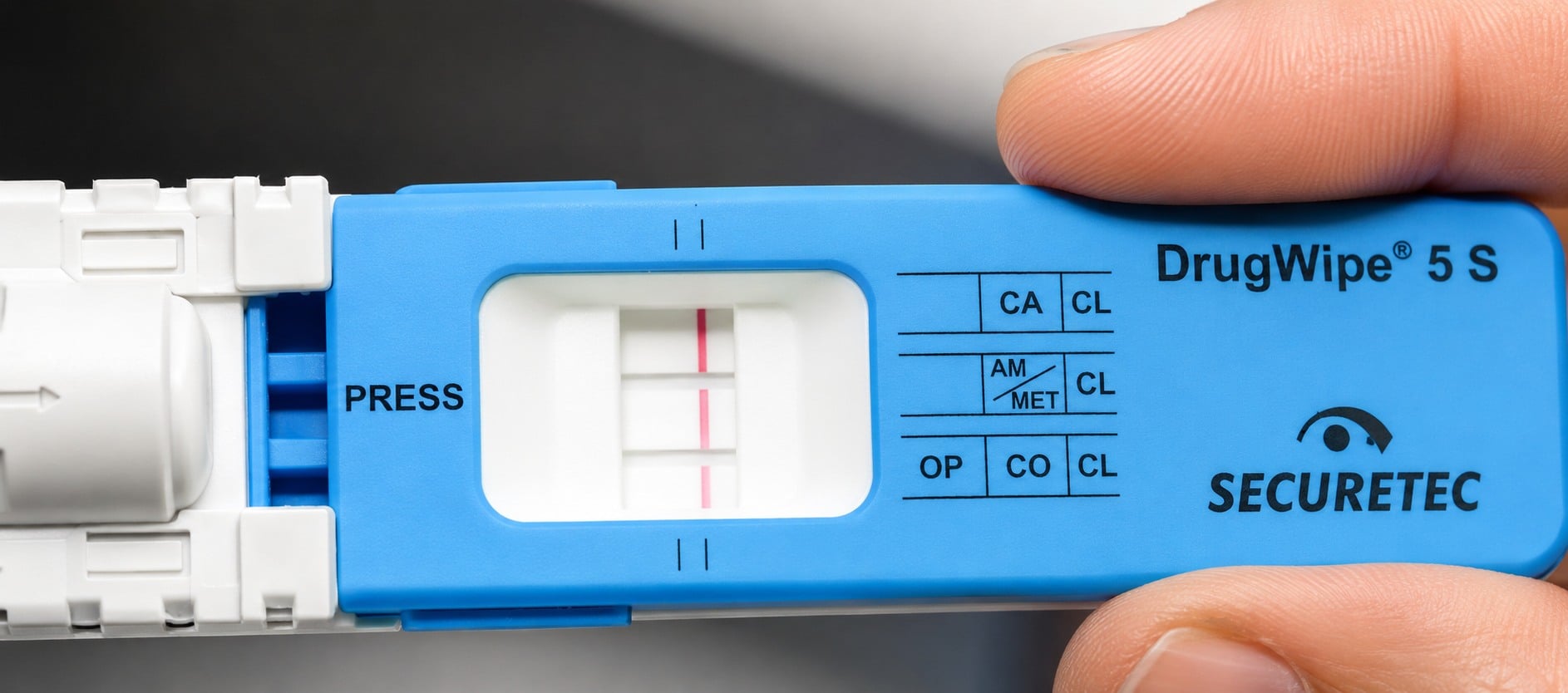
What does the saliva drug test measure?
- Qualitative detection: it shows whether drugs are present (positive or negative), regardless of the amount.
- Substances: THC (cannabis), amphetamines, benzodiazepines, cocaine, MDMA, methamphetamine and opiates. The list can vary depending on the test model and manufacturer.
- Detection threshold: it flags substances above roughly 10 to 20 ng/ml of saliva (the cut-off of the preliminary screening test).
How does the saliva drug test work?
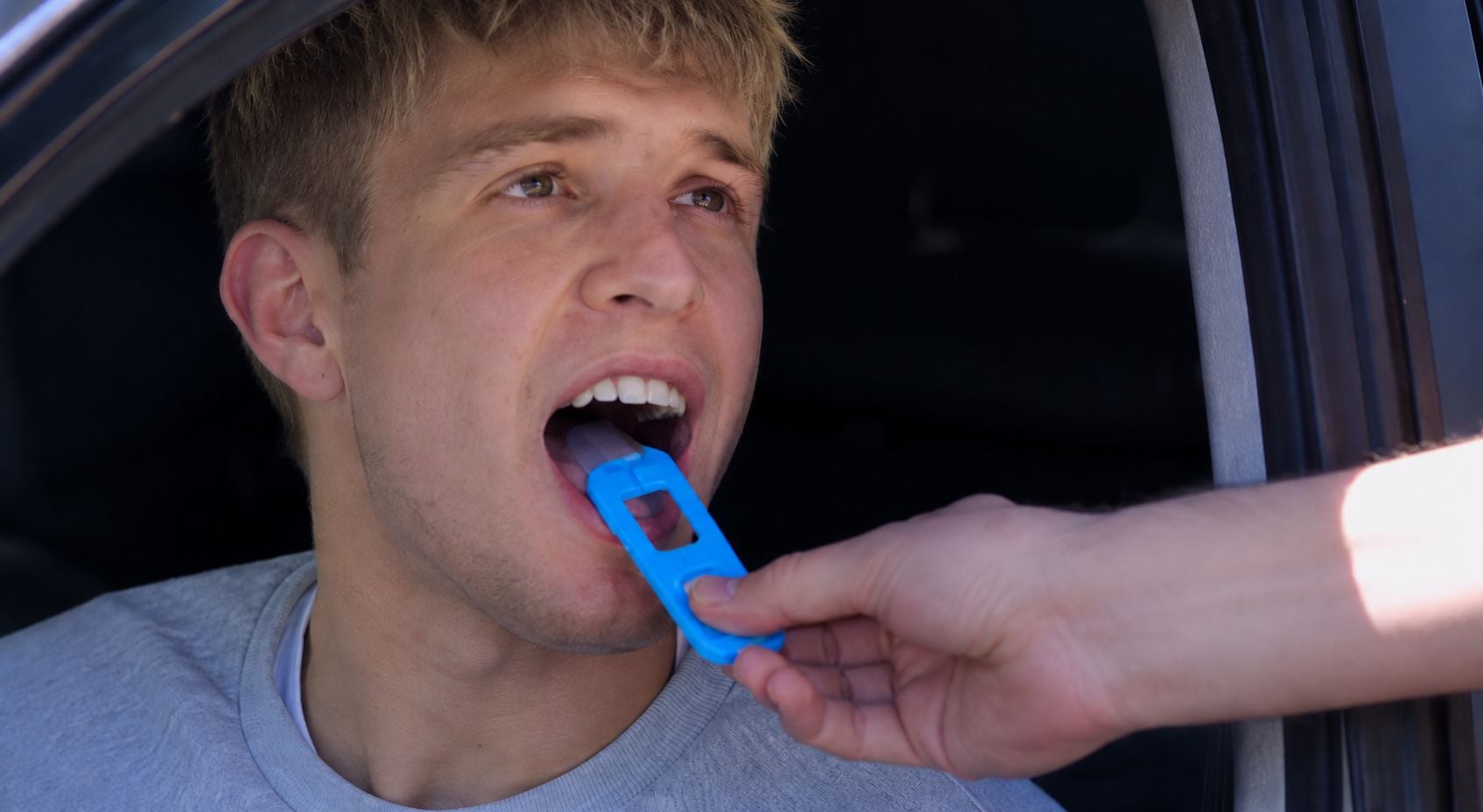
At roadside checkpoints, the Guardia Civil and the police use rapid oral-fluid detection devices —the most common being the Dräger DrugTest 5000 and the DrugWipe— which give a result in about 8 minutes. In Spain it is colloquially called "the lollipop", after the absorbent strip you rub on your tongue. On these devices, a single line (the control line) means negative and two or more lines indicate a positive for one or more substances. The procedure is:
- Collection: an absorbent strip is rubbed on the tongue to collect enough saliva.
- Application: the moistened strip is inserted into the cartridge, which starts a chemical reaction.
- Reading: a control line confirms the test is working; any additional lines indicate the presence of one or more substances. It is only negative if the control line alone appears.
The test does not indicate the exact time of use and can come back positive days after the effects have worn off. A positive on the preliminary screening test is later confirmed in a laboratory with a second sample (GC-MS/LC-MS-MS techniques), which is the one with legal validity.
Where can you buy a THC saliva test?
Pharmacies and online shops sell self-testing kits (THC saliva tests) with a qualitative result. They work as personal guidance, but they have no legal validity against an official DGT check.
How long does THC stay in saliva?
There is no single figure. The scientific literature is clear on one point: THC concentrations in saliva are highly variable between people and from one moment to the next, and they decline over time. An individual-participant meta-analysis (2024) concluded that saliva tests mainly reflect recent use and are not valid for measuring the level of impairment behind the wheel. As a general guide (1):
Type of use | Approximate detection window in saliva |
|---|---|
Occasional / one-off | from 6 to 24 h (in some cases up to 72 h) |
Frequent (several times a week) | 24–48 h |
Daily / chronic | 48–72 h or more |
According to the evidence, these windows are influenced by the dose, the frequency of use and the route (smoking or vaping leaves more THC in saliva than ingesting it). The test detects presence, not effect: that is why an occasional user can test positive even when they no longer feel anything. There is no fixed answer to how long THC lasts in a DGT test: it depends on your consumption profile.
How long does THC stay in urine and blood?
Saliva mainly reflects recent use; other tests have very different windows:
Test | What it detects | Approximate window |
|---|---|---|
Saliva | Active THC | hours – 2/3 days (recent use) |
Blood | Active THC | 1 – 48 h (current or very recent use) |
Urine | THC-COOH metabolite | 3 – 30+ days (builds up with chronic use) |
Hair | metabolites | up to 90 days |
If I smoke a cannabis joint, will I test positive in saliva?
Yes, very likely if the check happens soon after. Saliva reflects use over the last few hours or days depending on frequency (see the table above); even a single puff can test positive in the hours that follow.
How long should I wait to test negative on a drug test?
There is no reliable way to "beat" the test. The only safe way to avoid a positive is not to have used THC or other drugs within the detection window, which varies by substance. With frequent use, that window gets longer. Be wary of home remedies (mouthwashes, chewing gum, drinking lots of water): they do not reliably remove THC.
Does CBD test positive on a saliva test?
The drug test looks for THC, not CBD. Cannabidiol (CBD) is a hemp compound that is not psychoactive: it does not get you high and is not the molecule the test detects. The World Health Organization confirms this: according to its report, CBD is well tolerated, shows no potential for abuse or dependence and is not associated with public health problems (what the WHO says about CBD) (2).
So, can a CBD user test positive?
Technically, the saliva test is very sensitive and a CBD user can test positive, both at the roadside and in the laboratory analysis: that legal trace of THC (<0.3%) is enough for the device to flag "cannabis", especially with heavy or recent use.
According to scientific studies, pure CBD, in a single dose, does not test positive (3). The problem is the THC that comes with legal CBD products: although the THC concentration in hemp is very low (<0.3% THC), the amount is not zero. In trials, taken orally, positives in saliva have been recorded with THC doses as small as 0.5 mg, in a dose-dependent way (4). And when you smoke or vape CBD the effect is greater: the THC is deposited directly in the mouth and spikes its concentration in saliva in the short term. That is why someone who uses CBD flowers or hash can test positive.
Given these facts, and subject to each person's circumstances, in some cases lawyers recommend requesting the confirmatory blood test, which is less sensitive than saliva tests to those THC traces. That said, it is not a universal recommendation: it depends on whether use is habitual, whether you have smoked recently, and other individual circumstances that can change the legal advice. If in doubt, seek advice from a lawyer who specialises in cannabis.
False positives on the saliva test: why do they happen?
No test is infallible. The roadside drug test is a screening test: it is fast but less accurate, and cannabis is one of the hardest substances to detect reliably in saliva (1). A false positive is a positive result when the person has not used the substance. It can be caused by:
- Interference from certain substances that cross-react in screening tests.
- Contamination of the sample or reading the device outside the indicated time window.
- Device sensitivity: screening tests are designed not to miss any positives, at the cost of the occasional false positive.
That is why a positive screening result can be confirmed in a laboratory with more precise techniques (chromatography-mass spectrometry). If you are sure you have not used anything, the correct course of action is to request a confirmatory test (blood or urine) at that moment and under police custody (see below).
In the case of CBD, the main reason for a positive is not a faulty product but the extremely high sensitivity of the saliva test: its cut-off is so low (around 2 ng/ml) that it detects even the legal traces of THC. The blood test is less sensitive: according to the European DRUID project (EMCDDA), 1 ng/ml of THC in blood is equivalent to about 27 ng/ml in saliva and the blood threshold is 2 ng/ml, so a CBD user or a passive smoker usually tests positive in saliva (between 5 and 27 ng/ml) but negative in blood.
Can I test positive because my CBD contained more THC than allowed?
Established, legal CBD shops in Spain are the first to want to comply with the rules: they test their CBD flowers and derivatives to keep THC below the legal limit and do not risk selling products with more THC than is strictly regulated.
High THC levels can only happen with home-grown CBD (where there is no lab testing) or through unregulated sales channels, not from specialist retailers, who work with traceability and certificates of analysis. It is also possible to test positive from using HHC or other synthetic cannabinoids: we explain whether HHC tests positive on a drug test.
Which medicines can cause a false positive?
Some drugs can interfere with screening tests. The law exempts from penalty medicines taken on a documented medical prescription for a therapeutic purpose, provided you are driving in a fit state. So, if you take medication, carry the prescription or something that proves it. As for medical cannabis, in Spain it has been regulated since Royal Decree 903/2025 but in a very restricted way (compounded formulas for hospital use); how it fits with this exemption from the roadside test is uncertain and, in any case, it does not exempt you if your ability to drive is impaired.
What is the penalty for testing positive?
- Fine: €1,000. You have 20 days from notification to pay with a 50% reduction (€500).
- Licence points: up to 6 points off your licence.
- The same penalty applies whether one or several substances are detected.
The penalties for testing positive are set out in Royal Legislative Decree 6/2015 and are classed as a very serious offence. What is penalised is the presence of drugs in your system, not being under their effects: that is why even an occasional user can test positive when they no longer feel anything. If, in addition, there is evidence that your ability to drive is impaired (nervousness, dilated pupils, loss of balance), the case can escalate into criminal proceedings.
What to do if you test positive: the confirmatory blood test
The roadside saliva test is only a preliminary screening test (5). Under article 14.3 of Royal Legislative Decree 6/2015, the penalty also requires a subsequent laboratory analysis of a second saliva sample; without a positive result in that laboratory analysis, there is no punishable offence.
Can I refuse to take the saliva test?
You cannot refuse to take the drug test: refusal is punished with the same fine and loss of licence points (art. 14.2). What is a right is the confirmatory test. If you have tested positive in saliva and you are sure you have not consumed THC (for example, you only use CBD products), the best course of action is to demand a confirmatory blood test under article 14.5. The officers are obliged to take you in custody to the medical centre to carry it out.
They will often try to talk you out of it ("if you tested positive in saliva, you will test positive in blood"). As the lawyer Francisco Azorín explains (6), that statement is not correct: because of the lower sensitivity of the blood test (the DRUID equivalence we saw above), someone who has only used CBD usually tests positive in saliva but negative in blood. Azorín documents real cases won this way: the client, positive in saliva, invoked article 14.5, was taken in custody to hospital (with no deposit charged, as they had public health insurance), tested negative in blood and had the penalty dropped.
Practical tips for the confirmatory test:
- Request it on the spot and in writing, invoking art. 14.5; preferably a blood test.
- Insist that your request is recorded in the report: officers often fail to inform you of this right and tick that "no confirmatory test is requested".
- It is carried out under police custody: a test you take on your own does not count as evidence.
- Advance deposit: you generally have to pay the cost up front for the analysis (it varies by region and centre, roughly between €100 and €300). If the result confirms the positive, that deposit pays for the test; if it comes back negative, the Administration covers the cost and it is refunded to you (art. 23.4 of the General Traffic Regulations, Reglamento General de Circulación).
Subsequent appeals against the penalty
By filing an appeal you give up the 50% reduction for early payment. Once the administrative procedure is over, the only route left is the Administrative Court (Juzgado Contencioso-Administrativo). This is the route with real prospects, especially if you provide solid evidence of the absence of impairment (a negative blood retest is the strongest evidence). There is favourable case law: there are rulings from administrative courts that have overturned penalties applying the "in dubio pro reo" principle when the analysis only showed presence or an inactive metabolite, without proving real impairment behind the wheel. Specialist lawyers also point out that in Spain there is no national metrological control standard setting out which substances are detected or the cut-off points: these vary by device (Guardia Civil, Mossos, local police) and laboratory, so the same amount can come back positive or negative depending on the equipment. To assess your case, it is worth consulting a lawyer who specialises in cannabis.
Limitation period and expiry of the penalty
- Limitation period: six months for serious and very serious offences.
- Expiry: if it is not resolved within one year, the procedure lapses and is closed.
The saliva test is just one of the legal situations surrounding cannabis and CBD in Spain. If you want to understand the full picture, CBD is legal in Spain to buy and sell, although carrying it in public still sits in a grey area: we explain the fine for carrying CBD and how to appeal it.
The saliva drug test is a key tool for detecting drugs in saliva, particularly when it comes to policing cannabis use behind the wheel. If you test positive, the essential thing is to get legal advice and assess each case on its own merits. Road safety depends on everyone's responsibility: whether you use CBD products or coffee, wine or tobacco, only drive if you are certain you can do so safely and sensibly. Have a safe trip!
Legislation and official sources
Legal analysis (saliva test and confirmatory blood test)
- Penalties for the roadside drug test — S&F Abogados
- Drugs and driving: an important ruling — Francisco Azorín Abogados (DRUID saliva/blood equivalence, art. 14.5)
Scientific references
- Desrosiers NA, Huestis MA. Oral Fluid Drug Testing: Analytical Approaches, Issues and Interpretation of Results. J Anal Toxicol. 2019;43(6):415-443.
- World Health Organization (WHO). Cannabidiol (CBD): Critical Review Report, 2018.
- Spindle TR, Cone EJ, Schlienz NJ, et al. Urinary Pharmacokinetic Profile of Cannabinoids... J Anal Toxicol. 2020;44(2):109-125. (full text)
- Vikingsson S, Zamarripa CA, Spindle TR, et al. The acute and chronic pharmacokinetic oral fluid profile of oral cannabidiol (CBD) with and without low doses of Δ9-THC in healthy human volunteers. J Anal Toxicol. 2025. doi:10.1093/jat/bkaf102


