
Is there anything more tempting than the smell of freshly baked cookies? Add the aroma of your favourite cannabis to the mix and you have the recipe for paradise. That's how the day starts in our kitchen: with the sweet smell of cookies just out of the oven and that unmistakable cannabutter note.
The cannabis cookies recipe we're sharing with you today is delicious and will turn any afternoon into a proper experience. It's one of the most classic cannabis desserts — also known in some circles as magic cookies, space cookies or happy cookies — and a must-have for any gathering with friends.
Just a reminder: this is informational content, based on a recipe from popular cannabis culture. If you choose to ingest cannabis, you do so entirely at your own responsibility. Cannactiva products are not intended for ingestion.
The 3 key takeaways
- This recipe is built around cannabutter (130 g) — that's the key to making sure every cookie carries a homogeneous dose. With the standard recipe (4-8 g of buds infused in 130 g of butter for a batch of 24 cookies), each cookie carries between 10 and 40 mg of real THC depending on the amount and potency of the bud. We break it all down below in "Dosage, onset times and effects". Start with half a cookie if it's your first time.
- The effect takes 45-90 minutes to kick in and lasts between 4 and 8 hours. Never go for a second portion because "you can't feel anything yet": it hits all at once.
- For a more relaxing version with a minimal THC content, check out CBD flowers and CBD small buds.
Ingredients for the cannabis cookies
For 24 medium cookies (about 20-25 g each once baked — standard homemade chocolate chip cookie size):
- 130 g of cannabutter — the key piece of the recipe. If you don't have it ready yet, the next block sums up how to make it (we also link the full guide).
- 4-8 g of decarboxylated cannabis buds — if you're going to infuse the butter as part of this recipe. The range depends on the potency you're after (see the "Dosage, onset times and effects" block below).
- 250 g of plain wheat flour
- 150 g of sugar (white or brown, your call)
- 2 eggs
- 1 teaspoon of vanilla extract
- 1 teaspoon of baking powder (or ½ teaspoon of bicarbonate of soda)
- 1 pinch of salt
- 100 g of dark chocolate chips (optional, recommended)
- 100 g of chopped walnuts (optional)
How to make cannabutter (the previous step)
Cannabutter is the fatty vehicle that fixes and protects cannabinoids and terpenes, and it guarantees a homogeneous potency in every cookie. It's prepared ahead of the cookies (at least four hours before, ideally the day before).
If you already have it ready, skip to the recipe block. If not, here's the quick summary. For a more detailed version, check the full cannabutter guide.
Decarboxylate the buds
The first step is to activate the cannabinoids: THCA (the natural form of THC in the bud) is not psychoactive; it needs heat to convert into THC. This process is called decarboxylation.
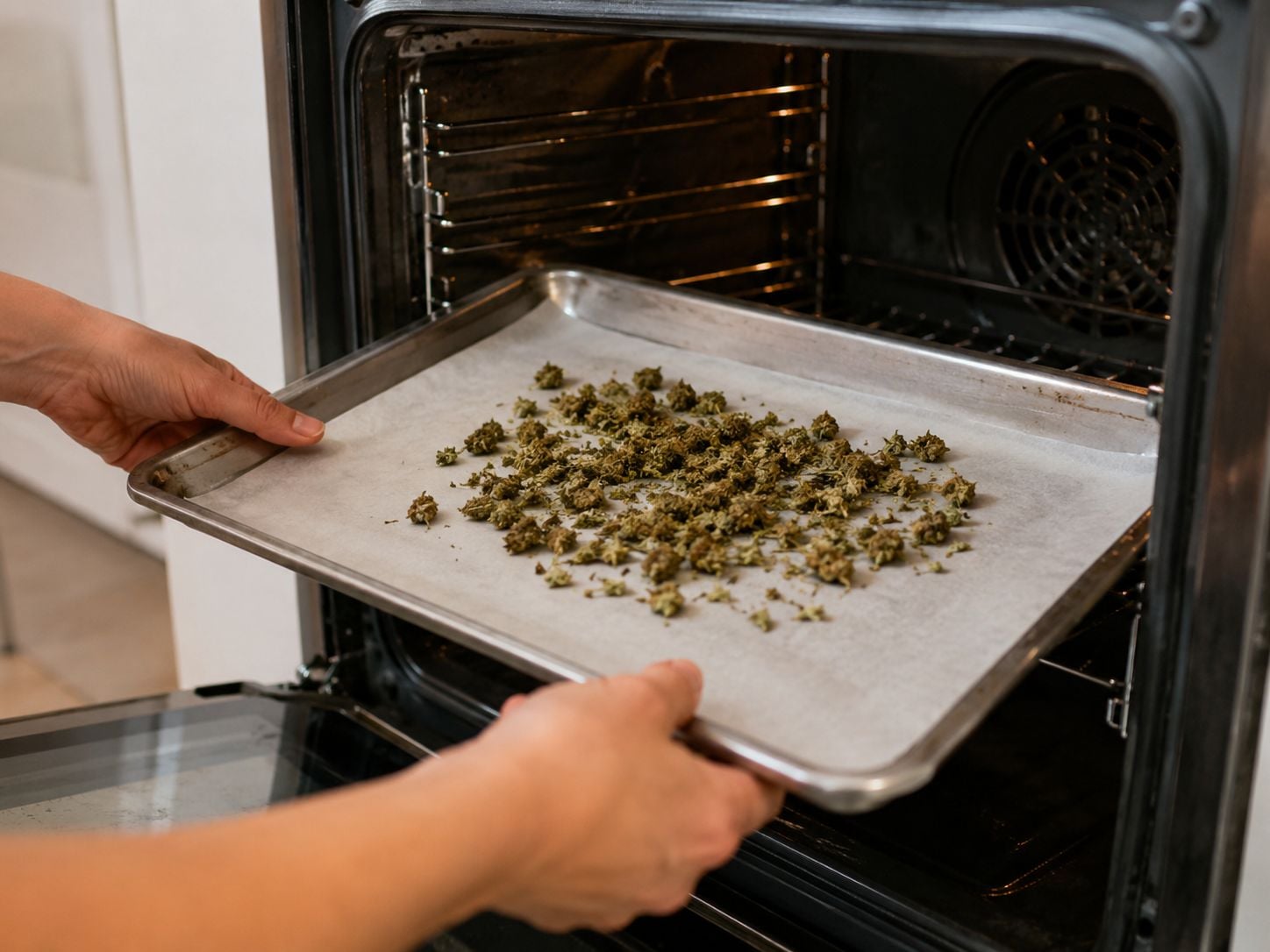
- Preheat the oven to 105-115 °C (top and bottom heat, fan off).
- Grind the buds without pulverising them (rice-grain size) and spread them out on a tray lined with baking paper.
- Bake 30-40 minutes, stirring halfway through. The buds will go from green to a dark golden tone and end up dry.
- Do not exceed 120 °C: above that temperature, THC starts degrading into CBN (far less psychoactive).
- Let them cool down before continuing.
Infuse the butter with the cannabis
Classic method — pot with water (the most reliable for beginners):
- In a saucepan, melt 130 g of butter together with 250 ml of water.
- Once it's fully melted, run the decarboxylated buds through a grinder and add them to the butter. Stir gently.
- Cook on very low heat (70-85 °C, never above 90 °C) for 2 hours, covered, stirring every 20-30 minutes. The water stabilises the temperature and stops the butter from burning. If you see bubbles breaking the surface, move the pot off the heat for a moment — it must never boil.
- (Optional) You can also do it in a slow cooker / crockpot on Low for 4-6 hours. It's the most convenient option: zero supervision and no risk of overheating.
⚠️ The 2 hours are key: with less time (the 30-minute versions you see online), extraction is only partial. At 2 hours you reach 80-90 % of the possible extraction.
Quick alternative — dry bain-marie, no water in the mix (skips the 24 h in the fridge):
If you want to finish sooner and avoid having to separate the butter from the water at the end, you can infuse it in a dry bain-marie, without adding water to the mix. The butter comes out cleaner, you strain it straight away and it cools down in a few hours (no need for the 24 h rest of the classic method).
- Put water in a saucepan and bring it to a gentle simmer (steaming, not bubbling). Place a metal or heat-resistant glass bowl on top.
- Drop the 130 g of butter into the bowl and let it melt with the steam's heat (3-5 min). Do not add water to the bowl.
- Add the ground decarboxylated buds and stir.
- Keep the bain-marie on the lowest heat for 1.5-2 hours, stirring every 15-20 minutes. Make sure the pot underneath doesn't run dry — top up with a little boiling water if the level drops.
- Once the time is up, strain straight into a glass container through cheesecloth or a coffee filter. The butter is ready: there's no water to separate.
Pros: you skip a day of resting and the phase separation. More uniform, golden butter. Ideal for small batches like this one.
Cons: less temperature control + because the water doesn't carry away the chlorophyll, the extraction can taste a touch more herbaceous.

Strain, cool and store the cannabutter
If you used the classic method (with water):
- Strain the liquid butter to remove the plant matter.
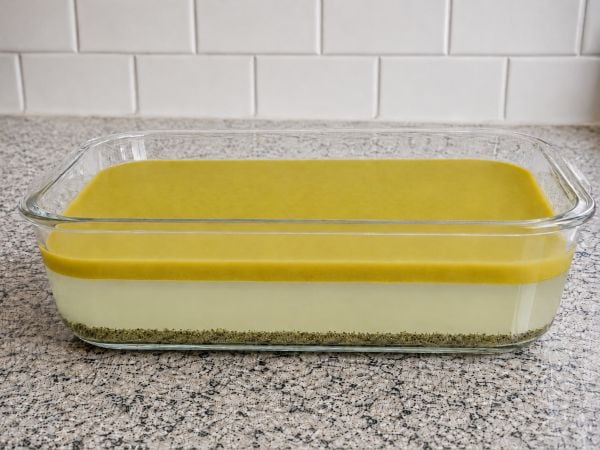
- Pour the liquid into a low, wide glass container.
- Let it cool at room temperature for 1 hour, then put it in the fridge for at least 24 hours without moving it. The fat solidifies on top and the water stays underneath.
- Lift off the yellow-green butter slab and discard the water at the bottom. You'll have around 120 g of cannabutter ready to bake with.
If you used the quick method (dry bain-marie):
Once strained into the glass container, leave it 1-2 hours at room temperature and then refrigerate for 2-3 hours. You'll have around 120 g of cannabutter ready the same day.
Cannabis cookies recipe step by step
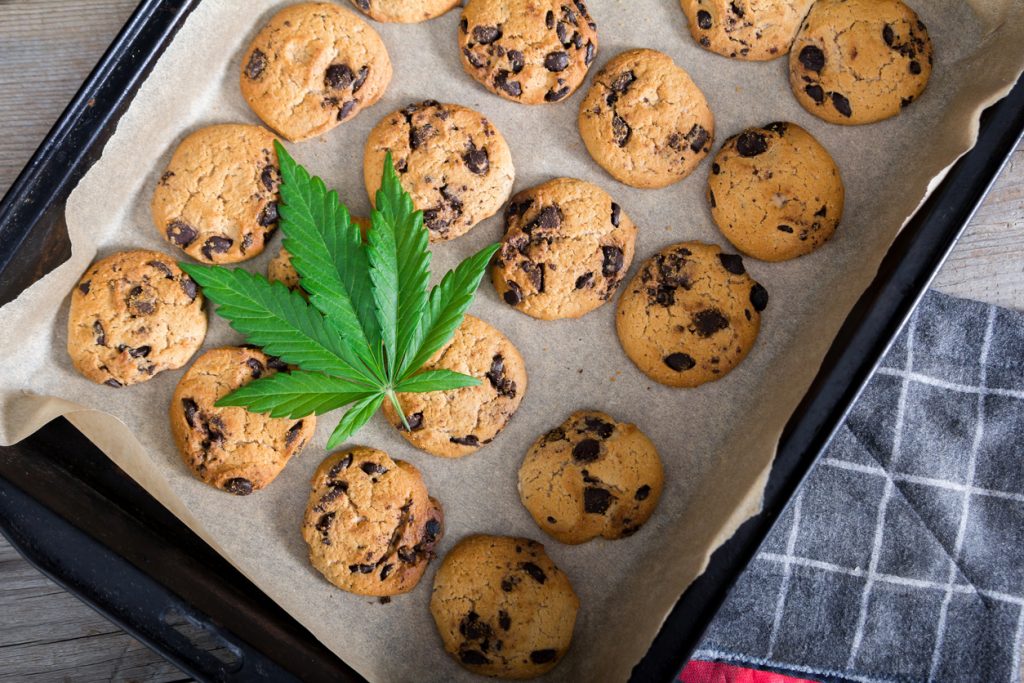
With the cannabutter ready (and at room temperature), the cookies are made exactly like normal chocolate chip cookies: the magic is already in the butter. Recipe for 24 medium cookies. Active time 25 min + oven 12-15 min.
Step 1 — Prepare the dough
- Preheat the oven to 175-180 °C (top and bottom heat). The cookies are baked at standard baking temperature: decarboxylation already happened when you made the butter, so there's no need to bake low here. Above 180 °C, THC starts degrading, which is why we don't go up to 200 °C.
- In a large bowl, beat the 130 g of cannabutter (at room temperature, soft but not melted) with the 150 g of sugar until you get a pale, fluffy cream. With electric beaters it takes 2-3 minutes; with a wooden spoon, 4-5 minutes.
- Add the 2 eggs one at a time, mixing each one in fully before adding the next, plus the teaspoon of vanilla extract. Beat until the mixture is even.
- In another bowl, sift together the 250 g of flour, the teaspoon of baking powder, the pinch of salt (and the chocolate chips or walnuts if you're using them).
- Fold the dry mix into the wet one in 2-3 additions, mixing with a spatula using folding movements. Don't overmix: as soon as the dough is even, stop. If you overmix, the cookies will turn out tough.
Step 2 — Mix and shape the cookies
- Line a baking tray with parchment paper.
- With a spoon or a cookie scoop, take walnut-sized portions (around 30 g of raw dough; after baking, each cookie weighs approx. 20-25 g). Roll them into balls with your hands and place them on the tray leaving 4 cm of space between them: they spread quite a bit in the oven.
- Flatten them slightly into discs about 1 cm thick. Cookies need a bit of height to stay tender inside.
- (Optional but recommended): if you have the time, put the tray with the shaped cookies in the fridge for 30 minutes before baking. Cold dough bakes better and ends up less flat.
Step 3 — Bake the cannabis cookies at 175-180 °C
- Bake 12-15 minutes at 175-180 °C (middle rack), until the edges start to turn golden and the centre is still slightly soft.
- Don't let them overbake: if you wait until they look fully golden, they're already dry. Cookies finish cooking with residual heat out of the oven.
- Take the tray out, let the cookies rest for 5 minutes on the tray to set, then move them to a wire rack to cool completely. As they cool they go from soft to crisp on the outside.
- How many do you get? 24 medium cookies of 20-25 g each (standard homemade chocolate chip cookie size). If you make them bigger, bakery-style (50 g final, ~55 g raw), you'll get 12-14 cookies and they need 16-18 min in the oven → the dose per cookie will be double: with 4 g of buds at 10 % THC, instead of 10 mg/cookie you'll get ~20 mg/cookie. Bear that in mind if you change the size.
Step 4 — Label and store the cookies
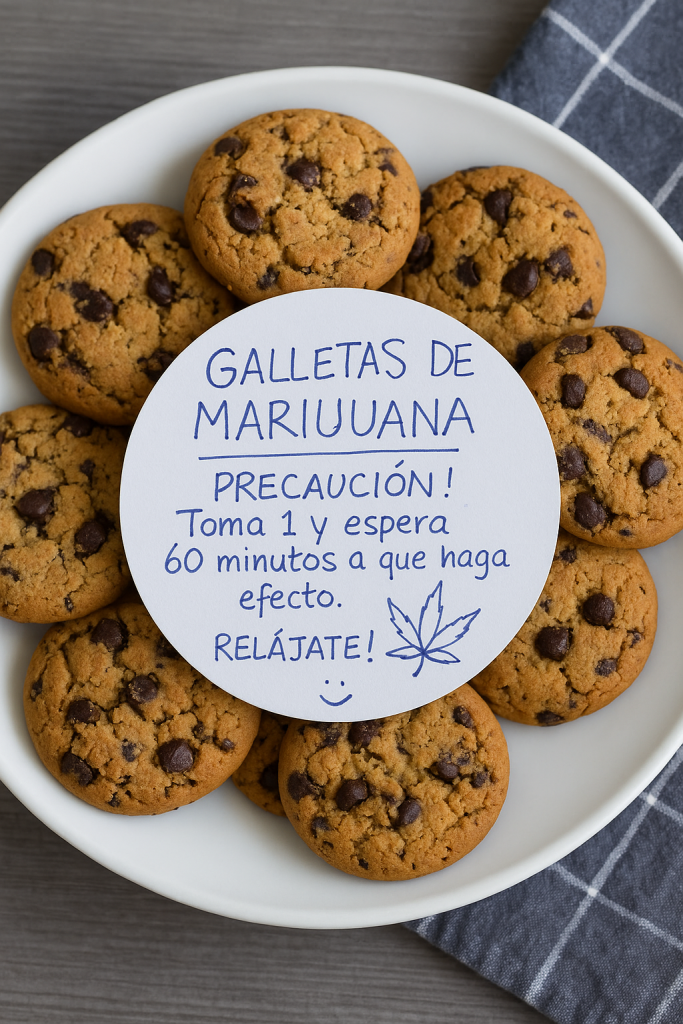
This step often gets overlooked and it's the one that prevents the most household accidents. Cannabis cookies look just like normal cookies and anyone at home (including a child, an unaware guest or a pet) can mistake them.
- Label the jar or container clearly and visibly. A simple line on a note or some tape will do: for example, "Cannabis cookies — eat only one and wait 90 min". If you give them away or take them to a get-together, label each portion individually.
- Keep them out of reach of children and pets: high shelf, locked cupboard or a box with a lid. Chocolate and cannabis are both toxic for dogs and cats — an accident can end in an emergency vet visit.
- Storage by how long you want them to last:
- Room temperature, airtight container: 5-7 days. Ideal if you're going to eat them in a few days.
- Fridge, airtight container: up to 2 weeks. They lose some texture (a bit softer) but the potency stays.
- Freezer, wrapped individually in cling film + airtight container: up to 3 months with no significant loss of potency. Thaw at room temperature for 15-20 min before eating.
If you're not sure whether a cookie from the container is cannabis or normal (after a few days without trying any), don't take the risk: throw away the one you can't identify. One confused cookie can ruin an afternoon.
Tempted to give the recipe a go? If you do, we'd love to see how yours turn out. Send us a photo of your cookies to info@cannactiva.com or tag us on Instagram @cannactiva_es — we share the best ones on our channels and celebrate the recipes of the cannactivista community.
Dosage, onset times and effects of cannabis cookies
Ingested cannabis takes longer to kick in but is more potent and longer-lasting than smoked cannabis. As it goes through the digestive tract, the liver converts THC into 11-hydroxy-THC, a more psychoactive metabolite. That's why the onset is slow, but when it arrives it's stronger and it lasts many more hours.
This is the section that generates the most questions. Read carefully before baking (and before eating).
How long does a cookie take to kick in?
- Onset: usually 45-90 minutes after eating the cookie. In some people it can take up to 2 hours, especially on a full stomach.
- Peak effects: between 1 and 3 hours after intake.
- Golden rule: wait at least 90 minutes before eating more. The vast majority of greening-out episodes happen because someone "wasn't feeling anything" and went for a second cookie.
How long does the high last?
- Total duration: 4-8 hours for most people.
- For those who metabolise THC more slowly, it can last 10-12 hours.
- Compared with smoking (1-2 h), the edible is much longer and much more intense. Drink water, don't mix with alcohol and have a comfortable place to lie down if it's your first time.
How much cannabis goes into each cookie?
The dose per cookie depends on three things, not just one:
- How many grams of bud you've infused into the butter.
- What percentage of THC that cannabis has (between 8 % and 25 % on the current market; in CBD flower, < 0.3 % THC + up to 22 % CBD).
- How many cookies the recipe yields.
That's why using cannabutter (130 g, infused beforehand) is what lets us calculate properly: all the potency ends up in the butter, and the butter is distributed evenly across the 24 cookies.
Indicative estimates assuming the standard recipe (buds infused in 130 g of butter → 24 cookies) and a 60 % efficiency:
- 4 g at 10 % THC → approx. 10 mg of THC per cookie (low-medium dose)
- 4 g at 15 % THC → approx. 15 mg per cookie (medium dose)
- 4 g at 20 % THC → approx. 20 mg per cookie (medium-high dose)
- 6 g at 10 % THC → approx. 15 mg per cookie (medium dose)
- 6 g at 20 % THC → approx. 30 mg per cookie (high dose)
- 8 g at 10 % THC → approx. 20 mg per cookie (medium-high dose)
- 8 g at 15 % THC → approx. 30 mg per cookie (high dose)
- 8 g at 20 % THC → approx. 40 mg per cookie (very high dose — risk of greening out)
- 8 g of CBD flower (18 % CBD, < 0.2 % THC) → approx. 36 mg of CBD + < 0.5 mg of THC per cookie (relaxing, no high)
These values are estimates; real potency depends on the quality of the decarboxylation, the actual concentration of the bud (which can vary from batch to batch) and how uniform the dough mix ends up. Below 5 mg of real THC per cookie is considered a low dose; between 5-15 mg is medium; above 15 mg is high.
How much bud should you actually use?
- First time or low tolerance: use 4 g of buds at 10 % THC → approx. 10 mg/cookie. Start with half a cookie and wait 90 minutes before having more.
- Medium tolerance: 4-6 g at 15-20 % THC → 15-30 mg/cookie.
- High tolerance / regular user: 8 g at 20 % THC → 40 mg/cookie. A whole cookie is already a high dose.
Remember: it's much easier to eat another half cookie if you've fallen short than to undo an excessive dose.
Frequently asked questions about cannabis cookies
What happens if I eat too many cookies?
You can have a "greening out": dizziness, racing heart, anxiety, paranoia, nausea and disorientation. It's not dangerous (no one has died from a THC overdose), but it's very unpleasant. Drink water, lie down in a dark place, breathe slowly and wait. It passes in 2-6 hours. CBD can help soften it: we have an article on whether CBD reduces the effects of THC.
Can I make the cookies with CBD only?
Yes. The process is the same: decarboxylate the flowers, infuse the butter and bake normally. You'll get cookies with a cannabis flavour and a relaxing effect, with no "high". In numbers, using 8 g of CBD flower at 18 % CBD and < 0.2 % THC in the 130 g of butter for 24 cookies, each cookie carries approx. 36 mg of CBD and less than 0.5 mg of THC — perfect for a long get-together without surprises.
How long do cannabis cookies last?
In an airtight container at room temperature: 5-7 days. In the fridge, up to 2 weeks. Label them clearly to avoid mix-ups with normal cookies — it's the most common cause of household accidents with edibles.
Can I freeze the cookies?
Yes. They lose some texture but keep nearly all of their potency for up to 3 months. Wrap them individually in cling film and store them in an airtight container. Thaw at room temperature.
Can I make them vegan (no eggs, no dairy butter)?
Yes. Replace the 2 eggs with 2 tablespoons of "flax egg" (2 tbsp of ground flax seeds + 6 tbsp of water, rested for 10 min) and the cannabutter with cannabis-infused coconut oil (same decarb + infusion process, but with 130 g of refined coconut oil instead of butter). They turn out a touch crispier and slightly thinner.
That's the recipe. And if you'd like to discover the finest premium CBD, here's a selection of our favourite flowers and packs from the Cannactiva catalogue:
Cannactiva's CBD flowers are sold as industrial hemp products for external use. Any preparation or consumption beyond that remains under the user's own responsibility.


