
420 is the code cannabis culture uses to refer to marijuana and to the moment of consuming it: 4:20 in the afternoon. And since dates in the United States are written month first (4/20), April 20 has become World Marijuana Day. That is what almost everyone knows; what almost no one knows is where the number actually comes from, and the answer has nothing to do with the police or with the plant's compounds, but with five high-school friends from San Rafael, California, back in 1971.
What does 420 mean? The number, the time and the date
- As a code: saying “420” means talking about marijuana, or about smoking, without naming it. It was born so that smokers could understand each other without parents, teachers or police catching on.
- As a time: 4:20 in the afternoon is the symbolic moment to light up. Everything else grows out of that.
- As a date: April 20 (4/20 in the US format) is the day the cannabis community gathers, campaigns and celebrates.
That is why a single number can be used to make plans with someone (“420?”), to mark a time of day and to flag a date on the calendar. And that is why, every April 20, 420 spikes across the internet.
For those outside the cannabis world, "420" passes as just another number, perhaps meaning nothing in itself. It could indicate anything: a weight, a price, a street address, a shift number in the bank waiting room. Indeed, there is no number that has no meaning: by definition, it is a sign that always represents something.
But here, in this cannabis brotherhood, we all know what 420 stands for. Smoke, sweet smell, a five- or seven-pointed leaf, a sticky flower, a joint going around in a round of friends.
The 420 is a wink, a not-so-secret code, a way of collective identification for all of us who orbit around the world of marijuana. An acronym for a conversation: what we talk about when we talk about reefer. That's why, for some time now, we can't know exactly how long, every April 20, in more and more places around the world, we celebrate something like Marijuana Day.
Thus, at 4:20 p.m. on the afternoon of the 20th of month 4, users of the millenary plant all over the planet are left to honor the moment, or upload to their social networks some allegorical manifestation of marijuana flowers. Instagram is filled with virtual smoke and animated GIFs, some radio stations play reggae, grow shops discount is, rappers - from Snoop Dog to Wiz Khalifa, and from L-Gante to Duki - flag the plant, and the whole blue planet called Earth gets a little greener.
Origin of 420
What is less known, by the way, is where this number comes from, how it was born, for what reasons and how these three numbers that make up 420 - the message - were linked to the cannabis struggle.
There is a lot of mythology surrounding the 420 acronym. On the one hand, some say that this was the code used by California police officers to warn each other that they had a marijuana crime on their hands ("Marijuana smoking progress"). For others, 4:20 is tea time in Holland; and some say 420 is the chemical components of the Cannabis sativa plant. But these are all failed hypotheses. The truth about the origin of 420 lies in the spirit of five teenagers in the 1970s.
What is the true meaning of 420?
The true origin of 420 dates back to the 1970s in California, United States, where a group of young high school students from San Rafael High School met at 4:20 pm to smoke marijuana.
Steve Capper, Dave Reddix, Jeffrey Noel, Larry Schwartz and Mark Gravich, a quintet that in early youth called themselves the Waldos, are the only ones who can show physical evidence that they had anything to do with the birth and heyday of 420.
The Waldos and the birth of 420
According to the story they have told over the past two decades, it all started one fall day in 1971, harvest time, when the Waldos learned that a Coast Guard member on the Point Reyes Peninsula could no longer care for their (illegal) crop of marijuana plants.
As if it were a treasure hunt, the Coast Guard agent himself was said to have made a map so that anyone who wanted to could get there. Somehow, that got through to the Waldos, who decided to go for the vegetable booty.
So, the Waldos arranged to meet at 4:20 p.m. at the school's Louis Pasteur monument, since at that time they could all arrive on time after the extracurricular subjects they were each taking.
The first outings to look for the crop were a failure, but the group did not give up on the idea of getting the marijuana for free. "We'd meet at 4:20, get in my old 66 Chevy Impala and, of course, smoke our way to Point Reyes. In fact, we smoked the whole time we were out there. We did it week in and week out," Steve told the Huffington Post some time ago.
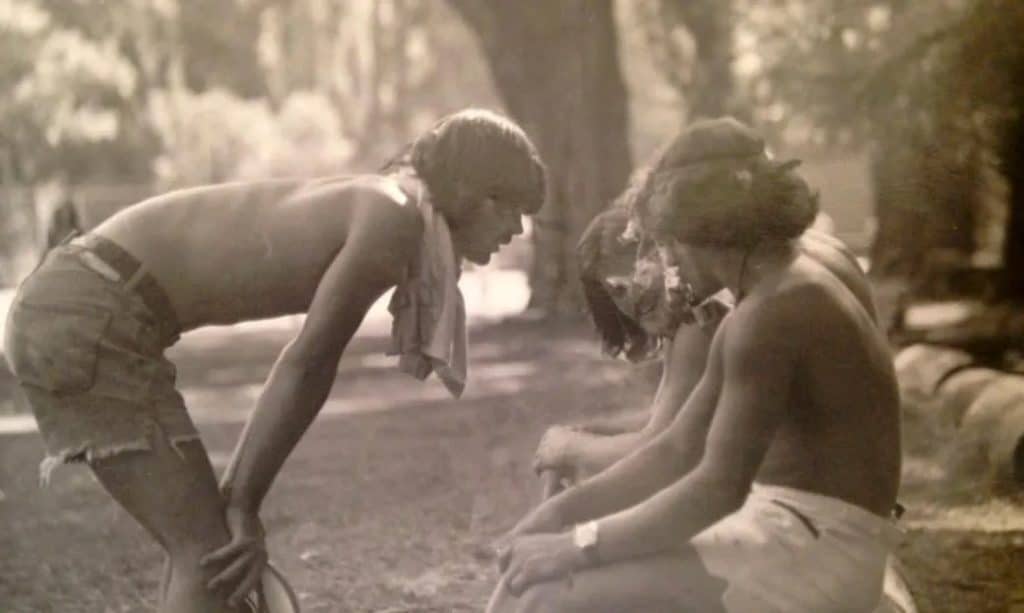
The history of the secret code of marijuana 420
The code they used among themselves for these escapades began to be "Louis 4.20", until the number 420 simply survived. The treasure was never found, but the custom remained, and the boys began to meet to smoke on a wall outside the school ("wall", hence "Waldos").
For them, "420" was a way of talking about marijuana without being understood by their teachers, their mothers, or other classmates who did not share the habit of consuming the sweet plant, in a time when social tolerance was not what it is today.
The code could have been born and died with these five friends, but there are twists of the universe that have no logical explanation. San Rafael, the California city of the Waldos, is 30 miles from greater San Francisco.
How did 420 become popular to talk about marijuana?
The Grateful Dead, one of the iconic California hippie and psychedelic bands of the late 1960s, left the big city for a while and moved to Mary County, an area just a few blocks from the Waldos' school. A twist of fate or destiny.
Mark Gravich's father, one of the Waldos, took over management of the Dead's real estate holdings. Dave Reddix's older brother, Patrick, was the manager of an alternative band that some of the musicians had put together with David Crosby, because he was good friends with Grateful Dead bassist Phil Lesh.
Thus, the Waldos began to frequent the rehearsals of the mythical band and to smoke marijuana with them. "So we used to hang out and listen to them play music and smoke while rehearsing for concerts. I think it is possible that my brother Patrick may have spread the 420 through Phil. And so was I, because I was hanging out with him and his band as a roadie (lead) when they were doing a summer tour that my brother was leading," Reddix recounted.
The Grateful Dead's role in the expansion of the term
The Waldos also agreed to the band's parties, so the 420 literally passed by word of mouth. "We'd go with Mark's dad, who was a modern '60s dad," Steve told Huffington Post. "There was a place called Winterland and we were always backstage running, or on the stage itself, and, of course, we'd use those phrases. When someone rolled a joint or something, it was "Hey, 420." Thus, the term began to spread throughout the community, he said.
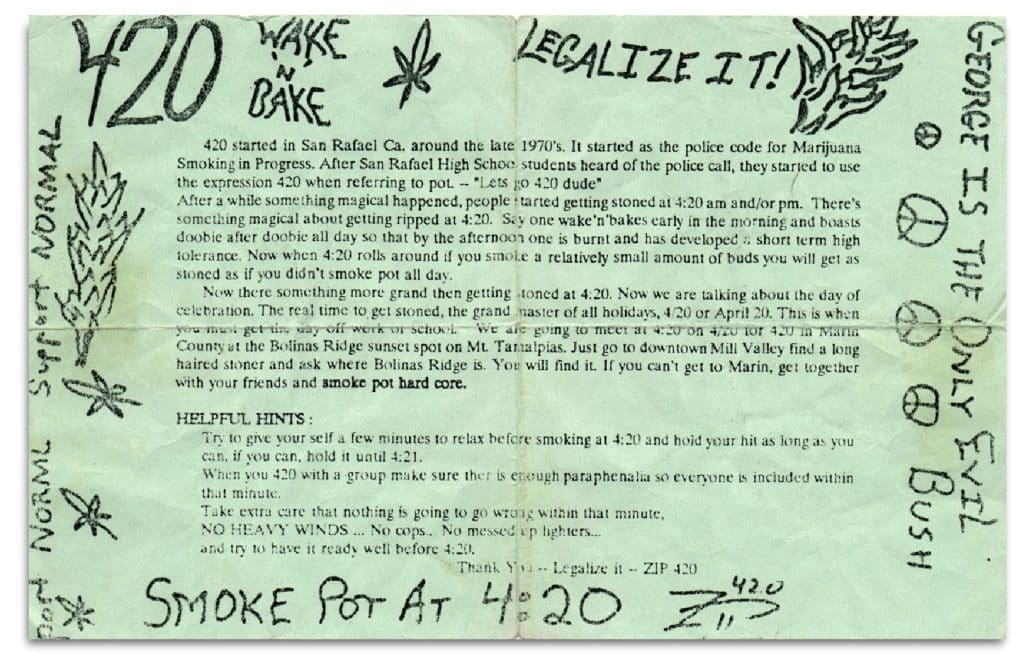
On December 28, 1990, a group of Deadheads (as Grateful Dead fans called themselves) in Oakland handed out flyers inviting people to smoke 420 on April 20 at 4:20 am. in the afternoon. One of the flyers ended up in the hands of Steve Bloom, former columnist for High Times magazine, the world's first cannabis culture publication. Thus began the true global expansion of the code, almost 20 years later than the original Big Bang.
How 420 became popular worldwide: the first time 420 was published in a cannabis magazine
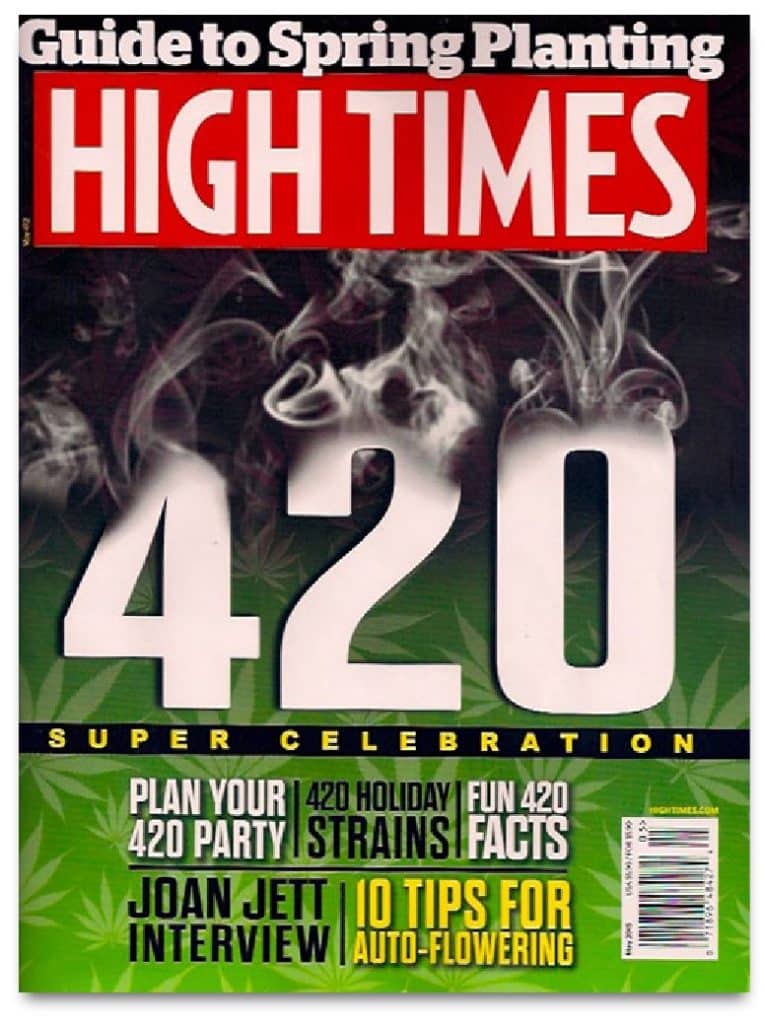
The famous cannabis magazine High Times featured the 420 pamphlet in a 1991 article and began referring to the term 420. The Waldos code crossed borders and cultures and returned to its origin. The eternal return: in 1998, one of the Waldos warned that they were who they were, and a High Times reporter revealed, for the first time, the 420 origin story.
Finding the illegal treasure
The story could end here. But in 2016, after investigating for two years, the Waldos finally met the owner of those early illegal marijuana grows. He was Gary Newman, who was already 68 years old. The old guard told them that, while stationed at Point Reyes, he tended the lighthouse in the area and planted the famous planter on federal land very close to his place of work.
He farmed for several years, but sure enough, in the fall of 1971, the agent was afraid of being caught by the police and it was then that he drew the treasure map and gave it to his brothers-in-law, Bill and Pat McNulty. It had been Bill who shared the map with Steve Capper. Paradoxically, Newman was 45 years unaware that his lost seedling was the inspiration and origin for a code that today is even more famous than the Grateful Dead.
The myths about the origin of 420 (and why they're false)
Before the Waldos' story became known, dozens of explanations did the rounds. None of them holds up:
- “It's the California police code for marijuana use.” False. No such code exists; 420 doesn't even appear in the penal codes it's attributed to.
- “It's the number of chemical compounds in cannabis.” Incorrect: the plant contains several hundred compounds, not 420.
- “It's teatime in Holland.” A legend repeated over and over with no real basis.
- “It's the ideal date to plant marijuana.” That depends on the climate and the type of crop; there is nothing universal about April 20.
- “It comes from Hitler's birthday or Bob Marley's death.” Coincidences with no connection whatsoever to the origin of the term.
The only version backed by physical evidence — photos, a flag and references in the school yearbooks — is the Waldos'. In fact, the Oxford English Dictionary credits the origin of the term to “some students in San Rafael”.
How 420 is celebrated around the world (and in Spain)
What began as a private joke is today a global event. Each place lives it in its own way:
- United States: huge gatherings in the states where cannabis is legal, with heavy media coverage and political campaigning.
- Amsterdam: the European epicentre, with events in coffeeshops and meet-ups in parks such as Vondelpark.
- Spain: the approach is more about advocacy and information. In Barcelona and Madrid — where our physical stores are — cannabis associations organise gatherings, and many online shops launch promotions.
If you want to join in without stepping outside the law, 420 is a great moment to discover CBD flowers and CBD hash: the same ritual, within the legal framework of hemp.
From 420 to 710: cannabis's other number
If 420 belongs to the flowers, 710 belongs to the concentrates. The trick is to read the number upside down: 710 spells out the word OIL, a nod to extracts and resins. Its day is July 10 and, although it is nowhere near as famous as 420, it is gaining ground among those who prefer concentrates.
Frequently asked questions about 420
What does “420 friendly” mean?
On dating apps, rental listings or social profiles, “420 friendly” means the person or place is tolerant of cannabis use. It doesn't imply any sale or anything illegal: it simply signals an open attitude towards 420.
Does 4:20 mean anything outside cannabis?
Many people see 4:20 on the clock and link it to signs or “love” messages. Beyond popular numerology, its only documented cultural meaning is the cannabis one: the time the Waldos chose to meet.
Is 420 the same as 710?
No. 420 is associated with marijuana flower and with 4:20; 710 with concentrates and oils, and it is celebrated on July 10. They are two different codes from the same culture.
Is April 20 an official holiday?
It isn't officially recognised in any country, but it works as a symbolic worldwide cannabis day, with events and campaigns every year.
Today, 420 is far more than a time or a date: it's a symbol of unity, culture and resistance. At Cannactiva we celebrate it with our CBD flowers, CBD hash and accessories, all within the legal framework of hemp. Happy 420!


