
What is cannabis oil?
Cannabis oil is a homemade preparation that yields an oil with a high concentration of active cannabinoids. This guide shows you, in a practical way, how to make homemade cannabis oil: find out which type of oil is best suited to preparing it, the timings and the temperature, and how to store it optimally.
You will learn not only how to prepare this oil at home, but also how to understand the importance of each stage —such as decarboxylation and infusion into a base oil— in order to obtain a high-quality, potent product.
In summary:
- Decarboxylate the cannabis first in the oven (105-120 °C, 30-45 min): without this step the cannabinoids barely take effect.
- Use a rough ratio of 1 g of cannabis per 30 ml of oil of virgin olive oil (around 3-3.5 g per 100 ml).
- Infuse at 60-80 °C for 2-3 hours, filter and store in a dark glass jar, in a cool place away from light.
Note: this is an informational article with no prescriptive intent, and it is not designed to prevent, diagnose or treat any illness or symptom. Cannactiva products are not medicines and are intended for external use. The following information is for informational purposes only. The making, possession and use of cannabis oil are governed by different laws in each country or region: inform yourself. Cannactiva accepts no liability for any improper use of the information set out here. Consult your doctor if you have any questions about cannabis and its uses.
Extracting cannabis into oil: key points
Cannabis is an exceptional plant that contains more than 100 different cannabinoids, the most prominent being THC and CBD. In their natural form, these compounds are not immediately active: it is through extraction processes that they are converted into their active forms, allowing them to exert effects in the body. These processes are the basis for making products such as CBD oil and medicinal cannabis oil. CBD oil is a preparation based on THC-free hemp extract, whereas cannabis oil covers a range of homemade preparations with a variable combination of THC and CBD.
Ratios: how much oil and how much cannabis
To make cannabis oil, a rough ratio of 1 gram of cannabis per 30 ml of oil is usually used. For example, for 100 ml of oil, around 3 to 3.5 grams of cannabis.
Making cannabis oil
1. Ingredients
The quality of cannabis oil largely depends on the quality of the cannabis used. Some aspects to consider are the origin and condition of the material (for example, that there is no mould and avoiding excess moisture).
Virgin olive oil is recommended for its quality and stability. Olive oil has been shown to be a better solvent than alcohol (used in cannabis tinctures) for preserving the cannabinoids and terpenes of cannabis (1). Good-quality coconut oil can also be used.
If possible, avoid refined oils (labelled as «light», «intense» or refined) and seed oils (grapeseed, sunflower, rapeseed). These oils are less stable than virgin olive oil and cope worse with heating, which would shorten the shelf life of the final preparation (the oil «goes rancid» sooner).
2. Grinding the cannabis
Break up the buds evenly, with clean hands. You can use a grinder to break the cannabis into smaller pieces, without reducing it to powder. It is best not to grind it to a fine dust, because very fine particles could slip through later during filtering.
3. Decarboxylation: activating cannabinoids with heat
Decarboxylation activates the cannabinoids, converting them into their active forms (for example, THCA is transformed into THC). This step is essential, because if this transformation does not take place, «raw» cannabinoids have very little affinity for the receptors of the body's endocannabinoid system and do not produce the desired effect.
To do this, preheat the oven to between 105 °C and 120 °C with a glass of water, which will stop the temperature from rising too much. Do not use the grill, as it raises the temperature through radiation and burns the broken-up buds more easily. If you cannot turn it off, keep the tray on the lower shelves of the oven.
Spread the ground cannabis evenly over a baking tray lined with parchment paper and bake at 105-120 °C for 30-45 minutes. Stir the cannabis every 10-15 minutes to achieve an even decarboxylation. Then remove the tray and let the plant material cool to room temperature. Stick to the times and temperatures given.
4. Infusion into the base oil
Now that we have the cannabis with active cannabinoids, the next step is to extract them into a base oil. Cannabinoids, being lipophilic compounds, dissolve efficiently in fats.
You will need a heavy-bottomed pot or a slow cooker and a kitchen thermometer.
First place the decarboxylated cannabis in the pot and cover it with the base oil. Stir to fully submerge all the cannabis in the oil, trying to ensure no dry cannabis is left on the surface. Heat the mixture over very low heat, keeping a constant temperature between 60 °C and 80 °C for 2 to 3 hours. The time-temperature trade-off: if you opt for the longer infusion time, it is best to keep the temperature at the lower end of the range, around 60 °C.
During the cannabis-in-oil infusion it is crucial to avoid higher temperatures, which could degrade the cannabinoids and volatilise the terpenes, the compounds responsible for the aroma that also modulate the oil's effects. Control the temperature with a thermometer.
During the infusion time the active cannabinoids of the cannabis are extracted, along with the terpenes and flavonoids, components that enhance the effects of the cannabinoids in what is known as the entourage effect of cannabis: the synergy between different compounds.
Some recipes opt for a longer infusion, of up to 6 hours, but this is not recommended. Going over on time or temperature could reduce the potency of the final product by degrading THC into CBN (cannabinol), a THC derivative with different properties.
5. Filtering and separation
Once the infusion time is over, and without letting it cool down too much, separate the oil from the plant material to obtain a quality extract and optimise its preservation.
If the oil is warm it will be much easier to filter. Also, if we let it cool for too many hours, the plant material could release unwanted aromas into the oil. You could even filter it while the oil is hot, just being careful not to burn yourself while handling it.
You will need: a fine metal sieve or a cheesecloth (muslin), a glass container to store the cannabis oil and a wooden spatula.
Place the fine sieve or the cheesecloth over the glass container. Carefully pour in the hot mixture, letting the oil filter through and leaving the cannabis residue behind. Using the wooden spatula, gently press the plant material to «squeeze» it and extract as much oil as possible. Let the filtered oil cool completely before going on to store it.
6. Storage and preservation
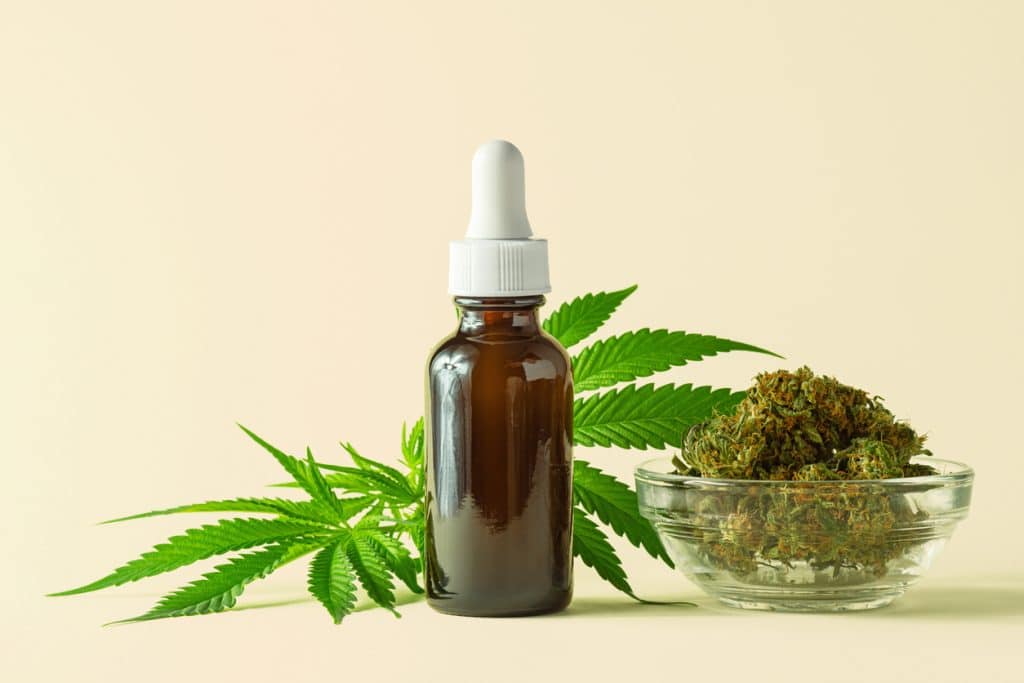
The final stage is to store the cannabis oil properly to preserve its properties and potency over time. The best option is dark glass jars (amber, for example) to protect the oil from light, which can speed up the degradation of the cannabinoids. You can also use clear glass jars, taking care to keep them inside a cupboard or in a dark, cool place. The same care used to store CBD oil applies here.
Important: put a label on the jar stating its contents and keep it out of the reach of children to avoid accidents. In case of accidental ingestion, consult a doctor or go to a health centre. Cannabis has intense and long-lasting effects, which begin to appear 30-60 minutes after ingestion and can last for 4-6 hours.
Smoking or ingesting cannabis oil: why the effects are not the same
The most common way is to take the oil as sublingual drops: you place a few drops under the tongue and hold them for a few seconds before swallowing. This way part of it is absorbed directly through the lining of the mouth, partly bypassing the digestive tract, and the effect tends to appear somewhat sooner than swallowing it all at once. We explain this in the guide on how to take sublingual CBD oil.
Taking the oil (sublingually or orally) changes how the effects are felt compared with smoking. When smoking or vaporising, the cannabinoids pass into the blood through the lungs and the effect appears almost immediately (within minutes), but lasts less (about 2-4 hours). Ingested, by contrast, it passes through the digestive tract before circulating: the effect takes longer to appear (1 to 3 hours) but is more intense and lasts longer (up to 6-8 hours).
That is why the most common mistake with oil and edibles is to think it «is not working» and repeat the dose too soon, ending up taking too much. The recommendation is simple: start with a small amount and wait long enough before taking more. If you want to understand in detail how long CBD takes to work and lasts depending on the route of consumption, we explain it in its guide.
References of interest
- Romano, L.L. and A. Hazekamp. Cannabis oil: chemical evaluation of an upcoming cannabis-based medicine. Cannabinoids, 2013. 1(1): 1-11.
- Moreno, T., P. Dyer and S. Tallon. Cannabinoid decarboxylation: a comparative kinetic study. Industrial & Engineering Chemistry Research, 2020. 59(46): 20307-20315.


