
Marijuana use, both recreational and medicinal, has grown as it has become legal in many countries, and with it the questions about how cannabis affects the brain: is it true that marijuana is bad for the brain? And why is it often said that CBD flowers have a milder effect?
In this article we go over the main effects of marijuana on the brain: how THC works, what happens to your neurotransmitters, why the munchies appear, whether cannabis causes paranoia and what role CBD plays. We will also explore, alongside the psychologist and researcher Alberto Sainz, PhD, whether it is true that cannabis makes us more sociable and how marijuana use influences empathy and the way we relate to others.
How does marijuana (THC) work in the brain?
Of all the compounds in cannabis, the one that most affects the brain is tetrahydrocannabinol (THC), responsible for the "high", euphoria or altered perception that marijuana use produces.
The marijuana people used 30 years ago had a THC content of around 4%. After years of genetic improvement, today it is common to find strains that exceed 30% THC: in barely three decades, its potency has multiplied. In other words, today's marijuana is not the one the Beatles smoked, but far stronger — and that explains much of its effect on the brain.
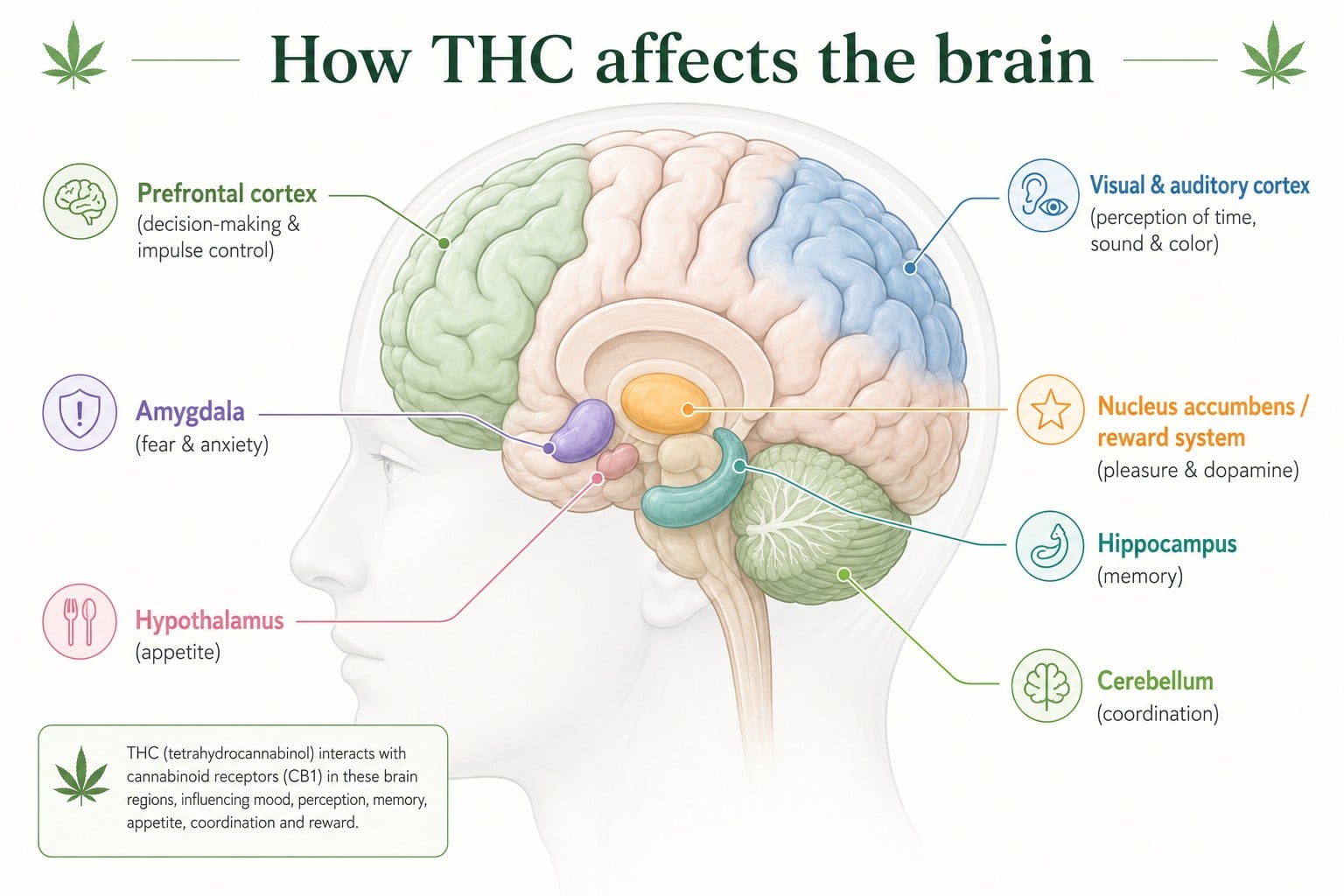
THC acts on the brain's endocannabinoid system, made up of a network of receptors spread throughout the brain that help regulate mood, memory, appetite and perception [1]. By activating them, THC disrupts the brain's normal functioning, which is why it changes how we feel, how we perceive our surroundings and even how we behave.
Effects of marijuana on the brain
Why does marijuana affect each brain differently?
The effects of THC on the brain are highly variable: they depend on the dose, the method of consumption and individual factors such as tolerance or age. The same amount can affect one person very differently from another.
The developing brain: why marijuana affects children and adolescents more
The brain does not fully mature until around the age of 25, and the last area to develop is the prefrontal cortex, responsible for impulse control, planning and decision-making. Throughout this whole stage, the endocannabinoid system itself acts as a "conductor" that guides the formation of connections between neurons.
When marijuana with a high THC content is used in a brain that is still under construction, it interferes with the natural maturation processes in which the endocannabinoid system is involved. That is why early and frequent cannabis use during adolescence is associated with a greater impact on memory, learning and attention, and, in vulnerable people, with a higher risk of mental health problems when use is heavy [2][3]. This is the reason why cannabis products — including legal CBD — are for adults over 18 only: a developing brain is far more sensitive to the effects of THC and cannabinoids.
In adults specifically, cannabis and its components mainly alter the balance of neurotransmitters, the chemical messengers that neurons use to communicate. Let's see how.
How marijuana use affects the brain's neurotransmitters
THC triggers the release of dopamine [4], the neurotransmitter of pleasure and reward — one of the happiness molecules — hence the feeling of satisfaction. It also alters serotonin (mood) and GABA (sedation and relaxation), and changes the activity of the visual and auditory cortices [5], which changes your perception of time, sound and colour.
CBD also acts on these same brain neurotransmitters, but in a very different way: as it is not psychoactive, it does not produce the THC "high" and, instead of overstimulating, it tends to balance and calm brain activity.
The munchies: how THC switches on appetite in the brain
THC has been used for centuries to stimulate appetite [6]. The munchies — the sudden hunger after using cannabis — arise from the heightening of taste and smell [7] and from the disruption of the dopamine-linked appetite-regulation system, which ends up increasing food intake [8]. We explain this in more detail in why cannabis makes you hungry.
Paranoia: how THC alters the brain's amygdala
In some people, THC can encourage states of anxiety or paranoia, especially at high doses and with chronic use. This is because the amygdala — the brain region involved in fear and anxiety — is one of the areas with the most CB1 receptors, the ones THC activates.
By disrupting this brain activity [9][10], negative thoughts, a feeling of being persecuted or mistrust can appear. It doesn't happen to everyone, or not with the same intensity: it depends on the dose, the strain, the method of consumption and each person's individual factors. If you notice these symptoms after using it, the sensible thing is to avoid it and, if you are worried, talk to your doctor.
Effects of CBD on the brain
Unlike "traditional" THC marijuana, cannabidiol or CBD is the non-psychoactive cannabinoid that predominates in hemp and in CBD flowers. In fact, the World Health Organization (WHO) notes that CBD is well tolerated and has a good safety profile, with no potential for abuse or dependence [11].
Differences between CBD and THC in the brain
Unlike THC, CBD barely binds to the brain receptors responsible for the psychoactive effect. In fact, CBD does the opposite: it makes it harder for THC to bind to them and so tempers its effects (what is known as a negative allosteric modulator of the CB1 receptor). This is one of the reasons why today's marijuana strains, with lots of THC and very little CBD, are so potent and have such unbalanced effects.
CBD also acts on other targets in the brain, such as the receptors for serotonin — linked to mood and the feeling of calm — which helps explain its relaxing effect, and it takes part in the renewal of neurons. We look at this in more depth in the neuroprotective properties of CBD.
That is why, and because of its calming action on the brain, many people turn to CBD looking for help with anxiety, better rest or relief from pain.
Although THC and CBD come from the same plant, they act very differently on the brain: THC alters perception and mood, while CBD modulates and balances that activity without producing any psychoactive effect. You can see all their differences in CBD vs THC: differences and similarities.
The social brain: how marijuana affects empathy and relationships
Beyond mood or appetite, cannabis also influences social cognition, that is, our ability to recognise emotions and understand what others think, feel or intend. In practice, this comes down to two skills: empathy (understanding and sharing what another person feels) and theory of mind (understanding that others have thoughts and intentions different from our own). Both are the basis of healthy relationships.
Why is this studied? Because regular marijuana users have been reported to have difficulties recognising emotions, and because in the therapeutic use in autism some cannabinoids appear to improve social skills. That is also why its possible link with disorders such as schizophrenia or neurodevelopmental ones is of interest. The explanation lies in the endocannabinoid system, present in the brain: its receptors are found in regions such as the amygdala and the prefrontal cortex, responsible for emotional processing, and both THC and CBD modulate them. To measure this, studies use facial-expression recognition tasks, theory-of-mind tests and functional neuroimaging (fMRI).
THC and empathy: the brain recognises emotions less well
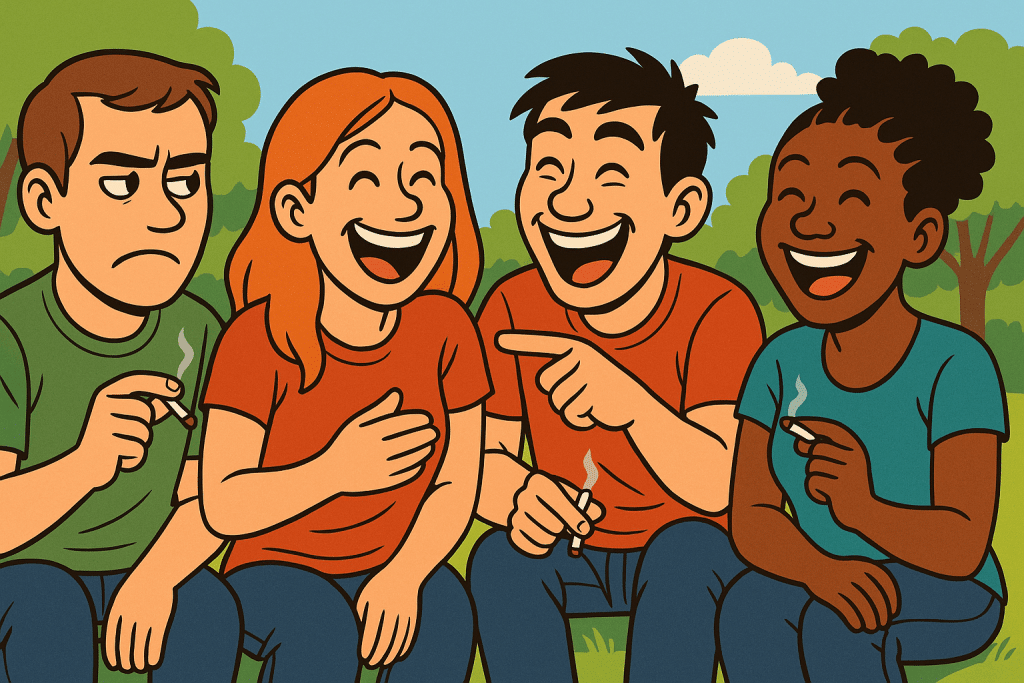
Some studies have linked cannabis use with changes in social cognition skills. They usually look at strains with a lot of THC and little or none of the other cannabinoids, and conclude that THC reduces the ability to recognise other people's emotions (what is known as cognitive empathy) — for example, when interpreting facial-expression tests — as well as reducing the processing of negative emotions [9,10,12–20].
Likewise, a study that used neuroimaging techniques to observe which brain areas were activated under the effects of THC found differences in the activation of areas involved in theory of mind [21]. This suggests that THC could alter our ability to understand other people's thoughts, beliefs and intentions.
CBD and social cognition: the opposite effect in the brain
There are very few studies on CBD, barely a couple. One of the main ones found no differences in social cognition with CBD [19]; another found that CBD improves emotion recognition — but only positive emotions — and counteracts the effect of THC on empathy [15].
Empathy and the brain: the study of Barcelona's cannabis clubs
A naturalistic controlled study carried out in Barcelona's cannabis clubs — that is, with real users in their usual setting, not in a laboratory —, led by José Carlos Bouso (ICEERS) with the collaboration of researcher Alberto Sainz, PhD (the author of this article), confirmed that chronic THC use reduces emotion recognition in regular users and decreases emotional empathy towards negative emotions.
In addition, THC and CBD showed opposite effects on emotion recognition: people recognised emotions better under the effects of CBD. And, for the first time, it was shown that CBD improves theory-of-mind skills — specifically its cognitive component: the ability to understand what others think, believe or want — in regular cannabis users [22][23].
Conclusion: how does cannabis affect the social brain?
The current evidence suggests that THC reduces the ability to recognise other people's emotions and to empathise affectively with negative ones. CBD tends to do the opposite: it improves emotion recognition — especially compared with THC —, can even counteract its effects and supports the understanding of other people's thoughts and intentions. Even so, the evidence is still limited and more studies are needed to reinforce these findings.
And social cognition is not the only complex function that cannabis alters: it also influences other brain processes, such as creativity, where once again THC and CBD seem to act differently.
We encourage responsible and informed use of cannabis and that you check the regulations in force in your country.
References
- Pertwee RG. The diverse CB1 and CB2 receptor pharmacology of three plant cannabinoids: Δ9-tetrahydrocannabinol, cannabidiol and Δ9-tetrahydrocannabivarin. Br J Pharmacol. 2008;153(2):199–215.
- Lubman DI, Cheetham A, Yücel M. Cannabis and adolescent brain development. Pharmacol Ther. 2015;148:1–16.
- Meier MH, Caspi A, Ambler A, Harrington H, Houts R, Keefe RSE, et al. Persistent cannabis users show neuropsychological decline from childhood to midlife. Proc Natl Acad Sci U S A. 2012;109(40):E2657–E2664.
- Zehra A, Burns J, Liu CK, Manza P, Wiers CE, Volkow ND, et al. Cannabis Addiction and the Brain: a Review. J Neuroimmune Pharmacol. 2018;13(4):438–452.
- Winton-Brown TT, Allen P, Bhattacharyya S, Borgwardt SJ, Fusar-Poli P, Crippa JA, et al. Modulation of auditory and visual processing by delta-9-tetrahydrocannabinol and cannabidiol: an fMRI study. Neuropsychopharmacology. 2011;36(7):1340–1348.
- Cota D, Marsicano G, Lutz B, Vicennati V, Stalla GK, Pasquali R, et al. Endogenous cannabinoid system as a modulator of food intake. Int J Obes Relat Metab Disord. 2003;27(3):289–301.
- Kirkham TC. Cannabinoids and appetite: food craving and food pleasure. Int Rev Psychiatry. 2009;21(2):163–171.
- Bloomfield MAP, Ashok AH, Volkow ND, Howes OD. The effects of Δ9-tetrahydrocannabinol on the dopamine system. Nature. 2016;539(7629):369–377.
- Freeman D, Dunn G, Murray RM, Evans N, Lister R, Antley A, et al. How cannabis causes paranoia: using the intravenous administration of Δ9-tetrahydrocannabinol (THC) to identify key cognitive mechanisms leading to paranoia. Schizophr Bull. 2015;41(2):391–399.
- Gorka SM, Fitzgerald DA, de Wit H, Phan KL. Cannabinoid modulation of amygdala subregion functional connectivity to social signals of threat. Int J Neuropsychopharmacol. 2015;18(3).
- World Health Organization. Cannabidiol (CBD): Critical Review Report. Geneva: WHO, Expert Committee on Drug Dependence; 2018.
- Bossong MG, van Hell HH, Jager G, Kahn RS, Ramsey NF, Jansma JM. The endocannabinoid system and emotional processing: A pharmacological fMRI study with Δ9-tetrahydrocannabinol. Eur Neuropsychopharmacol. 2013;23(12):1687–1697.
- Gorka SM, Phan KL, Lyons M, Mori S, Angstadt M, Rabinak CA. Cannabinoid modulation of frontolimbic activation and connectivity during volitional regulation of negative affect. Neuropsychopharmacology. 2016;41(7):1888–1896.
- Hindocha C, Wollenberg O, Carter Leno V, Alvarez BO, Curran HV, Freeman TP. Emotional processing deficits in chronic cannabis use: a replication and extension. J Psychopharmacol. 2014;28(5):466–471.
- Hindocha C, Freeman TP, Schafer G, Gardener C, Das RK, Morgan CJA, et al. Acute effects of delta-9-tetrahydrocannabinol, cannabidiol and their combination on facial emotion recognition: a randomised, double-blind, placebo-controlled study in cannabis users. Eur Neuropsychopharmacol. 2015;25(3):325–334.
- Hudson R, Rushlow W, Laviolette SR. Phytocannabinoids modulate emotional memory processing through interactions with the ventral hippocampus and mesolimbic dopamine system: implications for neuropsychiatric pathology. Psychopharmacology (Berl). 2018;235(2):447–458.
- Metrik J, Aston ER, Kahler CW, Rohsenow DJ, McGeary JE, Knopik VS. Marijuana's acute effects on cognitive bias for affective and marijuana cues. Exp Clin Psychopharmacol. 2015;23(5):339–350.
- Pillersdorf D, Scoboria A. Cannabis-associated impairments in the fading affect bias and autobiographical memory specificity. Conscious Cogn. 2019;74:102792.
- Woelfl T, Rohleder C, Mueller JK, Lange B, Reuter A, Schmidt AM, et al. Effects of cannabidiol and delta-9-tetrahydrocannabinol on emotion, cognition, and attention: a double-blind, placebo-controlled, randomized experimental trial in healthy volunteers. Front Psychiatry. 2020;11:576877.
- Wycoff AM, Metrik J, Trull TJ. Affect and cannabis use in daily life: a review and recommendations for future research. Drug Alcohol Depend. 2018;191:223–233.
- Roser P, Lissek S, Tegenthoff M, Nicolas V, Juckel G, Brüne M. Alterations of theory of mind network activation in chronic cannabis users. Schizophr Res. 2012;139(1–3):19–26.
- Sainz-Cort A, Martín-Islas M, Jimenez-Garrido D, López-Navarro M, Oña G, Muñoz-Marron E, et al. Validation of the Spanish version of the multifaceted empathy test: comparison between cannabis use effects and controls in social cognition. Int Clin Psychopharmacol. 2025;40(2):100–109.
- Sainz-Cort A, Jimenez-Garrido D, Muñoz-Marron E, Viejo-Sobera R, Heeroma J, Bouso JC. The effects of cannabidiol and δ-9-tetrahydrocannabinol in social cognition: a naturalistic controlled study. Cannabis Cannabinoid Res. 2024;9(1):230–240.


