
Marijuana butter — also called cannabis butter or cannabutter — is the foundation of all cannabis baking: if you can make it, you can make the marijuana brownie, marijuana cookies, sponge cake and pretty much any sweet recipe. It's prepared with a simple trick that prevents the grassy taste, keeps for months in the freezer and lets you precisely dose how much cannabis goes into each bite. Even if you're not much of a cook, it's worth making once to have your own base ready to bake with.
This is informational content, based on a typical recipe from popular cannabis culture. If you choose to ingest marijuana, you do so solely under your own responsibility. Cannactiva products are not intended for ingestion.
The 3 key takeaways
- One tablespoon (approx. 15 g) of this butter made with 7 g of buds at 10-20% THC contains between 30 and 60 mg of real THC. That's a high dose — start with half a teaspoon (approx. 2.5 g) if it's your first time.
- The trick to avoid the grassy taste: rinse the buds in very hot water for 20 minutes before cooking, without letting it boil.
- For a more relaxing version with a minimal THC content, prepare the same recipe with CBD flowers or CBD small buds.
What is marijuana butter (and why we prepare it this way)
Marijuana butter — technically called cannabis butter or cannabutter — is butter that has been infused with cannabis flowers to extract their cannabinoids (THC, CBD and others) so you can cook with them.
The technique works because cannabinoids are fat-soluble: they dissolve in fats but not in water. That's why the cannabinoids are first activated in the oven (decarboxylation: THCA becomes THC and CBDA becomes CBD) and then infused into the hot butter fat, which acts as an extraction vehicle.
Cannabutter or bud straight into the dough?
If you're going to bake marijuana brownies or cookies, it's better to use cannabutter than ground bud straight into the dough. Among the advantages of cannabutter: cannabinoid extraction is superior (because the fat dissolves them during infusion), a more uniform distribution of cannabinoids across servings, and the flavour is less grassy in the final result.
Once prepared, the butter is used in any classic baking recipe in the same proportion as regular butter. It's the foundation of practically every cannabis edible: brownies, cookies, sponge cakes, pies and even savoury dishes.
Ingredients for marijuana butter
For 250 g of cannabutter (approx. 13-14 tablespoons) you'll need:
- 250 g of butter (unsalted, preferably good quality)
- 7 g of marijuana buds (increase to 10 g for a stronger butter, or reduce to 4-5 g for a starter dose or low tolerance)
- 250-500 ml of water (1-2 glasses)
- Baking tray + parchment paper for decarboxylation in the oven
A note on the raw material: the quality of the buds is what most impacts the final result. For a medium-high potency butter, look for buds with good trichome density and a known cannabinoid percentage. If you'd prefer a more relaxing version with less psychoactive effect, CBD flowers or CBD small buds work exactly the same in this recipe.
Step-by-step recipe
Below you'll find the recipe step by step. Most of the total time is hands-off resting — active kitchen time is around 3 h 30 min.
📊 Recipe data
- ⏱ Total time: approx. 28-29 h (most of it resting, not active cooking)
- 👨🍳 Active kitchen time: approx. 3 h 30 min
- 😴 Hands-off resting: 2 h cooling + 24 h in the fridge
- 🧈 Final yield: 200-220 g of cannabutter (approx. 14 tablespoons — enough for 2-3 batches of brownies or cookies)
- 🎯 Difficulty: easy
Step 0 — Decarb the buds in the oven
Decarboxylation is the process that converts THCA into active THC (and CBDA into active CBD) through dry heat. Without this step, the cannabinoids don't activate properly and the butter will have very little potency, no matter how long you cook it afterwards.
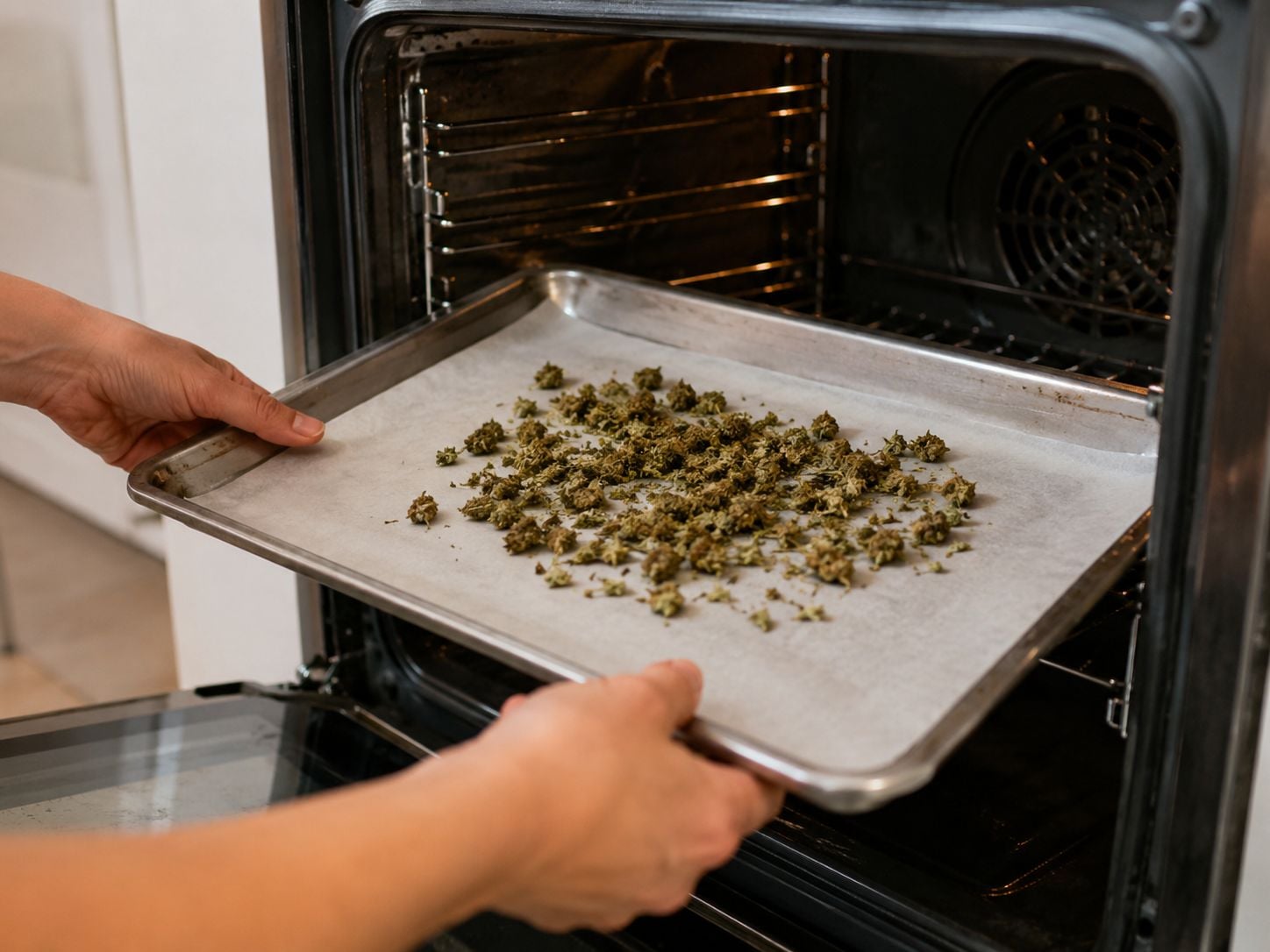
- Preheat the oven to 110-115 °C (top and bottom heat, no fan).
- Crumble the buds lightly with your hands. Don't grind them to powder: leave pea-sized pieces so activation is uniform without losing too many terpenes.
- Spread them on a tray lined with parchment paper in a thin and even layer.
- Bake for 30-40 minutes, stirring halfway through so activation is homogeneous.
- Take them out when they're dry and slightly golden (not brown or burnt) and let cool before continuing.
Key rule: never go above 120 °C. Above that, THC starts to degrade into CBN and you lose potency.
Step 1 — Grind the decarbed buds
Once cool, grind the buds with a grinder or food processor until they're uniform and fine (not powder). An even grind makes sure cannabinoid extraction stays consistent throughout the butter.
Step 2 — Rinse the buds in hot water (optional)
This step reduces the grassy taste in the final result. If the typical vegetal aftertaste of edibles bothers you, it's worth doing. If you prefer to preserve the bud's terpenes and aroma to the maximum, skip it and go straight to Step 3.
If you do it:
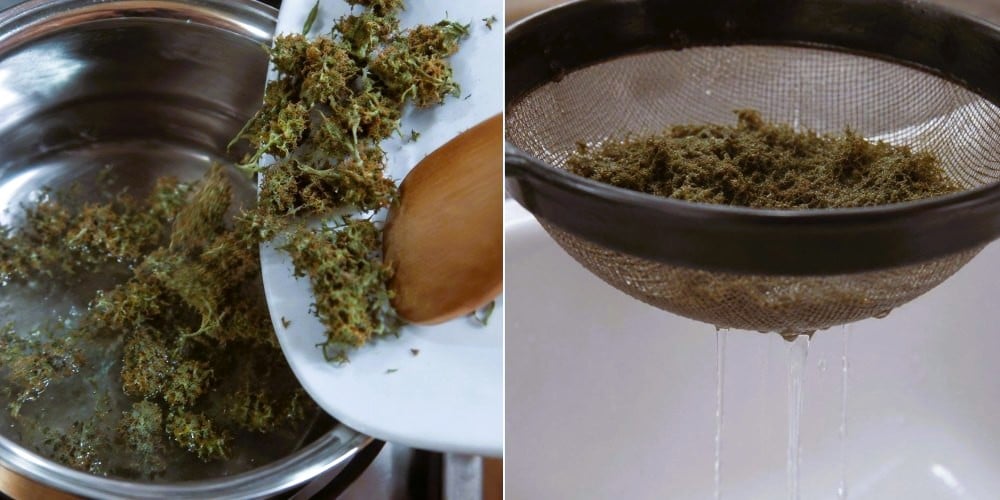
- Place the ground buds in a saucepan with very hot water for 20 minutes.
- The water must not come to a boil. Keep the heat at a minimum; if you see bubbles, lift the pan off the heat for a moment and put it back.
- After 20 minutes, strain the buds and discard the water. Set the clean buds aside.
Technical note: this step removes chlorophyll and other impurities, but also some volatile terpenes. It's a flavour decision, not a potency one.
Step 3 — Cook the butter on very low heat
In a clean pot (ideally in a bain-marie / double boiler for better temperature control), melt the 250 g of butter with 250-500 ml of water. Once fully melted, add the 7 g of decarbed buds (rinsed or not, depending on whether you did Step 2).
Cook on very low heat for 2-3 hours, stirring every 20-30 minutes. The ideal temperature is between 70 and 85 °C, never above 90 °C. If you have a kitchen thermometer, use it: above 95 °C, THC starts to degrade.
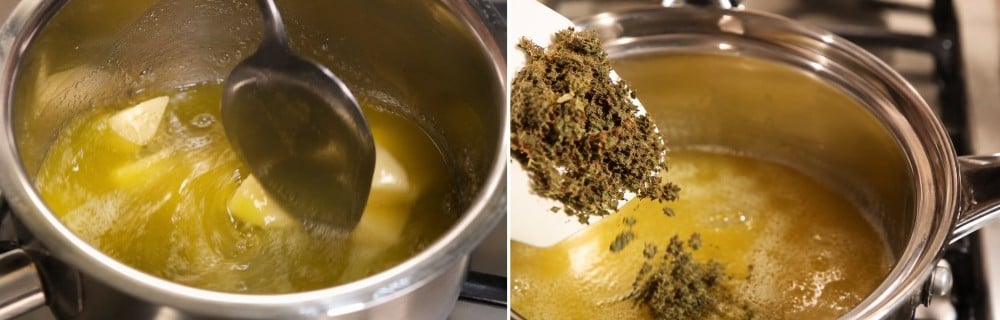
Without ever letting it boil: if you see bubbles breaking the surface, take the pot off the heat for a moment. The butter will gradually take on a green-gold colour as it infuses.
Why so long? Extraction is efficient at 70-85 °C but takes time. Below 2 hours, infusion is partial; between 2 and 3 hours you reach 80-90% of possible extraction. More than 3 hours doesn't add much.
Why with water? The water keeps the temperature controlled (it stops the butter from burning), helps extraction and removes additional impurities. If you don't use a bain-marie, water is essential as a thermal buffer.
Step 4 — Rest: 2 h at room temperature + 24 h in the fridge
After the 2-3 hours of cooking, strain the mixture into a glass container that's not too wide (the shorter and wider, the better — it makes later separation easier). Glass is preferable to plastic because the freshly strained butter is still hot, and fat at high temperatures can leach microcompounds from soft plastics. Discard the bud remains in the strainer.
Let the liquid butter rest at room temperature for 2 hours, until it loses the heat. Then place it in the coldest part of the fridge (the top shelf) and let it rest undisturbed for 24 hours.
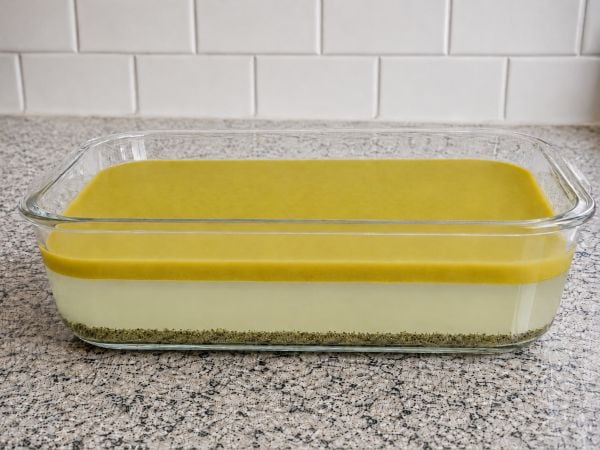
Why such a long rest? During cooling, the mixture separates by density into two phases: the fat (where the cannabinoids, terpenes and aromas are concentrated) rises and solidifies into a compact slab; the water and water-soluble impurities (residual chlorophyll, pigments, plant matter) settle to the bottom. The 24 hours in the cold ensure complete separation and a homogeneous butter slab that's easy to unmould and clean in flavour.
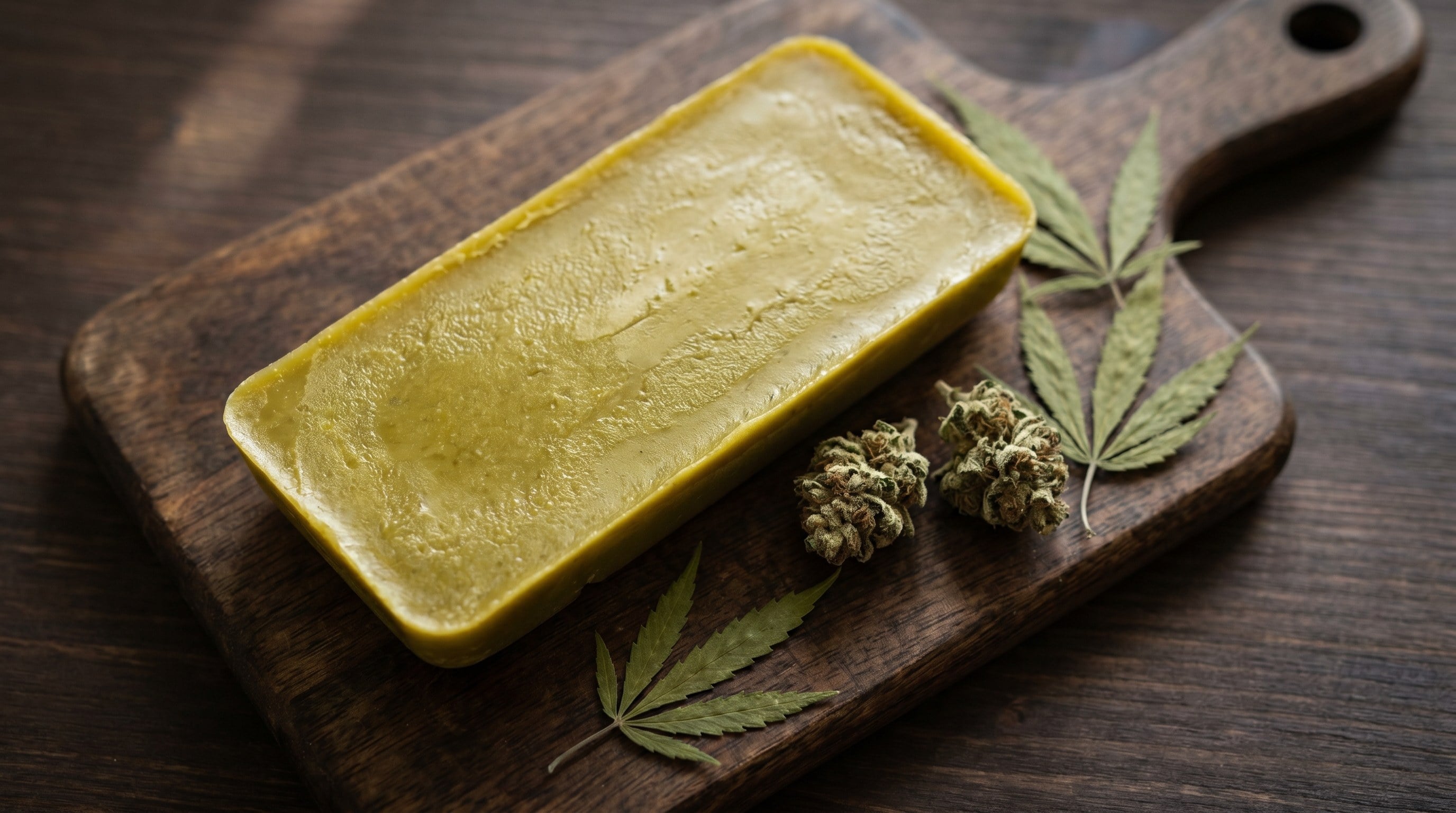
After that time, the butter will have fully solidified into a homogeneous yellow-green slab floating on top of cloudy water.
Step 5 — Separate the butter slab from the water
Take the container out of the fridge. Carefully squeeze the container from the bottom and sides as if you were unmoulding a flan: the solidified butter slab will lift away from the water below.
Remove the butter slab, drain off any drops and store it in an airtight container in the fridge. Drain the leftover water from the container and discard it.
Your cannabutter is ready to use.
Fancy giving the recipe a go? If you make it, we'd love to see how it turns out. Send us a photo of the result at info@cannactiva.com or tag us on Instagram @cannactiva_es — we publish the best ones on our channels and celebrate the recipes of the Cannactivista community.
Marijuana butter: dose, potency and cost
There are three questions every cannabutter recipe needs to answer: how much cannabis to use for a given potency, how much THC ends up in each tablespoon of the final product, and how much it costs to make at home. We break them down below.
Before you dive into the numbers, bear in mind that the mg of THC per tablespoon are always approximate figures, not exact measurements. They depend on three variables that change from recipe to recipe:
- The % THC of the bud you use, which in today's marijuana ranges from 8% to 25% depending on genetics.
- The combined efficiency of decarboxylation and extraction, which with this recipe is around 60% assuming you decarb properly in the oven (88% THCA → THC conversion × 70% transfer to the fat).
- The losses during straining and resting: part of the butter is left trapped in the cheesecloth, in the bud remains and in the water you discard (around 15-20% of the initial volume).
Treat the figures in the following sections as a rough guide, not a lab-grade measurement. And, above all, with edibles the golden rule applies: always start with less and wait 45-90 minutes before going again. The effect arrives late and lasts a long time — you can go up, but you can't come back down.
How many grams of buds per 250 g of butter
- 3-4 g of buds: very mild potency, ideal for first-timers
- 5-6 g of buds: low-medium potency, moderate dose
- 7-8 g of buds: medium-high potency — the standard recommended recipe
- 10 g+ of buds: high to very high potency, only for regular consumers
- 14 g+ of buds: very high potency. The butter saturates above 14 g (no more cannabinoids are extracted)
These references assume buds with 10-15% THC. With stronger buds (15-20% THC), scale down proportionally. With CBD flowers (< 0.3% THC), the psychoactive effect is minimal — physical relaxation predominates.
How to calculate potency per tablespoon
Before you look at the numbers, two important clarifications.
1. Not all the THC in the bud ends up in your butter. Between decarboxylation (~88% THCA → THC conversion) and fat extraction (~70% efficiency with 2-3 h of cooking), the real combined efficiency usually sits between 55% and 70%. In home cooking with proper decarbing, assuming approx. 60% efficiency is a reasonable estimate. Without prior decarbing, real efficiency drops to 15-25% — that's why this step isn't optional.
2. The % THC of the bud changes the result a lot. Today's marijuana ranges from 8% to 25% THC; CBD flower barely reaches 0.3% THC but can contain up to 22% CBD. Check the label on your product before calculating.
A standard tablespoon = 15 g of butter. For 250 g of butter with 7 g of buds at 10% THC (assuming 60% efficiency), these are the estimates of real mg per tablespoon:
- 🌿 Medium marijuana (7 g × 10% THC): approx. 420 mg of active THC in total → approx. 30 mg per tablespoon (high dose)
- 💪 Strong marijuana (7 g × 20% THC): approx. 840 mg of active THC → approx. 60 mg per tablespoon (very high dose)
- 🌱 CBD flower (7 g × 18% CBD + 0.2% THC): approx. 756 mg of active CBD + < 1 mg THC → approx. 54 mg of CBD per tablespoon (with noticeable relaxing effect)
Below 10 mg of real THC per serving is considered a low dose; 10-25 mg is medium; above 25 mg is high. For a first time, start with half a teaspoon (approx. 2.5 g) — that's about 5 mg of THC with the standard recipe — and wait 90-120 minutes before eating more: edibles take a while to kick in (45-90 min) but last between 4 and 8 hours.
For more detail on timings and effects, see our guide to the marijuana brownie, where we explain in detail why edibles work this way.
How much does marijuana butter cost?
Cannabutter isn't sold as a finished product: producing and selling THC edibles to third parties is restricted in most jurisdictions, so it's typically prepared at home for personal consumption.
The cost depends on the price of the buds you use, which varies a lot depending on quality, source and local market — from a few euros per gram in home-grown to significantly higher figures in premium circuits. The other ingredients are cheap: 250 g of unsalted butter cost €2-3 and the water is negligible.
If you'd prefer to make the version with CBD flowers (more relaxing and with less psychoactive effect), quality CBD buds run €4-8/gram depending on variety. For a standard batch of 7 g of CBD buds + 250 g of butter, that's €30-60 in ingredients for 200-220 g of cannabutter (enough for 2-3 batches of brownies or cookies).
How to use cannabis butter
Once you've prepared it, cannabutter is used exactly like regular butter, in the same proportion. These are the most popular recipes, and they all work with this same butter:
- Marijuana brownie — the classic of cannabis culture. One tray makes 8 servings; 125 g of this butter is enough.
- Marijuana cookies — easier to dose (1 cookie = 1 controlled serving). Ideal for beginners.
- Marijuana oil — the olive or coconut oil alternative if you prefer a more fluid or vegan fat.
- Hot drinks — a little cannabutter in a hot drink with milk is a quick, gentle way to test the effect.
Frequently asked questions about marijuana butter
Can I make the butter with cannabis leaves instead of buds?
It's better not to use leaves, but the buds instead, because they have a higher concentration of cannabinoids, which will result in a more potent butter.
How should I store marijuana butter once it's prepared?
Store the butter in an airtight container in the fridge. You can also freeze it for longer storage.
Which type of marijuana is better to use, sativa or indica?
It depends on your preferences. Sativa tends to be more energising, while indica is more relaxing. You can choose based on the effect you want — more on the difference in our sativa vs indica guide.
How long can marijuana butter keep in good condition?
If stored properly in the fridge, it can last several weeks. In the freezer, this butter keeps in good condition for several months.
Can I adjust the amount of marijuana to control the potency?
Yes, you can adjust the amount of marijuana to your tolerance and preference, but do it carefully, with amounts similar to those shown in this recipe, to avoid too much potency and therefore unwanted effects.
Can I use a slow cooker to make the butter?
Yes, a slow cooker (crockpot) is an excellent option for keeping a constant, low temperature during preparation.
Can margarine be used instead of butter?
You can but it's not recommended, because the result is completely different, with different flavour and texture. In addition, most margarines contain very unstable fats that aren't designed to be heated or baked. You can follow the recipe substituting butter for margarine in the same proportions, using lower temperatures than with butter (margarine handles heat worse than butter), but in general it's not recommended because the result isn't great in terms of stability and product quality.
How do you make vegan marijuana butter?
A good alternative to butter to make vegan marijuana butter is coconut oil, with a high percentage of saturated fats (which hold up well to heat throughout the entire extraction process). Follow the recipe as instructed here, swapping one fat for the other.
One thing to bear in mind is that coconut oil is liquid at 24-25 °C. This makes it harder to separate from water when both are in liquid phase. In addition, the density of coconut oil is close to that of water, which can make the separation process slower. And another point is that butter contains phospholipids and other emulsifying molecules that help it separate from water — these aren't present in coconut. For all these reasons, compared to butter, you'll need more hours of refrigeration to separate coconut oil from water.
Can you make marijuana butter without water?
Yes, but it's not recommended. Some quick recipes skip the water and melt the butter directly with the buds. The problem is threefold: the butter burns more easily (without water as a thermal buffer), impurities aren't removed as well, and the final flavour is much grassier. Water isn't optional in this recipe: it's what keeps the temperature controlled and protects the cannabinoids.
Our recommendation
The CBD strains that lend themselves best to baking are those with a sweet or fruity profile — their terpenes harmonise with doughs, chocolates and fruits better than more herbal or citrus strains. Four examples from our catalogue that work particularly well:
Why Cannactiva?
- 🧪 Lab analysis available as PDF for every product
- 🚚 24h delivery within mainland Spain, free from €50
- 🔄 30-day guarantee: if you don't feel the effect, we refund you
- ⭐ 4.8/5 with 15,000+ verified reviews
- 🌿 CBD specialists since 2018, based in Barcelona
And that's it! Now you know how to make marijuana butter. Remember to consume in moderation and bear in mind that cannabis is absorbed much more when ingested than when smoked. The peak effect can take longer to appear (between 30 and 90 minutes) but the effects are more intense and longer-lasting than when smoking.
If you share a home with other people, warn them about the content and keep the butter out of reach of children and pets. Label it clearly — confusing cannabutter with regular butter is the most frequent cause of household accidents with cannabis edibles.
Cannactiva's CBD flowers are sold as industrial hemp products for external use. Any other preparation or consumption is the sole responsibility of the user.


