
HHC (hexahydrocannabinol) is a semi-synthetic cannabinoid with a psychoactive effect, derived from THC, that became popular as a “legal high”. But since 23 April 2025 HHC has been illegal in Spain. Here we explain what it is, how it is produced, what effects and risks it has, and its current legal status.
The world of cannabinoids includes a vast number of compounds that are not yet fully described, identified or regulated. One of them is HHC or hexahydrocannabinol: a novel cannabinoid with psychoactive effect that is currently in a legal grey area in many countries around the world. The popular HHC buds are CBD flowers that are sprayed with this product to produce a psychoactive effect.
In this post we explain what HHC is and crucial aspects you should know before signing up for the new fad of this cannabinoid, advertised as "the legal high", and whose popularity continues to grow. You will discover that HHC products present different composition and effects in relation to the type of HHC they contain, as well as their possible risks and legality. Join us until the end!
What is HHC?
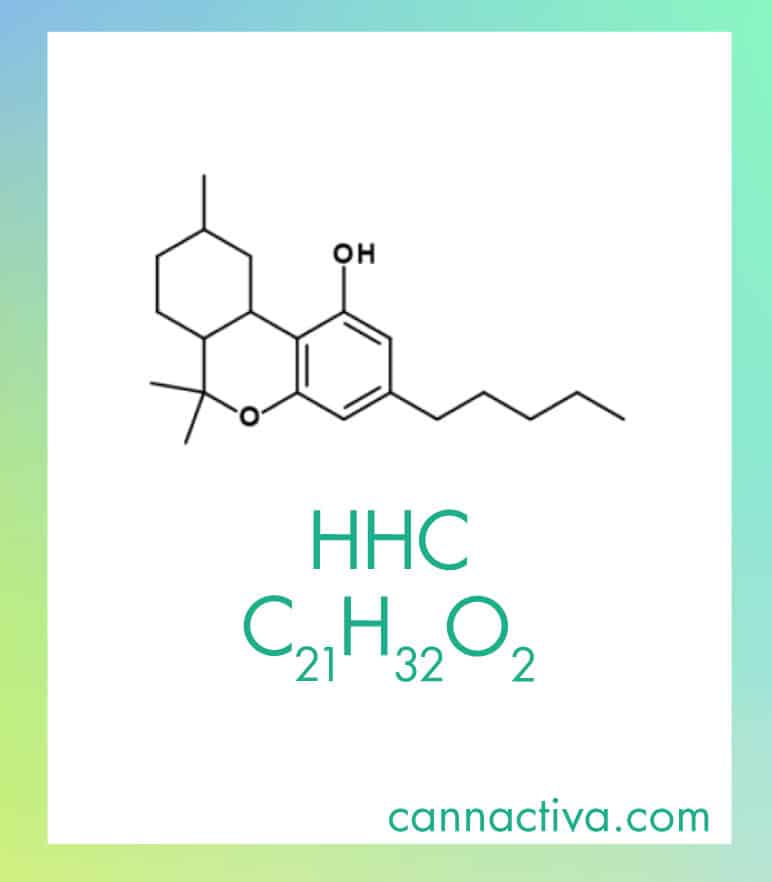
Hexahydrocannabinol (HHC) is a poorly studied type of cannabinoid with a psychoactive effect that is found in very small amounts in cannabis (1) and produces an effect similar to tetrahydrocannabinol (THC).
In reality, HHC is found in the cannabis plant not because it is produced by the plant, but because it is a breakdown product of THC. THC is the best known psychoactive cannabinoid to date and shares many of its characteristics with HHC.
Origin of HHC
HHC was first identified in 1940 (2) and is commercially produced semi-synthetically, i.e., it is synthesized from THC and cannabidiol (CBD).
What is CBD and what is it for Learn with our Blog
There are no natural HHC products, but it is obtained in laboratories and added to products, either sprayed on CBD flowers, mixed with hashish or in the composition of oils and edibles.
Because HHC is found in very low doses in cannabis, all HHC on the market is obtained semi-synthetically, from THC or CBD, in a proprietary laboratory process.
HHC synthesis is a subject shrouded in misinformation and secrecy on the part of manufacturers. There is a basic process called hydrogenation, which generates a dark golden colored oil, known as hydrogenated cannabis oil (HCO), which is rich in HHC.
Products containing HHC
Products with HHC were detected in the European market in 2022. They are sold as a "legal" marijuana product, either as a replacement for THC or simply sprayed on CBD flowers or added to CBD hashish hashish to enhance the psychoactive effects.
There is a wide variety of products with hexahydrocannabinol: HHC vapes, HHC oil for dosing in drops, HHC marijuana, HHC hashish or even edibles, such as cannabis candy. These products claim the title of "legal cannabis" products and generally contain a mixture of two types of HHC (the two isomers 9S-HHC and 9R-HHC).
Types of HHC
When we speak of HHC, we are actually referring to two hexahydrocannabinol compounds, of which their short chemical names are (3):
- 9 alpha HHC (9α-HHC) for epimer (9S)-HH
- 9 beta HHC (9β-HHC) for (9R)-HHC epimer, also known as hexahydrocannabinol (HHC), hexahydro-CBN or HXC
Epimers are different molecules with the same chemical composition, but different spatial structure (a type of isomer or stereoisomer), which influences their properties and effects. Depending on the type of synthesis, there will be more proportion of one type of HHC or another in the final product (9, 10).
The potency of HHC products depends on the dose and the type of HHC they contain. The 9R-HHC epimer has more psychoactive effects. Marketed HHC is a mixture of both types of molecules, leading to possible variations in the potency and overall effects users experience with HHC products.
The 9R-HHC epimer is more affine to endocannabinoid receptors, which means that it has a greater ability to bind to these receptors (4). As a result, 9R-HHC has more potent psychoactive effects compared to the other epimer.
In contrast, the 9α-HHC epimer (9S-HHC), due to its slightly different molecular structure, does not bind as actively to the body's natural endocannabinoid receptors as 9R-HHC. Therefore, it is considered to have a much lower potency and little psychoactive effect. For simplicity, some refer to these molecules as "active HHC" (for 9R-HHC) and "inactive HHC" (for 9S-HHC), only colloquially (9).
What effects does HHC have on the human organism?
HHC is a cannabinoid and therefore interacts with the endocannabinoid system to exert its effects on the body. Although there are no specific studies of HHC, it is said to bind to the same cannabinoid receptors as THC, which has a higher affinity for CB1 receptors and thus, its psychoactive response.
Non-clinical studies and anecdotal reports indicate that HHC has psychoactive properties similar to THC, although with slightly lower potency (10).
Although the exact effects of HHC on the body are not known, the effects of THC are known:
- Euphoria
- Relaxation
- Cognitive alterations: impaired perception of time and space, memory and ability to concentrate.
- Changes in sensory perception, such as more vibrant colors or greater sensitivity to visual or auditory stimuli.
- Increased appetite (known as "munchies")
- Lack of motor coordination
- Dry mouth ("cottonmouth")
- Red, glassy-looking eyes
Mechanism of action of HHC
Although little has been studied so far on HHC, some scientific articles mention that, for guidance purposes only, it should be taken into account that it acts in a similar way to THC. Therefore, it is assumed that it has a hepatic metabolism and binds to the endocannabinoid system in a similar way to THC, resulting in a psychoactive effect. To give you a broader idea, you might want to take a look at our post on the effects of THC.
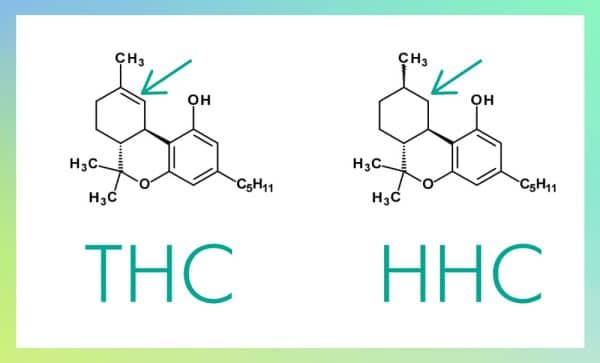
Differences between THC and HHC
Both THC and HHC are two cannabinoids found naturally in cannabis, but they have important differences in their origin, effects and risks. Find out in the post.
Therapeutic potential of HHC? Research areas
It is curious that HHC was described 80 years ago and there is not much scientific information on its characteristics and physiological effects, so the correct or safe dose of HHC is known. This is probably because its low presence in the cannabis plant was not as important as CBD and THC.
At present, there are no data to affirm that HHC has any therapeutic effect.
Despite this, there are some publications mentioning the anticancer effect of HHC analogs called LYR-7 and LYR-8 (5, 6), but these are results that we cannot transpose to humans.
Side effects and potential risks of HHC
The side effects and potential risks of HHC are not yet fully understood due to the lack of comprehensive research. However, it is believed that HHC, being a cannabinoid with properties similar to THC, may have risks similar to those associated with THC consumption.
For example, if THC or HHC, which constantly interact with the CB1 receptor, are consumed regularly, they can disrupt the neuronal communication exerted by our endocannabinoids (7). By affecting neuronal circuits, it may give rise to the following adverse effects:
- Memory problems
- Development of anxiety
- Depression
- Paranoia
This is suggested by what is currently known as the long-term effects of THC use.
Precautions with the use of HHC
The cannabis industry is in constant motion. The discovery of new cannabinoids gives rise to the rapid commercialization of products that are in a legal "limbo", as is the case of HHC. Because the long-term effects of HHC have not yet been documented, it is important that it be consumed with caution.
It should be noted that there are no natural HHC products, but rather products that have been enriched with the semi-synthetic compound. HHC may represent a less expensive alternative to the consumption of natural cannabis products. Due to their lower cost and lack of regulation, synthetic or semi-synthetic cannabinoids tend to displace natural cannabis compounds found in stores.
A crucial point to note here is that the cannabis plant contains a wide range of compounds that interact synergistically with each other, known as the cannabis entourage effect. Science has tried to explain how some of these interactions work, but has failed to fully elucidate how the various compounds in cannabis can regulate the effects to maintain balance or homeostasis in the human body. For example, CBD modulates the effect of THC, indicating that the plant itself is "naturally" formulated to produce a balanced effect. This level of sophistication of nature cannot be recreated in the laboratory and, therefore, caution should be exercised with the consumption of compounds such as HHC.
The concerns involved in a new compound such as HHC include not only the legal framework, but above all the risks that are linked to the lack of research on its toxicity and safety profile. In an ideal world, taking HHC or other synthetic cannabinoids would be similar to taking pharmaceuticals with controlled effects. But let us not forget that cannabinoids are peculiar compounds, which exert their effects in a personalized way, where negative individual characteristics (such as predisposition to depression, stress or anxiety) can cause undesirable effects (8).
In the end, much of the talk about HHC is speculation, perhaps in the future science will point to some tangible benefit that justifies its mass production. For the time being, we recommend that you exercise caution and consult your medical practitioner for further information.
Legality of HHC in Spain and Europe
The legal status of HHC has changed completely. When it burst onto the European market in 2022 it was sold by exploiting a legal loophole, but most countries have banned it since then. HHC is now illegal in Spain: Order SND/380/2025, in force since 23 April 2025, added HHC and its derivatives (HHC-O, HHC-P, THCP, among others) to the list of controlled psychotropic substances.
At European and international level, the list of bans has kept growing:
- Austria — March 2023
- France — June 2023
- Italy, the United Kingdom, Belgium, Denmark, Switzerland… — 2023-2024
- Germany — June 2024
- Spain — April 2025
- UN — March 2025: HHC was added to Schedule II of the 1971 Convention on Psychotropic Substances.
Its sale, possession and use are therefore banned on the same terms as THC. If you are thinking of travelling with cannabis products, check the destination's legislation first — with HHC, it is simply not a good idea.
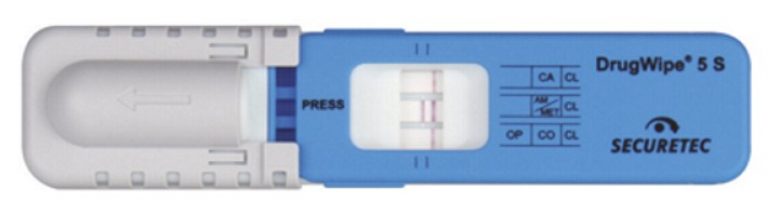
The legal, natural and well-studied alternative is still CBD. We explain the differences between CBD and HHC and, if your concern is a drugs test, whether HHC tests positive on a drugs test.
HHC frequently asked questions (FAQ)
What is HHC?
HHC (hexahydrocannabinol) is a semi-synthetic cannabinoid with a psychoactive effect, obtained in the laboratory by hydrogenating THC or CBD. It occurs only in tiny amounts in the cannabis plant, so all commercial HHC products are semi-synthetic in origin.
Is HHC legal in Spain?
No. HHC has been banned in Spain since April 2025 (Order SND/380/2025), which added it together with its derivatives to the list of psychotropic substances. Its sale, possession and use are illegal.
Does HHC get you high?
Yes. HHC is psychoactive and produces an effect similar to THC but somewhat milder, according to reports and preliminary studies. Its potency depends on the dose and on the proportion of the 9R-HHC (more active) and 9S-HHC (less active) epimers.
Does HHC test positive on a drugs test?
Yes, it can test positive through cross-reactivity with THC and through its metabolite 10-OH-HHC. We explain this in detail in does HHC test positive on a drugs test?.
Is HHC dangerous?
Its safety profile has not been clinically proven. As it is semi-synthetic and poorly regulated, purity and composition vary from batch to batch, and poisonings have been documented from products containing HHC, H4CBD and other synthetic cannabinoids, especially in edibles.
We hope you have found this information about the synthetic cannabinoid HHC, which is making such a strong impact in the CBD sector, useful. If you prefer the natural option, at Cannactiva you will always find the highest quality:
Note: this is an informational article that is not intended to prevent, diagnose or treat any disease. Its content can complement, but never replace, the diagnosis or treatment of any disease or symptom. Consult your physician if you have any questions about the use of HHC.
Referencias
- Casati, S., Rota, P., Bergamaschi, R. F., Palmisano, E., La Rocca, P., Ravelli, A., Angeli, I., Minoli, M., Roda, G., & Orioli, M. (2022). Hexahydrocannabinol on the Light Cannabis Market: The Latest "New" Entry. Cannabis and cannabinoid research, 10.1089/can.2022.0253. Advance online publication. https://doi.org/10.1089/can.2022.0253
- Adams R, Pease DC, Cain CK, Clark JH. Structure of cannabidiol. VI. Isomerization of cannabidiol to tetrahydrocannabinol, a physiologically active product. Conversion of cannabidiol to cannabinol. J Am Chem Soc. 1940; 62(9): 2402- 2405. doi:10.1021/ja01866a0407. Available at: https://analyticalsciencejournals.onlinelibrary.wiley.com/doi/10.1002/dta.3519
- Ujváry I. (2023). Hexahydrocannabinol and closely related semi-synthetic cannabinoids: A comprehensive review. Drug testing and analysis, 10.1002/dta.3519. Advance online publication. https://doi.org/10.1002/dta.3519
- Mechoulam R and Parker LA (2013). The Endocannabinoid System and the Brain. Annu Rev Psychol 2013;64:21-47; https://doi.org/10.1146/annurev-psych-113011-143739
- Thapa, D., Lee, J. S., Heo, S. W., Lee, Y. R., Kang, K. W., Kwak, M. K., Choi, H. G., & Kim, J. A. (2011). Novel hexahydrocannabinol analogs as potential anti-cancer agents inhibit cell proliferation and tumor angiogenesis. European journal of pharmacology, 650(1), 64-71. https://doi.org/10.1016/j.ejphar.2010.09.073
- Thapa, D., Kang, Y., Park, P. H., Noh, S. K., Lee, Y. R., Han, S. S., Ku, S. K., Jung, Y., & Kim, J. A. (2012). Anti-tumor activity of the novel hexahydrocannabinol analog LYR-8 in Human colorectal tumor xenograft is mediated through the inhibition of Akt and hypoxia-inducible factor-1α activation. Biological & pharmaceutical bulletin, 35(6), 924-932. https://doi.org/10.1248/bpb.35.924
- Prini, P., Zamberletti, E., Manenti, C., Gabaglio, M., Parolaro, D., & Rubino, T. (2020). Neurobiological mechanisms underlying cannabis-induced memory impairment. European neuropsychopharmacology : the journal of the European College of Neuropsychopharmacology, 36, 181-190. https://doi.org/10.1016/j.euroneuro.2020.02.002
- Kardash, T., Rodin, D., Kirby, M., Davis, N., Koman, I., Gorelick, J., Michaelevski, I., & Pinhasov, A. (2020). Link between personality and response to THC exposure. Behavioural brain research, 379, 112361. https://doi.org/10.1016/j.bbr.2019.112361
- Savage Levenson M. (2021) What is HHC? Leafly. Available at: https://www.leafly.com/news/strains-products/what-is-hhc
- EMCDDA, European Monitoring Centre for Drugs and Drug Administration (2023). Hexahydrocannabinol (HHC) and related substances. ISBN: 978-92-9497-855-4. DOI: 10.2810/852912.


