
HHC, or hexahydrocannabinol, is a semi-synthetic cannabinoid derived from THC (tetrahydrocannabinol) that became popular across Europe from 2022 as a supposedly “legal” alternative to psychoactive cannabis, before Spain banned it in 2025, joining France, Germany, Italy and other European countries. The question every user asks sooner or later: does HHC show up on a drug test? What about a roadside test by the Spanish Traffic Authority (DGT)? And on a workplace drug screening?
Three key takeaways
- Yes, HHC can test positive on a drug test. Not because of HHC itself, but because of its main metabolite (10-OH-HHC), and because most HHC products on the European market also contain residual THC.
- In a DGT roadside check, the rapid saliva screening test can come back positive through cross-reactivity with THC; a confirmatory blood analysis would clear it up but, in the meantime, the fines apply.
- In a urine drug screening (workplace, sports, military), the risk increases because the detection window for cannabinoids in urine can extend up to 30 days in heavy users.
What is HHC and why does it show up on drug tests?
HHC (hexahydrocannabinol) is a semi-synthetic cannabinoid produced by chemical hydrogenation of THC, or tetrahydrocannabinol — a process similar to the one that converts liquid vegetable oils into solid margarine. The result is a molecule very similar to tetrahydrocannabinol, with comparable psychoactive effects (a high, altered perception, motor incoordination, red eyes, dry mouth), although somewhat milder according to users.
HHC products appeared on the European market from 2022 and were sold by exploiting a legal loophole: since HHC was not expressly prohibited, it was sold as “legal” in grow shops, head shops and online stores. Since then, France (2023), Germany (2024), Italy, Austria, Belgium, Denmark, Spain (2025) and other countries have expressly banned or restricted it.
Typical HHC products include:
- Disposable vapes and HHC cartridges
- Hemp flowers sprayed with HHC (visually identical to CBD flowers)
- Hash with HHC or sprayed hash
- Gummies and edibles containing HHC
- New derivatives: HHC-P (more potent), HHC-O (acetate), 10-OH-HHC (the metabolite)
Does HHC test positive on a drug test?
Yes, HHC can test positive on standard drug tests, especially urine tests and laboratory immunoassays. The answer depends on three factors: the type of test and the device used, which metabolites the lab is screening for, and whether the product consumed contained only pure HHC or also residual THC.
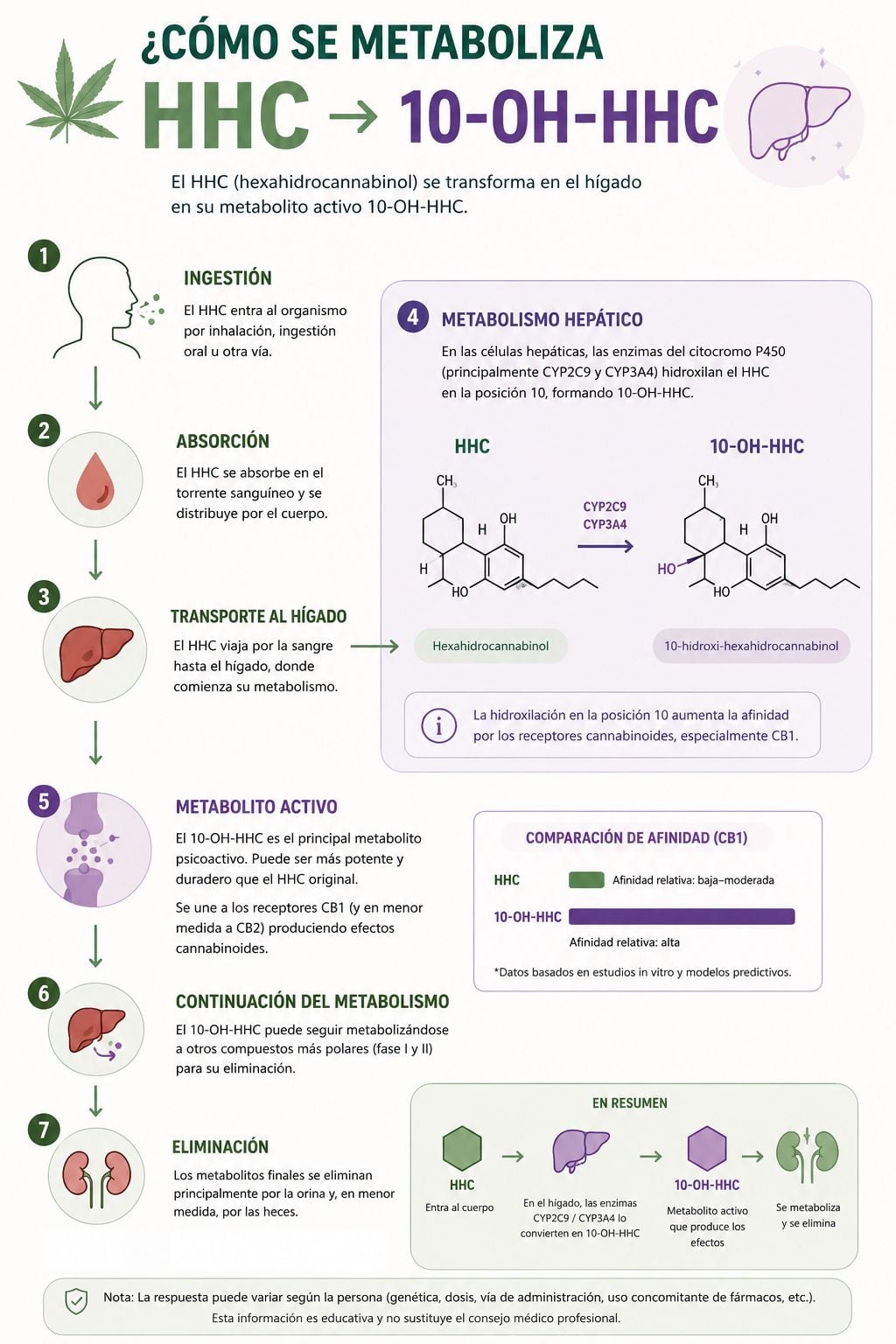
Standard drug tests are designed to detect 11-nor-9-carboxy-THC (THC-COOH), the main metabolite of tetrahydrocannabinol. HHC is metabolised in the liver into 11-hydroxy-HHC (11-OH-HHC) and 11-nor-carboxy-HHC (11-COOH-HHC), two molecules chemically very similar to the THC metabolites. The 47th WHO critical review on HHC (1) confirms that HHC metabolites show cross-reactivity with THC-COOH in immunoassays, so they can produce a “THC positive” result without any cannabis consumption.
In addition, according to the EMCDDA (now EUDA, 2023) technical report (3), products sold as “HHC” on the European market have been found to actually contain a mixture of HHC and THC because of unpurified starting materials. This multiplies the risk of a positive result even if the user believes they are only consuming HHC.
Important: HHC pharmacokinetics in humans are still being studied. The windows given below are estimates based on clinical THC data, preliminary HHC pharmacokinetic studies (2) and the WHO review (1) — they can vary by device, dose and individual metabolism.
Urine drug screening (workplace, sports, military)
Urine testing is the most common in workplace drug screenings (transport companies, construction, healthcare), sports settings (federations, WADA) and the military. It detects metabolites over days or weeks:
- Occasional user: estimated window of 3 to 7 days
- Frequent user (several times per week): estimated window of 7 to 14 days
- Chronic daily user: may exceed 30 days due to accumulation of fat-soluble metabolites in adipose tissue
In a controlled study with 25 mg of oral HHC and 95% inhaled HHC (2), a rapid urine test (DrugScreen®, cut-off 25 ng/mL of THC-COOH) returned a positive result during the first 10 hours even after a single low dose.
Saliva test (the one used by the DGT)
This is the test used by the DGT in roadside checks and some workplace anti-doping protocols (more detail in saliva test for THC and what to do if you test positive). It returns a result in minutes, but the evidence on HHC is mixed:
- The Schirmer et al. study (2) with the DrugWipe® 5S device (one of the most commonly used in DGT roadside checks, cut-off 5 ng/mL of THC) detected no cross-reactivity with HHC after controlled low doses
- Other laboratory immunoassays (CEDIA) did return a positive up to around 6 hours after ingestion and 4 hours after inhalation in the same study (2)
- High doses, repeated use or products containing residual THC can alter this result: if the product contains THC alongside HHC, a positive is very likely
In practice: even if the saliva drug-test device is not calibrated for HHC, traces of THC in the product alone (something common in Europe according to the EMCDDA) (3) are enough to trigger a positive at the roadside.
Blood test
Measures the active presence of the cannabinoid, not its metabolites. It is the test used as a confirmatory analysis after an initial positive in saliva. HHC has a short plasma half-life (~1.3–1.6 h according to the WHO review) (1):
- After acute use: detectable for 2–12 hours
- Chronic user: THC and its metabolites can persist for several days (data extrapolated; no HHC studies with sufficient sample size yet)
Hair test
The widest window. Detects use over the past 3 months (1 cm of hair ≈ 1 month of exposure). Used in forensic assessments, child custody cases and security-personnel screening. No specific protocols for HHC detection in hair have yet been published, but its metabolites share structure with those of THC and are assumed detectable by the same chromatographic methods.
HHC and DGT roadside checks: can I be fined?
In a routine DGT roadside check, the procedure is always the same: the Guardia Civil or local police first ask you to blow into an alcohol breathalyser, and if there is any suspicion they then apply a saliva test with a rapid device (Dräger DrugTest 5000, Securetec DrugWipe 5S or others) that screens for several substances: THC, cocaine, amphetamines, methamphetamines, opiates and benzodiazepines.
These devices are not calibrated to detect HHC directly. The Schirmer et al. study (2) with the DrugWipe® 5S observed no cross-reactivity after controlled low doses, suggesting that with pure HHC and moderate doses the rapid saliva test might not detect it. But there are three reasons why a positive result remains likely in practice:
- Almost all commercial HHC products in Europe contain residual THC according to the EMCDDA-EUDA report (3), and THC does trigger the device
- Repeated use or high doses: increase the likelihood of cross-reactivity through accumulated metabolite concentration
- Other devices different from the DrugWipe can have different cross-sensitivities (published evidence covers only a few devices)
The confirmatory laboratory analysis (gas or liquid chromatography coupled to mass spectrometry) can distinguish HHC from THC accurately, but that analysis takes weeks. In the meantime:
- Your driving licence is withdrawn on the spot if you test positive on the screening device
- Administrative proceedings begin (a fine of €1,000 + 6 licence points, under article 27 of the Spanish General Traffic Regulations (5))
- Recovering your licence and challenging the fine with a confirmatory analysis can take 6–12 months
Practical conclusion: if you use HHC products, do not drive. The risk of a positive in a DGT check is real (whether from residual THC or from high doses) and the administrative consequences are the same as with cannabis: licence loss and a fine. And since 23 April 2025, HHC and its derivatives have been banned in Spain by Order SND/380/2025 (4), so their consumption and possession add criminal liability on top of the administrative traffic sanction.
How long should I wait before driving after using HHC?
There is no official threshold because HHC was not covered by traffic legislation before 2025. As a safe reference, extrapolating from THC data and the preliminary HHC pharmacokinetic studies (2):
- Occasional use (1 vape, one gummy, one bud): a minimum of 24 hours
- Intense acute use (several doses in a row): 48–72 hours
- Regular use (several times per week): at least one week
These timeframes are indicative. If you have a scheduled check (licence renewal, occupational medical review, sports anti-doping), the prudent approach is to stop using HHC 30 days in advance and, if possible, request a confirmatory laboratory analysis to make sure the metabolite concentration is below the threshold.
10-OH-HHC: the metabolite that does show up (and why it matters)
10-OH-HHC (also known as 11-hydroxy-HHC) is the main metabolite of HHC in the human body. When you consume HHC, the liver transforms it into 10-OH-HHC, a molecule that is pharmacologically more active than HHC itself — comparable to the relationship between THC and its metabolite 11-OH-THC.
And this is the problem: 10-OH-HHC is chemically almost identical to 11-hydroxy-THC, the molecule that urine tests are specifically designed to detect. So even if HHC were 100% pure (with no residual THC), there would still be a high risk of a positive through metabolite cross-reactivity.
Other HHC derivatives with similar risk:
- HHC-P (hexahydrocannabiphorol) — a more potent analogue, even less studied
- HHC-O (HHC acetate) — an ester with reportedly more intense and longer-lasting effects
- 9-OH-HHC — another secondary metabolite
All of them share a molecular core with THC and all can generate metabolites detectable in urine. There is not yet enough clinical data on the exact detection windows for these compounds in humans, which adds uncertainty: any product containing HHC, HHC-P, HHC-O or their mixtures should be assumed potentially positive on a drug screening.
HHC, THC and CBD on a drug test: comparison
The three most discussed cannabinoids behave very differently in a drug screening:
Cannabinoid | Does it test positive? | Urine window | Legal status |
|---|---|---|---|
THC | Yes, definitely | 3–30 days depending on use | Banned |
HHC | Yes, high risk | Similar to THC | Banned since 2025 |
HHC-P / HHC-O | Yes, high risk | No clinical data | Banned / grey area by country |
Pure CBD | No at normal doses | — | Legal with THC <0.2% |
If you want to dig deeper into each case:
How long does HHC stay in the body?
The detection window depends on five factors:
- Frequency of use: occasional vs habitual can mean up to a fourfold difference
- Dose and concentration: a 1 g vape of 95% HHC ≠ a flower sprayed with variable concentration
- Route of administration: vaping or smoking is eliminated faster than oral gummies
- Individual metabolism: age, weight, body fat, hydration, liver function
- Product purity: if it contains residual THC, the window multiplies
Indicative summary (no definitive clinical data for HHC):
Type of test | Occasional use | Habitual use |
|---|---|---|
Saliva (DGT) | 6–24 h | 24–72 h |
Blood | 2–12 h | 24–48 h |
Urine (drug screening) | 3–7 days | 14–30 days |
Hair | up to 3 months | up to 3 months |
For reference, heavy cannabis users can test positive in urine for more than 30 days after stopping use, whereas a single exposure in non-users can be detected for up to 72 hours. HHC behaves in a similar way.
HHC risks: adulteration, legal status and adverse effects
The most concerning thing about HHC is not only its potential positive on a drug screening, but the open questions about its safety:
- Lack of control and dosing: HHC is produced at industrial scale without pharmaceutical standards. Amounts, purity and byproducts vary from batch to batch.
- Undeclared mixtures: according to the EMCDDA technical report (3), products labelled as “HHC” on the European market have actually been found to contain mixtures of HHC, THC, HHC-P or residual solvents.
- Reported adverse effects: mood alteration, anxiety and panic attacks (especially in first-time users), nausea, tachycardia, vomiting at high doses, psychological dependence with continued use.
- Banned across much of Europe: France (2023), Germany (2024), Spain (23 April 2025, Order SND/380/2025) (4), Italy, Austria, Belgium, Denmark, Switzerland and others have banned or restricted it between 2023 and 2025. The Spanish decision aligns with the inclusion of HHC in Schedule II of the 1971 Convention on Psychotropic Substances by the UN Commission on Narcotic Drugs (March 2025).
Frequently asked questions about HHC and drug tests
Can I test positive from passive exposure to HHC smoke?
Very unlikely, but not impossible. Passive exposure to regular cannabis smoke only produces a positive result in extreme conditions (small, unventilated spaces, prolonged exposure to dense smoke) and with low laboratory cut-offs. The same rule applies to HHC: the metabolite concentration absorbed passively rarely exceeds the detection threshold of a standard urine test (25–50 ng/mL of THC-COOH). On a saliva or blood test, traces could appear for a few hours if the exposure was intense.
Will HHC show up on a routine medical blood test (not a drug screening)?
No. A routine occupational or private-insurance blood panel (CBC, biochemistry, lipid profile, liver function) does not screen for cannabinoids. These analyses are only requested in specific contexts: an occupational medical review with an anti-doping clause, sports anti-doping, a forensic assessment, military intake or treatment in an addiction unit. Unless the doctor specifically orders a toxicology screening, HHC will not appear on the report.
Is HHC legal in Spain?
No. On 23 April 2025 Order SND/380/2025 (4) entered into force, adding HHC and its derivatives (HHC-O, HHCP, THCP, THC-O, H4-CBD, among others) to Schedule II of psychotropic substances under Royal Decree 2829/1977. Their manufacture, sale, possession and recreational use are banned, joining Spain to France (2023), Germany (2024), Italy, Austria, Belgium, Denmark and other European countries.
References
- World Health Organization. Hexahydrocannabinol (HHC) — Critical Review Report. Expert Committee on Drug Dependence, 47th meeting, 2024. Available at cdn.who.int (PDF).
- Schirmer M, et al. Preliminary pharmacokinetic and psychophysical investigations after controlled oral and inhalative consumption of hexahydrocannabinol (HHC). Forensic Toxicology, 2024. Available at PubMed Central, PMC11933371.
- European Monitoring Centre for Drugs and Drug Addiction (EMCDDA, now EUDA). HHC and related substances — Technical report. Luxembourg: Publications Office of the EU, 2023. Available at emcdda.europa.eu.
- Spanish Ministry of Health. Orden SND/380/2025, de 14 de abril, por la que se actualizan los anexos del Real Decreto 2829/1977, de 6 de octubre, por el que se regulan las sustancias y preparados medicinales psicotrópicos. Spanish Official Gazette (BOE) no. 96, 22 April 2025. Available at BOE-A-2025-8109.
- Real Decreto 1428/2003, de 21 de noviembre, approving the Spanish General Traffic Regulations. BOE no. 306, 23 December 2003. Consolidated text available at BOE — Spanish General Traffic Regulations.


