
CBD has gained popularity for its benefits on the sense of well-being, standing out for its absence of psychoactive effects, no addictive potential, and few mild adverse effects. In this context, the CBD market is filling up with products containing a new synthetic cannabinoid, H4CBD (hydrogenated CBD, or tetrahydrocannabidiol, THD), which is said to share properties with CBD but with a slight psychoactive effect.
This article explains the differences and similarities between CBD and H4CBD, whether it is true that they share properties, and the key aspects of their effects and safety based on current evidence.
What are CBD and H4CBD?
CBD (cannabidiol)
Cannabidiol (CBD) is one of the most abundant medicinal compounds in cannabis, widely studied by science and with numerous proven benefits. It has anti-inflammatory, analgesic and anxiolytic properties, and unlike other cannabinoids, does not produce mental effects or a “high”.
The CBD market covers a broad range of products: from CBD flowers, to CBD oils, CBD relief creams, CBD cosmetics and CBD vaping products. This compound is so versatile and multifaceted that it has proven effective in a wide range of cases.
H4CBD (hydrogenated CBD)
On the other hand, H4CBD — also called hydrogenated CBD, or tetrahydrocannabidiol (THD) — is a synthetic cannabinoid produced chemically through the hydrogenation of CBD, which does not occur naturally in the plant. Through a chemical process, CBD is modified to produce effects different from those of CBD, including a mild psychoactive effect that CBD does not have. H4CBD is added to CBD flowers, hash and all kinds of vaping products.
The main difference between CBD and H4CBD
The main difference lies in their origin, molecular structure and resulting effects. CBD is a cannabinoid of natural origin that acts through known mechanisms and does not produce mental effects.
By contrast, H4CBD is a chemically modified form of CBD that appears to bind to CB1 receptors in the brain, producing a slight psychoactive effect. However, the mechanisms by which H4CBD acts are still unknown.
Effects of CBD vs effects of H4CBD
CBD has anxiolytic and relaxing effects. It can also influence pain perception and sleep quality. These effects can be more or less pronounced, varying widely between individuals and depending on the dose. Some people feel an effect with very small amounts, while others need a higher dose to achieve the same sensation. All of this without producing alterations in perception or psychoactive effects.
Although H4CBD is marketed as having effects similar to CBD, it has not been shown to share the same properties as CBD, and its effects and safety remain unknown.
H4CBD has no therapeutic or medicinal uses, and the only effects attributed to it come from anecdotal user reports. It is promoted as having a relaxing and euphoric effect, without causing too much of a “high”. H4CBD seems to interact with the endocannabinoid system in a different way to CBD, resulting in a mild psychoactive effect. The truth is that data are very scarce, and its effects and safety profile are not yet fully understood.
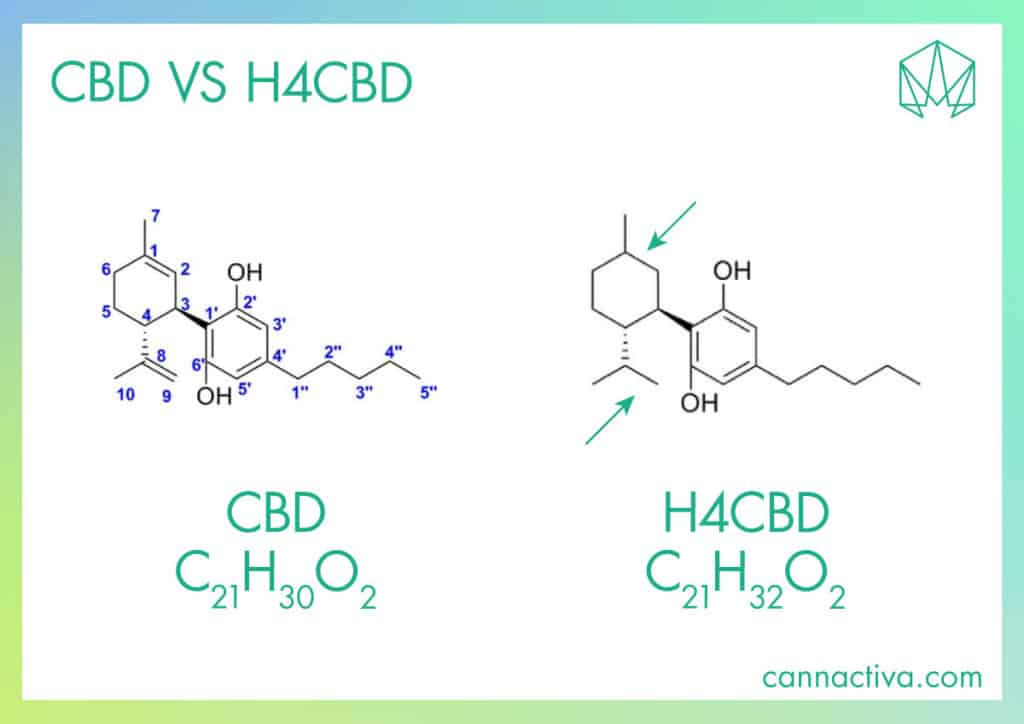
CBD vs H4CBD: Differences in how they are obtained
While CBD is a cannabis extraction or hemp extract, preserving its natural structure, H4CBD is obtained through the chemical modification of CBD, adding hydrogen to its molecular structure to alter its properties and effects.
Is H4CBD psychoactive? The key difference with CBD
The key distinction between CBD and H4CBD lies in their effects: CBD is non-psychoactive and has approved medicinal, cosmetic and therapeutic uses, which vary depending on the country but are generally widely recognised by the scientific community.
By contrast, H4CBD has psychoactive potential. It has gained popularity precisely for these effects and is sold as a “legal” compound that produces a high. It has reached great popularity despite presenting several question marks regarding its safety.

Is H4CBD legal? Regulation of CBD and H4CBD
The CBD has a clear regulatory framework in most European countries: it is permitted in cosmetics, food and medicinal products (varying by country), provided that the THC content is below 0.3% and no therapeutic claims are made without authorisation.
The H4CBD has moved from a legal grey area to outright prohibition in several countries. In Spain, Order SND/380/2025 (BOE of 22 April 2025) included it in the list of controlled psychotropic substances, alongside HHC and THCP: since 23 April 2025 its manufacture, import, distribution, sale and possession are prohibited outside authorised medical or scientific use. France acted ahead in June 2024, classifying H4CBD as a narcotic, and Germany, Austria and Hungary have adopted equivalent restrictions for semi-synthetic cannabinoids. At European Union level there is no harmonised ban — each Member State legislates independently — but the EUDA (European Union Drugs Agency) monitors these compounds through its Early Warning System, and the trend is to close the market.
Which is better, CBD or H4CBD?
With this information at hand, everyone is free to choose between CBD and H4CBD. For those who do not want to feel any alteration in their mental state, CBD is undoubtedly the preferred option.
H4CBD is marketed as a psychoactive alternative with milder effects than THC and sold as “legal” (more precisely, unregulated). It is an option for those who want to explore new effects within the cannabinoid spectrum, although it should be borne in mind that it is not a fully safe product (it has not been studied).
In terms of safety, the safest compound is CBD or cannabidiol, with known effects and a wide safety profile, and no psychoactive effects.
Conclusions: CBD or H4CBD, which one to choose?
CBD and H4CBD are two completely different compounds. They differ in their origin, effects and safety. CBD is a regulated and well-known compound, while H4CBD is a synthetic product with very limited data and barely known effects. It appears to have psychoactive effects, and has not been shown to share the same properties as CBD.
At Cannactiva we are committed to continuing to bring you the best CBD flowers in Europe, grown to organic standards and free from any synthetic additive. Because true excellence can only be the work of nature!
Sources
- Collins A, Ramirez G, Tesfatsion T, Ray KP, Caudill S, Cruces W. Synthesis and Characterization of the Diastereomers of HHC and H4CBD. Natural Product Communications. 2023;18(3). https://doi.org/10.1177/1934578X231158910
- Ben-Shabat, S., Hanus, L. O., Katzavian, G., & Gallily, R. (2006). New cannabidiol derivatives: synthesis, binding to cannabinoid receptor, and evaluation of their antiinflammatory activity. Journal of medicinal chemistry, 49(3), 1113–1117. https://doi.org/10.1021/jm050709m
- Tesfatsion, T., Ramirez, G., Collins, A., Ray, K., & Cruces, W. (2022). Evaluation of In-Vitro Cytotoxicity, Genotoxicity and Cardiac Safety of Hydrogenated Cannabidiol on Cells Using Metabolic Assay, AMES and hERG Test. PREPRINT (Version 1). https://doi.org/10.21203/rs.3.rs-2256889/v1


