Decarboxylation: Cannabinoid activation and terpene retention

Have you ever wondered why cannabis needs to be heated before consuming it, whether you smoke it, vaporise it or cook with the plant? The answer lies in a process called decarboxylation, which is triggered by heat and transforms cannabinoids into their most active forms, such as THC and CBD.
In this article you'll learn the chemistry behind joints and marijuana recipes, and understand why heating these compounds properly optimises your cannabis experience. It all begins in the plant, where the biosynthesis of cannabinoids takes place; here we focus on the next step: their activation through heat.
The 3 key takeaways
- Decarboxylation is the reaction that, with heat, converts acidic cannabinoids (THCA, CBDA) into their active forms (THC, CBD).
- For CBD, around 140 °C for 30 minutes; for THC, around 160 °C for 20 minutes; at 150 °C for 20 minutes both are activated in a balanced way.
- Terpenes are volatile and are lost with heat: gentle, controlled heating better preserves aroma and flavour.
What is the decarboxylation of cannabinoids?
In the cannabis world, decarboxylation is well known because it is a chemical process through which cannabinoids go from their acidic form to their neutral form, which is the one that exerts the greatest effects on the body.
Why does cannabis need to be decarboxylated?
The cannabis plant produces acidic cannabinoids, denoted by an “A” in the nomenclature. Some examples of acidic cannabinoids are tetrahydrocannabinolic acid (THCA) and cannabidiolic acid (CBDA). Acidic cannabinoids have no psychoactive properties and few therapeutic properties until they are converted into their neutral form through the chemical process of decarboxylation.
How does the decarboxylation of cannabinoids happen?
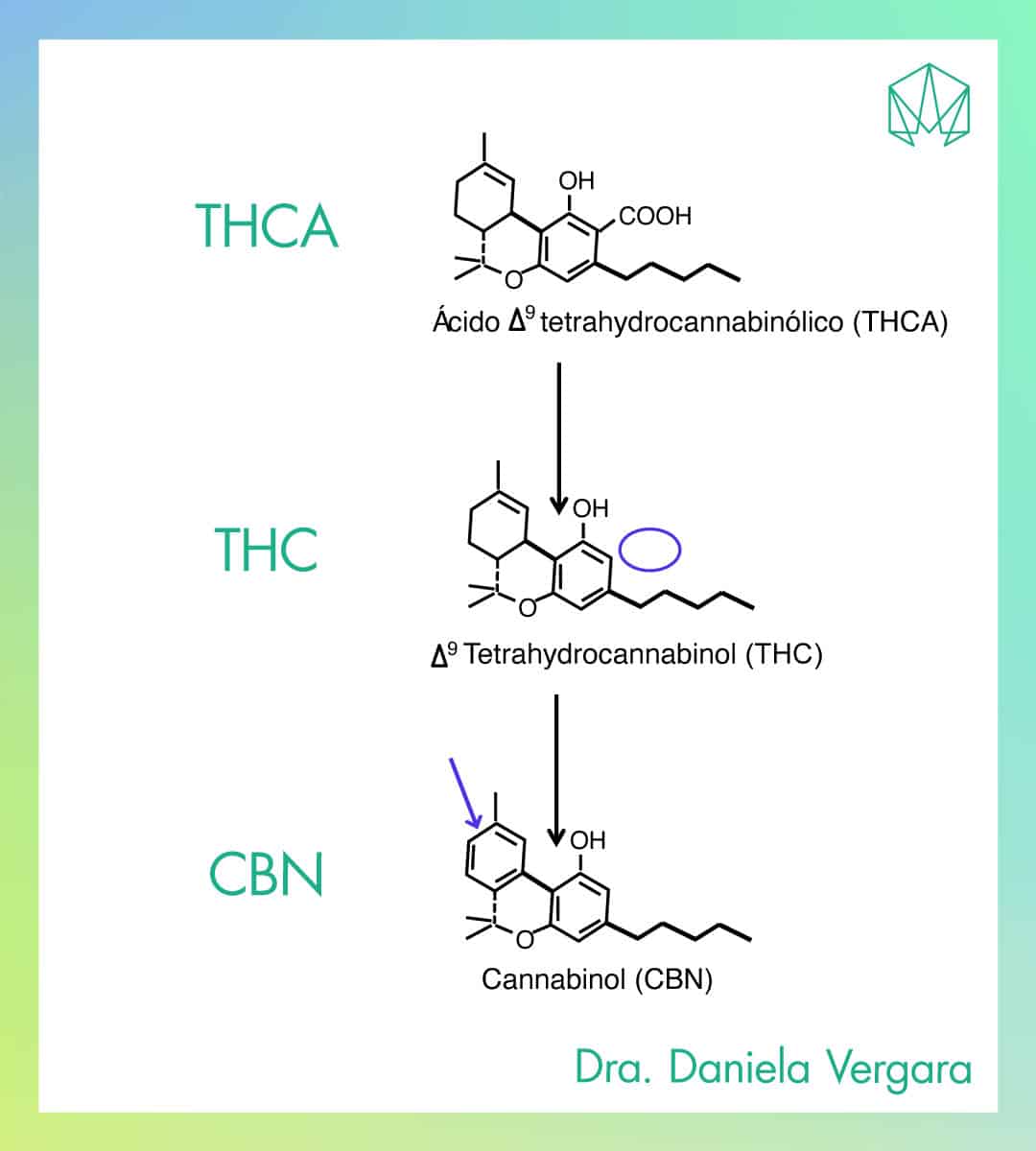
Decarboxylation can happen naturally over time, or it can be sped up by applying heat [1]. The most universal way to decarboxylate cannabis is the joint. During the combustion of marijuana, heat converts THCA into tetrahydrocannabinol (THC), the compound we inhale and the one responsible for the psychoactive effects. The same process occurs when the CBDA in CBD flowers is heated, turning into cannabidiol (CBD) after decarboxylation.
In this decarboxylation process, where one of the products is CO2 (carbon dioxide), cannabinoids lose part of their mass. For example, THCA loses 12% of its weight when it converts to the neutral form THC [2].
Cannabinoid degradation: compounds derived from cannabinoids
There are other compounds that can form in the plant when cannabinoids are decarboxylated. These are not produced by decarboxylation itself, but from neutral cannabinoids and through exposure to air or light, via other chemical changes such as oxidation.
CBN – Cannabinol
Thus, once decarboxylated, THC can oxidise to become cannabinol (CBN), which has fewer hydrogen atoms and therefore more double bonds between its carbons. CBN has been studied for its sedative properties and appears to be less psychoactive than THC.
This degradation can also lead CBD to convert into THC (delta-9-THC), or THC to oxidise into CBN or into delta-8-THC (an isomer of THC) [1], before these compounds are consumed.
Now, the million-dollar question: can this step happen inside the body, and if I take CBD, could I test positive for THC? The answer is no — this step occurs outside the body. Although there is no conclusive scientific evidence, taking CBD does not usually lead to a positive THC test; however, because cannabis products contain so many compounds, there may be traces of THC that result in a positive reading.
Delta-8-THC – Delta-8 tetrahydrocannabinol
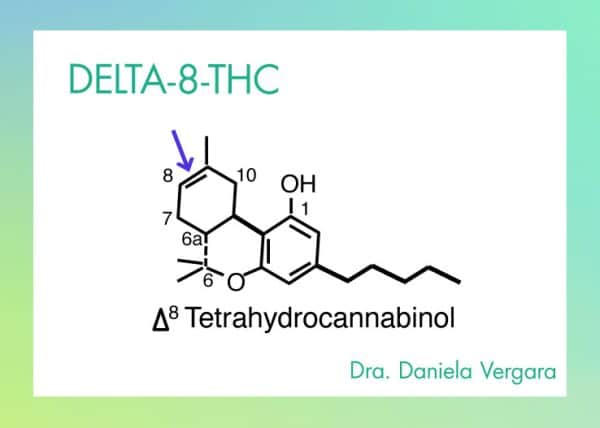
Delta-8-THC is another cannabinoid that has gained fame recently: it has a double bond between carbons eight and nine, whereas delta-9-THC has it between carbons nine and ten.
What happens to terpenes during decarboxylation?
One of the problems during the decarboxylation of cannabinoids is the loss of terpenes, compounds present in cannabis that contribute significantly to its aroma and flavour (and which should not be confused with cannabinoids: here we explain the difference between cannabinoids and terpenes). Terpenes are volatile, meaning they evaporate easily at high temperatures, and this can cause them to be lost during the decarboxylation process [3].
Some terpenes evaporate at temperatures as low as 20 °C, although the boiling point of some monoterpenes is between 155–276 °C and that of some sesquiterpenes between 282–314 °C [6].
Controlled heating is the simplest way to promote decarboxylation, preserve the highest terpene content and avoid cannabinoid degradation. One of the advanced methods that better preserves terpenes is supercritical CO2 extraction, which uses temperatures between 40 and 60 °C.
Other compounds that form during heating
In cannabis extractions it has been found that the sum of the concentrations of THCA + THC + CBN is not constant, dropping to 78% after 60 minutes at 160 °C. This is similar for other cannabinoids such as CBDA and CBGA, since in both cases the sum of their acidic and neutral forms falls by more than 90% after 60 minutes at 160 °C. This suggests that as-yet-unidentified products may form during heating, in addition to the evaporation of the neutral forms at high temperatures [4]. To quantify these changes in the laboratory, cannabinoid testing is used.
Time and temperature for decarboxylation
The kinetics of decarboxylation, which refers to the rate and proportion of the chemical reactions taking place, has been studied under different conditions of temperature and time.
The time–temperature pairing is crucial, as it affects the speed of conversion, terpene loss, cannabinoid degradation and, therefore, the quality of the final product. Raising the temperature makes decarboxylation happen faster, but it can also increase the loss of volatile terpenes.
Decarboxylation follows first-order kinetics [4], which means the reaction rate is proportional to the concentration of the reactant. In other words, the amount of neutral cannabinoids produced (such as CBD or THC) is proportional to the amount of acidic cannabinoids (such as CBDA or THCA) present in the original sample.
At what temperature should cannabis be heated to obtain cannabinoids in their neutral form?
When the cannabis sample is subjected to high temperatures (approximately 160 °C), there can be a greater loss of cannabinoids, which can be minimised if it is done in the absence of oxygen [4].
The optimal temperature for decarboxylation has been found to be around 200 °C for a short time of 3 minutes. At lower temperatures, below 80 °C, the conversion from the acidic to the neutral form is slower, and this rate increases as the temperature rises.
The conversion of THCA to THC is faster than that of CBDA to CBD or CBGA to CBG [4]. At 120 °C, THCA decarboxylates completely after 90 minutes [4], whereas CBDA takes about an hour [5]. At a slightly higher temperature of 160 °C, only 20 minutes are needed to fully decarboxylate THCA [4], while at 140 °C CBDA converts into CBD in 30 minutes [5].
To decarboxylate the maximum amount of CBD, you can heat the cannabis at 140 °C for 30 minutes. Under these conditions, CBDA converts into CBD.
To avoid the build-up of CBN, it is important to carry out the conversion of THCA to THC at 120 °C for one hour, or at 105 °C for 1–2 hours [5].
To decarboxylate the maximum amount of THC, you can heat the marijuana at 160 °C for 20 minutes. In this case, THCA decarboxylates completely, turning into THC.
According to other assessments, at 150 °C for 20 minutes, approximately 63% of the CBDA converts into CBD, 86% of the THCA into THC and 63% of the CBGA into CBG [3].
If you want to decarboxylate the maximum amount of CBD and THC together in a single cannabis sample, you need to find a balance.
Based on the data above, at 150 °C for 20 minutes you see the conversion of approximately 63% of the CBDA to CBD, 86% of the THCA to THC and 63% of the CBGA to CBG. These conditions can be a good starting point for a reasonable decarboxylation of the three main cannabinoids.
Vaporisation temperatures
The boiling point of THC is around 157 °C, while that of CBD is in the range of 160–180 °C [4]. This is relevant for anyone who wants to vape CBD and cannabis, as these cannabinoids can be released and inhaled at the right temperatures.
And now that you know what decarboxylation is… we hope you understand why, whenever you want to obtain the properties of cannabis, it is heated, whether as a joint or in recipes, such as the now legendary marijuana brownie.
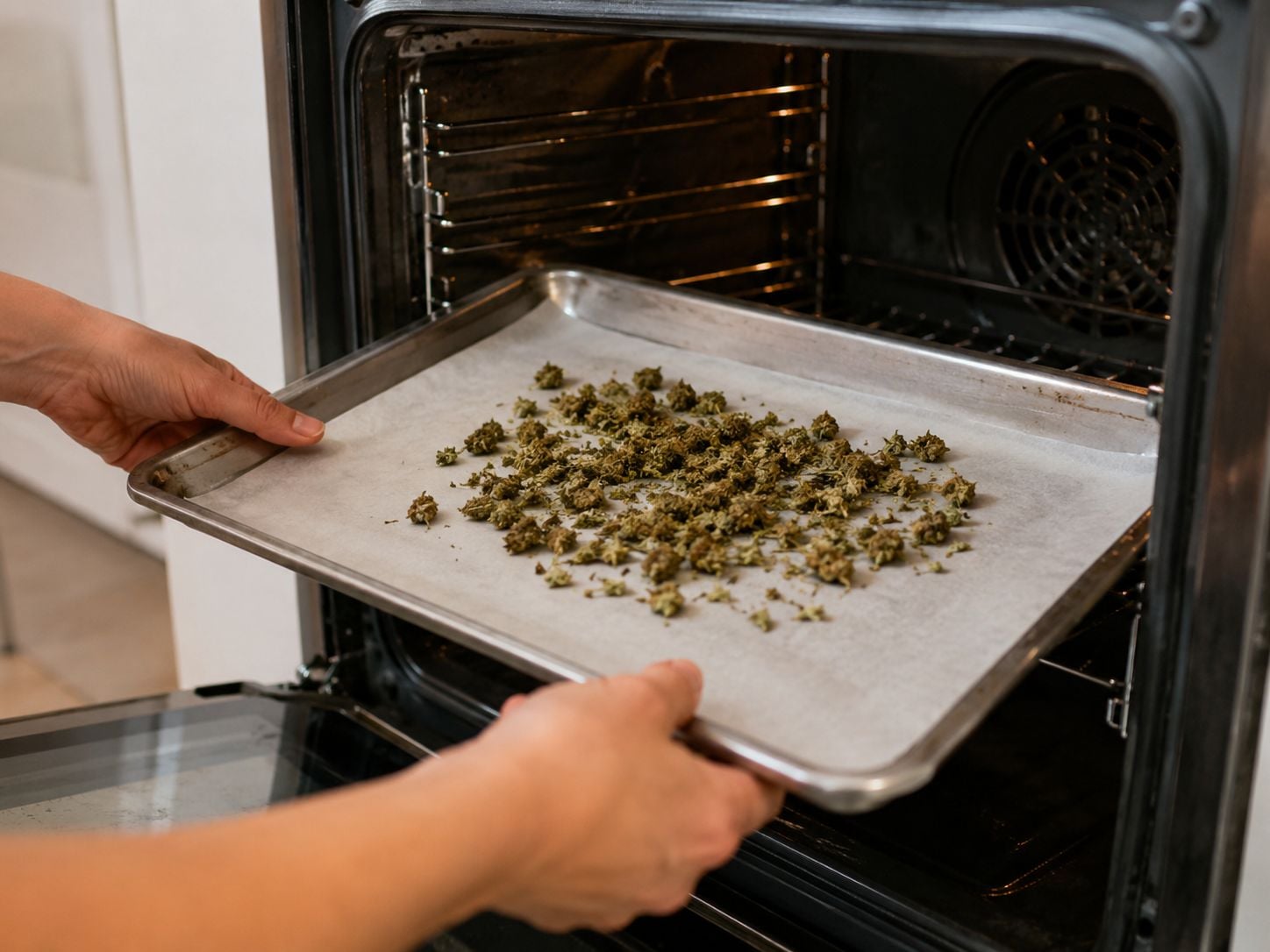
But the topic doesn't end here. You may be wondering: what is the best method to decarboxylate and extract cannabinoids? Marijuana can be heated in a home oven or in laboratories with sophisticated extraction equipment. This is how extracts and preparations such as marijuana butter are obtained.
Frequently asked questions
Does CBD decarboxylate when smoking or vaping?
Yes. The combustion of a joint and the heat of a vaporiser instantly decarboxylate CBDA into CBD (and THCA into THC), so there's no need to heat the flower before smoking or vaping it.
At what temperature does CBD decarboxylate in the oven?
Around 140 °C for 30 minutes converts almost all of the CBDA into CBD. Raising the temperature speeds up the process, but it evaporates more terpenes and can degrade some of the cannabinoids.
Does decarboxylation destroy terpenes?
Partly. Terpenes are volatile and begin to evaporate at low temperatures, so gentle, controlled heating better preserves the aroma and flavour of the cannabis.
Do you need to decarboxylate the flower before making oil or butter?
Yes, if you're going to infuse it into fat to eat. Without prior heating, the acidic forms (CBDA, THCA), which are less active, predominate, so prior decarboxylation is key in edible recipes.
References
- Grijó, D.R., I.A.V. Osorio and L. Cardozo-Filho. Supercritical extraction strategies using CO2 and ethanol to obtain cannabinoid compounds from Cannabis hybrid flowers. Journal of CO2 Utilization, 2018. 28: p. 174-180.
- Valizadeh Derakhshan, M., et al. Extraction of cannabinoids from Cannabis sativa L. (Hemp). Agriculture, 2021. 11(5): p. 384.
- Moreno, T., et al. Extraction of cannabinoids from hemp (Cannabis sativa L.) using high pressure solvents: An overview of different processing options. The Journal of Supercritical Fluids, 2020. 161: p. 104850.
- Moreno, T., P. Dyer and S. Tallon. Cannabinoid decarboxylation: a comparative kinetic study. Industrial & Engineering Chemistry Research, 2020. 59(46): p. 20307-20315.
- Qamar, S., et al. Extraction of medicinal cannabinoids through supercritical carbon dioxide technologies: A review. Journal of Chromatography B, 2021. 1167: p. 122581.
- Eyal, A.M., Berneman Zeitouni, D., Tal, D., Schlesinger, D., Davidson, E.M. and Raz, N. (2022). Vapor pressure, vaping, and corrections to misconceptions related to medical cannabis' active pharmaceutical ingredients' physical properties and compositions. Cannabis and Cannabinoid Research.


