
Both CBD and THC are the two main cannabinoids in the cannabis plant, and their fundamental difference lies in their effect on the nervous system: THC is psychoactive — it produces the altered perception and euphoric state associated with marijuana use — whereas CBD is not and does not alter consciousness. The two even share the same chemical formula, but their different molecular arrangement means they act differently in the body.
This difference is also what distinguishes marijuana from CBD flowers: while marijuana buds can concentrate between 10% and 30% THC, the hemp that CBD flowers come from contains a THC percentage below 1% (1).
Throughout this guide we analyse how these two compounds differ and how they are alike — molecular structure, mechanism of action, effects, applications and the legal framework in Spain and Europe — starting with a comparison table that sums up their main differences at a glance.
CBD vs THC: comparison table at a glance
CBD | THC | |
|---|---|---|
Gets you high? | No | Yes |
CB1 receptor | Doesn't activate it | Activates it |
Plant | Hemp | Marijuana |
Legality (EU) | Legal (≤0.3% THC) | Restricted |
Uses under research | Anxiety, epilepsy, inflammation | Pain, appetite, nausea |
Side effects | Mild | More marked |
Drug test | Negative | Positive |
CBD and THC: two compounds from the same plant
The cannabis plant (Cannabis sativa L.) contains hundreds of different chemical compounds. Of these, the best known are the cannabinoids, and among them the most studied are tetrahydrocannabinol (THC) and cannabidiol (CBD).
THC and CBD are similar in that both can interact with our endocannabinoid system, but because they do so in very different ways, one produces a psychoactive effect and the other does not. For the same reason, one is considered an illegal drug and the other is legal, among many other differences.
What is THC (tetrahydrocannabinol)?
THC or tetrahydrocannabinol is the cannabinoid that generates the psychoactive effect, or high, of marijuana. It is credited with some therapeutic properties, but above all it is responsible for the effect used recreationally and for the strict legal restrictions cannabis has faced throughout its history.
Precisely because of this psychoactive character, THC is classified as a narcotic substance: it appears on the international drug-control schedules and its recreational use is not permitted. This is the major legal difference with CBD, which is not considered a narcotic and can be marketed within the THC limits we will see below.
What is CBD (cannabidiol)?
CBD or cannabidiol is a cannabinoid found mainly in the hemp plant, and the second most abundant in marijuana, after THC. It is one of the most studied cannabinoids — alongside THC — for its potential therapeutic or medicinal applications, with one key difference: unlike THC, CBD does not produce a psychoactive or intoxicating effect in the body. In other words, CBD does not get you high.
In fact, the World Health Organization (WHO), in its 2018 review report, concluded that CBD has a good safety profile, is generally well tolerated and shows no signs of abuse or dependence potential (2).
What are the differences between CBD and THC?
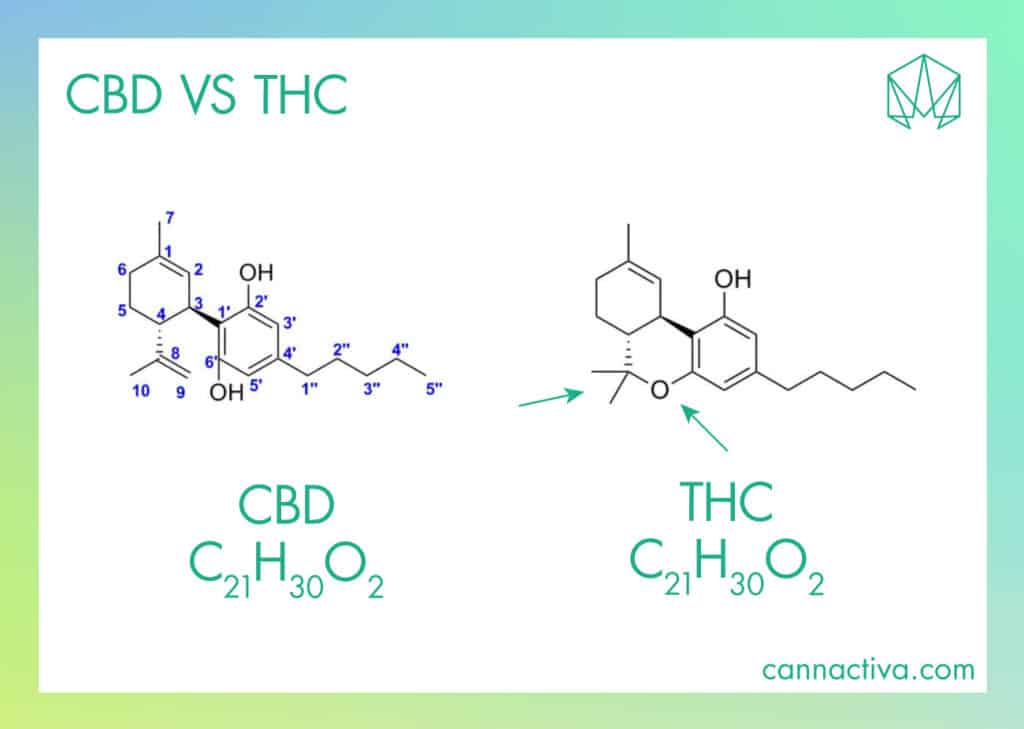
CBD and THC are two cannabinoids that differ in many respects. They differ in the shape of their molecule — although their number of atoms is identical —, interact differently with the endocannabinoid system and, consequently, also show different effects.
Molecular differences between CBD and THC
In terms of their molecular structure, both CBD and THC have the same molecular formula; that is, both are made up of 21 carbons, 30 hydrogens and 2 oxygens. What makes them different is the arrangement of all the atoms that make up the CBD and THC molecules. Thus, CBD has a linear structure with a hydroxyl group (-OH) at the end, while THC has a cyclic ring in place of that hydroxyl group.
Although it may seem a minor chemical detail, this small difference in their molecular arrangement means that CBD and THC have a different affinity for the cannabinoid receptors and, therefore, interact differently with them, giving rise to different effects.
What differences are there between CBD and THC in terms of effects?
THC and CBD interact differently with the receptors of the endocannabinoid system, which results in different effects.
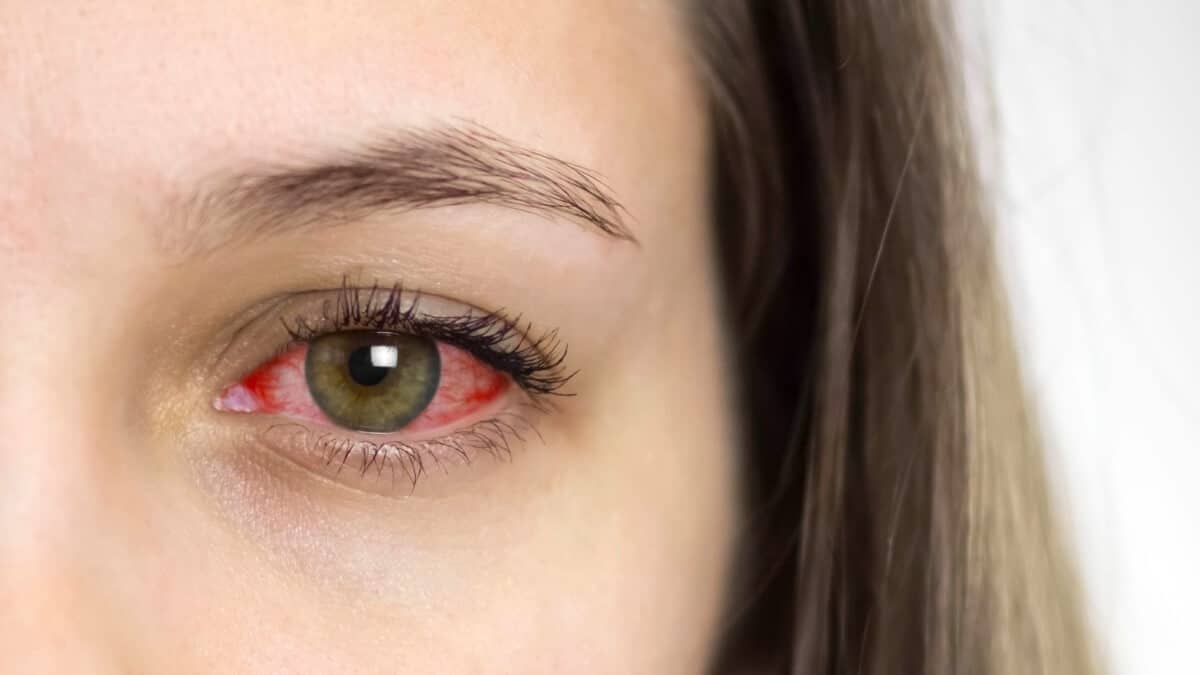
THC binds to the CB1 cannabinoid receptor and fully activates it (what is known as full agonism). These CB1 receptors, to which THC binds, are very abundant in the brain and are also present in the blood vessels. That is why, when smoking marijuana, THC produces both its psychoactive effect and the dilation of the blood vessels — including those of the eye —, which explains the characteristic red eyes from smoking marijuana.
Does CBD reduce the effect of THC?
CBD, on the other hand, binds in a different way: it does not activate the receptor but reduces its activity and makes it harder for other substances — such as THC — to attach to it (technically, it acts as an inverse agonist and negative allosteric modulator of CB1 and CB2) (3). That is why it exerts its effects differently.
In other words, THC binds to and activates the mechanisms linked to the CB1 cannabinoid receptor, such as the psychoactive effects; CBD binds differently and, although it does not activate it, prevents other compounds from attaching to this receptor in order to avoid its activation. For this reason, CBD attenuates the psychoactive effects of THC. If you want to go deeper into this point, we explain it in detail in does CBD diminish the effect of THC?.
The brain and central nervous system contain a large number of CB1 receptors (4). This abundance explains two opposite effects: on the one hand, it gives CBD many points on which to act to modulate different bodily functions; on the other, it is the very reason why THC, by activating those receptors, produces its psychoactive effect in the brain.
Differences in the metabolism of CBD and THC
Both CBD and THC are metabolised in the liver, but in different ways.
When THC is processed in the liver, it is transformed into another active compound (a metabolite) called 11-hydroxy-THC (7), which is more potent than THC itself and produces strong psychoactive effects, because it binds more strongly to the cannabinoid receptors of the brain. THC and its derivatives are eliminated from the body through urine and faeces.
On the other hand, when CBD reaches the liver, it is transformed into several inactive compounds (inactive metabolites), which are eliminated from the body mainly through urine.
This difference is important in one very specific case: drug tests detect THC and its metabolites, not CBD. That is why pure CBD does not usually test positive, although it is worth knowing the nuances, which we explain in does CBD test positive for drugs?.
Uses of CBD and potential benefits
Beyond the endocannabinoid system, CBD also interacts with other receptors in the body: the serotonin receptors (5-HT1A), linked to mood, and the pain and temperature receptors (the vanilloid TRPV1 receptors) (5, 6). For this reason, its potential role in regulating mood, easing anxiety and reducing inflammation is being researched. We go deeper into each case in our guides on CBD for anxiety, CBD for chronic pain and CBD for sleep, as well as a general overview of the benefits of CBD for wellbeing. And to see how each format is used, check our guide on how to use CBD. THC, on the other hand, does not act on these receptors and has been linked to undesirable effects.

Applications and side effects of CBD and THC
What are the differences between the applications of CBD and THC?
CBD and THC have different potential therapeutic uses.
Applications of CBD
CBD has neuroprotective, anti-inflammatory and antioxidant effects, which is why it is being researched as support in multiple sclerosis (8), Alzheimer's disease (9) and Parkinson's disease (10), as well as autism.
Applications of THC
THC, on the other hand, is studied to relieve chronic pain, stimulate appetite or as a palliative treatment in patients with cancer (11); you can see what science says about the benefits of THC.
What differences are there between the side effects of CBD and THC?
In general, if we compare CBD vs THC, CBD has milder side effects than THC. We review them in detail in our guide on the side effects of CBD.
CBD can cause diarrhoea, fatigue, vomiting and drowsiness (12), but this is most likely due to the drug-drug interaction that occurs when it is used as a complementary therapy. To date, no serious adverse effects resulting from the standalone use of CBD are known. A 2026 meta-analysis in healthy adults confirmed this good tolerability profile and noted diarrhoea as the most frequent side effect (13).
THC produces alterations of consciousness or perception that lead to problems with coordination and judgement. In addition, THC can cause alterations in the formation of neural connections, which may lead to impaired memory and learning (12). Likewise, THC can also trigger anxiety and paranoia (14).
Hemp vs marijuana: where does each come from?
Although CBD and THC come from the same species, they do not come from the same plant. THC predominates in marijuana, the cannabis varieties selected to maximise their psychoactive content. CBD predominates in hemp, the variety grown with residual THC. In practice, the legal boundary between the two is precisely that THC percentage: below the legal limit we speak of hemp; above it, of marijuana.
This distinction is the basis of the entire CBD market: legal products in Europe start from hemp, not from marijuana. We develop this in differences between hemp and marijuana, and you can see all the variants in our guide to the types of marijuana.
THC:CBD ratios and types of CBD oil: full spectrum, broad, isolate
In the plant, THC and CBD never appear completely isolated: there is a natural proportion between the two. By working with that genetics, different THC:CBD ratios are obtained: a 2:1 ratio (more THC than CBD) tends towards more psychoactive effects; a 1:1 ratio is associated with a more balanced profile. It is one of the concepts that best explains why two cannabis products can feel so different.
In CBD products this translates into three types of extracts in CBD oils: full spectrum (the complete spectrum, with all the cannabinoids including a legal trace of THC), broad spectrum (the broad spectrum, without THC) and isolate (CBD only). The choice depends on whether you are looking for the so-called entourage effect — the idea that cannabis compounds act in synergy — or want to avoid THC entirely (15). You have the in-depth comparison in full spectrum vs broad spectrum vs isolate.
If you are going to buy a CBD oil, this type of extract is one of the keys to getting it right, along with the extraction method, the certificate of analysis (CoA) and the concentration. We develop this step by step in our guide to buying the best CBD oil.
And what about CBN? CBD vs THC vs CBN
Alongside CBD and THC, you increasingly hear about CBN (cannabinol). It forms when THC ages and oxidises, has very low psychoactivity and is studied mainly for its relaxing profile. It is not the focus of this guide, but it is worth placing it on the map: CBD, THC and CBN are three different pieces of the same puzzle.
Legality of CBD and THC in Spain and Europe
In Europe, legality revolves around the THC percentage. European regulation sets the limit for industrial hemp at 0.3% THC: below that threshold, hemp and its derivatives are not considered a narcotic. Some countries are more flexible and allow up to 1% THC.
The key legal piece is the ruling of the Court of Justice of the EU in the Kanavape case (C-663/18, 2020): it established that CBD is not a narcotic and protects its free movement in the EU, so that a Member State may only restrict it with scientific proof of risk. In Spain, the framework is completed by RD 903/2025.
That said, the fact that CBD is legal does not mean that all its forms of consumption are: it is not regulated for smoking or for oral consumption in every country. The permitted route of use (topical, sublingual, oral or smoked) depends on each country's legislation, as we explain in our guide on how to consume CBD.
THC, by contrast, remains regulated as a psychoactive substance: its recreational use is not permitted in every country, and its medicinal use is restricted to specific medicines under prescription.
Similarities between CBD and THC
CBD and THC come from the same plant
Yes, CBD and THC come from the Cannabis sativa plant. Nevertheless, depending on the cannabis variety, CBD and THC will be found in different concentrations.
Although CBD and THC were originally isolated from the cannabis plant, they can also be produced synthetically in the laboratory. These are what we know as synthetic cannabinoids.
Are CBD and THC similar?
Their similarities are very general: for example, CBD and THC share their origin, being cannabinoids of the cannabis plant. Both have therapeutic effects which, although they occur through different pathways, have the potential to provide relief from some conditions.
On the other hand, both have side effects; although they are much more evident with THC, both can cause dizziness, tiredness, diarrhoea and changes in appetite (16).
Another similarity is that CBD and THC both have effects on the brain, due to the concentration of cannabinoid receptors in the central nervous system.
Frequently asked questions about CBD vs THC
Does CBD get you high like THC?
No. CBD is not psychoactive: it does not produce the “high” nor alter perception. In fact, it can attenuate part of the psychoactive effects of THC.
Are CBD and THC the same thing?
No. They are two different cannabinoids from the same plant. They share a chemical formula, but their atomic arrangement differs and, above all, they act in opposite ways on the CB1 receptor: THC activates it (psychoactive effect) and CBD does not.
Do CBD products contain THC?
They may contain legal traces of THC (below the legal limit), because they come from the whole plant. Broad spectrum products and CBD isolates are formulated without THC.
Which is better, CBD or THC?
It is not a question of “better or worse”: they are compounds with different profiles and uses. CBD is associated with a non-psychoactive profile; THC, with psychoactive effects and a heavily regulated medicinal use.
Does CBD test positive on a drug test?
Drug tests detect THC, not CBD. Pure CBD should not test positive; the risk arises with mislabelled full spectrum products that contain more THC than declared.
Conclusion: the key differences between CBD and THC
With this, you now have a complete picture of the differences between CBD vs THC: CBD is not psychoactive and is legal within the THC limits, whereas THC is responsible for the psychoactive effect and is far more restricted. Before using either of them, check the regulations in force in your country and, if you have any doubts about their use, consult a healthcare professional.
This article is for informational purposes only and does not constitute medical advice. Cannactiva products are neither medicines nor food supplements. In most European countries CBD is not regulated for oral use: Cannactiva products are intended for external use. This information and Cannactiva products are not intended to diagnose, treat, cure or prevent any disease. If you take medication or have a health condition, consult a healthcare professional before using CBD.
References
1. ElSohly, M. A., et al. (2016). Changes in Cannabis Potency Over the Last 2 Decades (1995–2014): Analysis of Current Data in the United States. Biological Psychiatry, 79(7), 613–619.
2. World Health Organization (2018). Cannabidiol (CBD): Critical Review Report. Expert Committee on Drug Dependence, 40th Meeting, Geneva.
3. Peres, F. F., et al. (2018). Cannabidiol as a Promising Strategy to Treat and Prevent Movement Disorders? Frontiers in Pharmacology, 9, 482.
4. Piazza, P. V., Cota, D., & Marsicano, G. (2017). The CB1 Receptor as the Cornerstone of Exostasis. Neuron, 93(6), 1252–1274.
5. Melas, P. A., et al. (2021). Cannabidiol as a Potential Treatment for Anxiety and Mood Disorders. Int. J. Mol. Sci., 22(4), 1863.
6. Swenson, K. (2025). Beyond the hype: a comprehensive exploration of CBD's biological impacts and mechanisms of action. Journal of Cannabis Research, 7, 24.
7. Schwilke, E. W., et al. (2009). Δ9-THC, 11-hydroxy-THC, and 11-nor-9-carboxy-THC plasma pharmacokinetics… Clinical Chemistry, 55(12), 2180–2189.
8. Furgiuele, A., et al. (2021). Immunomodulatory Potential of Cannabidiol in Multiple Sclerosis. J. Neuroimmune Pharmacol., 16(2), 251–269.
9. Abate, G., Uberti, D., & Tambaro, S. (2021). Potential and Limits of Cannabinoids in Alzheimer's Disease Therapy. Biology, 10(6), 542.
10. Patricio, F., et al. (2020). Cannabidiol as a Therapeutic Target… in Parkinson's Disease. Frontiers in Pharmacology, 11, 595635.
11. Blake, A., et al. (2017). A selective review of medical cannabis in cancer pain management. Annals of Palliative Medicine, 6(Suppl 2), S215–S222.
12. Huestis, M. A., et al. (2019). Cannabidiol Adverse Effects and Toxicity. Current Neuropharmacology, 17(10), 974–989.
13. Safety of cannabidiol versus placebo in healthy population: a systematic review and meta-analysis (2026). Annals of Medicine & Surgery, 88(3), 2348–2356.
14. Sharpe, L., et al. (2020). Cannabis, a cause for anxiety? A critical appraisal… Journal of Translational Medicine, 18(1), 374.
15. Russo, E. B. (2011). Taming THC: potential cannabis synergy and phytocannabinoid-terpenoid entourage effects. British Journal of Pharmacology, 163(7), 1344–1364.
16. Iffland, K., & Grotenhermen, F. (2017). An Update on Safety and Side Effects of Cannabidiol. Cannabis and Cannabinoid Research, 2(1), 139–154.


