Can CBD test positive for drugs? We clarify your doubts

The use of CBD products to address various everyday problems has gained popularity in recent times. From regulating sleep patterns to decreasing stress and contributing to pain management, the information available on the properties of CBD is becoming more and more prevalent.
Given the boom of buying CBD online, a recurring question arises: Can CBD be detected in drug tests? This question is especially relevant in contexts such as competitive examinations, security professionals or anti-doping controls.
The 3 key takeaways
- CBD does not test positive in a drug test: these tests specifically look for THC metabolites, not cannabidiol.
- Things are a little more complex because of three factors: the THC content of some products, the test’s “cut-off point” and false positives, which exist in any test.
- At the recommended doses of CBD products, such as CBD oils, a positive result on a cannabis test is unlikely.
What is CBD and why isn’t it what drug tests look for?
Cannabidiol (CBD) is a natural compound found in the cannabis plant(Cannabis sativa). Unlike tetrahydrocannabinol (THC), the cannabinoid with psychoactive effects present in marijuana, CBD does not produce a high. In addition, both compounds have chemical differences between them.
In short, CBD does not test positive in drug tests for cannabis, as these tests specifically look for THC metabolites. But in reality things are a bit more complex than a positive or negative result. There are specific considerations and details that need to be addressed in depth, such as the THC content of some CBD products, the characteristics of the tests used, and pharmacology concepts such as "cut-off point" or "false positives".
In addition, the particularities of a routine saliva traffic control are different from those of anti-doping tests. In this post, we will address common doubts about drug tests related to cannabis and CBD, to provide you with clear and accurate information on the subject.
At Cannactiva we lab-test every batch: both our flowers and our CBD oils have a THC content below 0.2%.
What is a drug test and what does it really detect?
A drug test is a tool used to identify the presence of psychoactive substances in the body. In general, the tests do not detect the drugs themselves, but their metabolites.
Metabolites of a drug (or of a drug in general) are the chemical compounds into which substances are broken down when they are eliminated by the body. Thus, tests are available for different drugs (cocaine, cannabis, amphetamines, MDMA...).
When are drug tests carried out?
In principle and from a theoretical point of view, drug testing is practically unnecessary. There are tests for diabetes, for pregnancy or for infectious diseases, because the subject/patient does not know if he/she is diabetic, pregnant or infected with HIV. However, the simplest and most effective way to find out whether or not a person has consumed a particular substance is to ask him or her.
On some occasions, the person is unable to provide us with this information because he or she is unconscious or very upset. Thus, the indication for drug testing is in emergency medical care.
In other circumstances, the person does not want to acknowledge drug use because of the potential negative consequences it may entail: sanction or loss of employment, traffic fines, prohibition to participate in professional sports activities... This aspect, which is sometimes debatable at the ethical level, is the one that generates the most problems and conflicts around drug testing.
Drug tests are used in a wide variety of contexts: medical care, road safety management (traffic controls), sports (anti-doping controls), judicial assessment... The techniques and procedures are highly variable depending on the purpose of the test and its field of application.
Routine blood and urine tests, such as health and preoperative checks, do not routinely include this type of test.
Does CBD affect driving?
If you’re worried about getting behind the wheel after taking CBD, we explain it all in Driving and CBD: Does it affect Driving?.

Types of test for detecting cannabis (urine, saliva and others)
There are many analytical procedures for detecting drugs in body fluids. Some are quick, inexpensive and simple to use, such as enzyme immunoassay tests (similar to the pregnancy tests available in pharmacies). Others, such as gas chromatography, involve the use of large apparatus and the need for specialized personnel.
In general, the most common types of tests are:
Type of test | What it analyses | Common use |
|---|---|---|
Urine | THC metabolites | Recent or past use |
Saliva | THC (qualitative) | Traffic controls and rapid tests |
Sweat | Cannabis metabolites | Patches or samples |
Hair and nails | Accumulated residues | Judicial or forensic procedures |
Blood | Many drugs in blood | Clinical trial settings |
Rapid enzyme immunoassay tests are “similar to pregnancy tests”, whereas gas chromatography needs “large equipment and specialised staff” (in the author’s words).
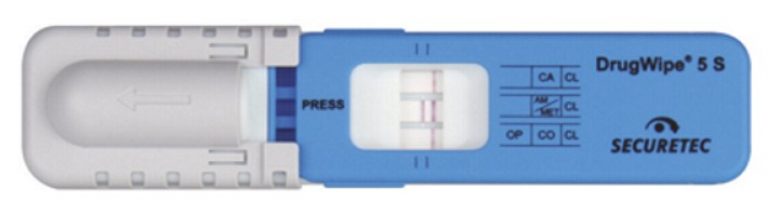
The saliva test to detect THC
If you’ve tested positive at a saliva control, we go through what to do step by step in Saliva Test for THC: What To Do If You Test Positive.
How do cannabis drug tests work?
All tests designed to detect the presence of cannabis look for metabolites of tetrahydrocannabinol or THC, responsible for the psychoactive effects of the substance. Specifically, THC-COOH (11-nor-9-carboxy-Δ9-Δ9-tetrahydrocannabinol acid) and 11-OH-THC (11-hydroxy-Δ9-tetrahydrocannabinol) are two of the most commonly used in both rapid saliva and urine tests (2).
Detecting recent use through exhaled air
The first devices to detect recent cannabis use through exhaled air are being tested (3). These instruments are similar to the breathalyzers used in routine traffic controls to detect drivers driving under the influence of alcohol.
Why they only give a qualitative result
One of the drawbacks of cannabis tests is that they provide a qualitative result (positive or negative). This does not provide information about the user's context, consumption pattern, motivations, beliefs, experiences and problems.
Differences between THC and CBD
THC and CBD are different cannabinoids; we explain their Differences between THC and CBD.
Cut-off point, sensitivity and false positives
Test sensitivity
The sensitivity of a drug test refers to its ability to detect true positives. In other words, it measures the proportion of people who have actually used a substance and are correctly identified as positive by the test. A high sensitivity means that the test is less likely to give false negatives, i.e. to miss people who have actually used the substance in question.
The cut-off point
Drug tests detect the presence of these compounds above a certain concentration, called a cut-off point. Samples with concentrations equal to or greater than this point will be considered positive, while those with lower concentrations will give a negative result. Therefore, the probability of testing positive for cannabis depends not only on its sensitivity, but also on the cut-off point established in the test.
False positives
However, it is important to note that as the cut-off point decreases (i.e., tests that detect the presence of drugs at lower concentrations), the number of false positives is more likely to increase. This means that some people may test positive for cannabis without having used the substance. This may be due to the presence of other factors, such as the influence of drugs, dietary supplements, drug interactions or even errors in the sample collection and processing procedure, which may contribute to false positive results.
How long is cannabis detectable? Factors that play a role
In any case, the characteristics of cannabinoids mean that there is great variability in detection times (which in exceptional cases can last up to three months). Some important factors are:
Factor | Why it matters |
|---|---|
Body mass and fat ratio | THC accumulates in fatty tissue |
Frequency of administration and dose | The more you consume, the longer the detection time |
Route of administration | Smoked, vaped or oral give different times |
Individual metabolic differences | Each body eliminates it at a different rate |
Products to test negative in drug tests: Do they work?
Through the Internet, it is easy to locate various types of products that supposedly allow you to obtain a negative result in drug tests. From liquids and "detox" pills to more or less original gadgets with synthetic urine.
Generally speaking, we can distinguish between saliva cleansers (sprays) and urine cleansers (diuretics). Each of these products has a method of action, often involving dilution or masking. But do they really work? In short, none of these options are effective.
Products for negative saliva test
As for sprays or saliva cleansers, there are simply no scientific references to support their efficacy. In any case, for physiological reasons, its supposed efficacy would be maintained for a few seconds after administration. Saliva tests are mostly used in traffic drug controls, so they are unlikely to be useful in practice, since the agent is present during the process.
Negative urine test products
More problematic may be the use of "urine cleansers". They are products to be ingested orally and that ensure to accelerate the speed of drug elimination. This idea is unfounded, since under normal conditions, the speed with which a drug is eliminated from the body depends on a series of pharmacological parameters that cannot be influenced.
First, the use of diuretics (especially of undetermined origin, composition and quantity) can have serious health consequences. Secondly, urine drug screening tests are always accompanied by a basic urinalysis, which would be clearly altered by the use of diuretics (15).
Other types of "urine cleaners" are products to be added to the sample that alter the cannabis metabolites to make them undetectable. They are effective, but have the same disadvantages as those just mentioned: alterations in parameters such as pH, density or protein in the urine would make fraudulent intent evident (15, 16).
In any case, we insist again on the absence of the need to resort to cheating when consuming CBD products such as CBD oils, in the recommended doses. A positive test result for cannabis is unlikely.
Product | How it claims to work | Does it work? (according to the author) |
|---|---|---|
Saliva cleansers (spray) | Dilution or masking | No: no scientific references; its effect would last “a few seconds” and the agent is still present at the control |
Urine cleansers (diuretics) | Speeding up elimination | No: no basis; besides, a basic urine analysis would appear “clearly altered” |
Sample additives | Altering the metabolites | Effective at hiding them, but they alter pH, density or proteins and “would make the attempted fraud obvious” |
We look in detail at why these “detox” products don’t work in Products to test negative in drug tests: Do they work?.
I tested positive for cannabis after using CBD. What can I do?
As we have explained throughout this article, the likelihood of testing positive for cannabis using CBD products is unlikely. But in biology there are few things impossible and we have also pointed out that false positives are an intrinsic problem with any diagnostic test.
First step: review your recent use
So, in this circumstance, the first recommendation would be to try to remember all the consumptions in the previous weeks to remember if there has been any exposure to cannabis. Am I sure I have not consumed any quantity? Am I sure that that joint I was offered last week had only CBD in it as its owner claimed?
When to turn to a quantitative analysis
If you are sure that you have not consumed THC and if the positive result has significant negative repercussions (disqualification from work, drug tests, legal repercussions, etc.), it is important to know that there are analytical procedures that allow precise quantification of the amounts of THC, CBD and their metabolites (16, 17). Thus, it is possible to distinguish whether the positive result can be attributed to the use of THC or CBD products. These are complex and costly procedures that are likely to involve a lengthy legal process, although the effort may be worthwhile in certain circumstances. In these cases, it is advisable to seek expert legal advice.
Frequently asked questions
Does CBD test positive in a drug test?
No. Cannabis tests specifically look for THC metabolites, not cannabidiol. At the recommended doses of CBD products, a positive is unlikely.
Does CBD test positive in a saliva test?
Saliva tests detect THC qualitatively (positive or negative) and are mainly used at traffic controls. As they look for THC metabolites, CBD is not what they detect.
Why might a false positive occur?
Because as the cut-off point is lowered, false positives increase; medicines, food supplements, drug interactions or errors in collecting and processing the sample can all play a part.
Do “detox” products work to test negative?
No. Neither saliva cleansers nor urine cleansers are effective and, on top of that, they alter the analysis to the point of making the attempted fraud obvious.
I’ve tested positive after using CBD, what should I do?
Go over any possible THC exposure in the previous weeks. There are procedures that quantify THC, CBD and their metabolites to tell the source of the positive apart; expert legal advice is advisable.
This article is intended for informational purposes only and is not intended to diagnose, prevent or cure any disease or symptom. Its content can complement, but never replace, the diagnosis or treatment of any disease or symptom. Cannactiva products are intended for external use. We recommend a responsible use of CBD products. Consult a professional if you have any doubts about its use.
References
- Dobri SCD, Moslehi AH, Davies TC. Are oral fluid testing devices effective for the roadside detection of recent cannabis use? A systematic review. Public Health. 2019 Jun;171:57-65. doi: 10.1016/j.puhe.2019.03.006. Epub 2019 May 15. PMID: 31102828.
- Raouf M, Bettinger JJ, Fudin J. A Practical Guide to Urine Drug Monitoring. Fed Pract. 2018 Apr;35(4):38-44. PMID: 30766353; PMCID: PMC6368048.
- Ramzy V, Priefer R. THC detection in the breath. Talanta. 2021 Jan 15;222:121528. doi: 10.1016/j.talanta.2020.121528. Epub 2020 Aug 11. PMID: 33167238.
- McCartney D, Kevin RC, Suraev AS, Irwin C, Grunstein RR, Hoyos CM, McGregor IS. Orally administered cannabidiol does not produce false-positive tests for Δ9 -tetrahydrocannabinol on the Securetec DrugWipe® 5S or Dräger DrugTest® 5000. Drug Test Anal. 2022 Jan;14(1):137-143. doi: 10.1002/dta.3153. Epub 2021 Aug 30. PMID: 34412166; PMCID: PMC9292716.
- Hart ED, Mullen L, Vikingsson S, Cone EJ, Winecker RE, Hayes ED, Flegel RR. Conversion of water-soluble CBD to ∆9-THC in synthetic gastric fluid-An unlikely cause of positive drug tests. J Anal Toxicol. 2023 Sep 15;47(7):632-635. doi: 10.1093/jat/bkad043. PMID: 37440360.
- Golombek P, Müller M, Barthlott I, Sproll C, Lachenmeier DW. Conversion of Cannabidiol (CBD) into Psychotropic Cannabinoids Including Tetrahydrocannabinol (THC): A Controversy in the Scientific Literature. Toxics. 2020 Jun 3;8(2):41. doi: 10.3390/toxics8020041. PMID: 32503116; PMCID: PMC7357058.
- Crippa JAS, Zuardi AW, Hallak JEC, Miyazawa B, Bernardo SA, Donaduzzi CM, Guzzi S, Favreto WAJ, Campos A, Queiroz MEC, Guimarães FS, da Rosa Zimmermann PM, Rechia LM, Jose Tondo Filho V, Brum Junior L. Oral Cannabidiol Does Not Convert to Δ8-THC or Δ9-THC in Humans: A Pharmacokinetic Study in Healthy Subjects. Cannabis Cannabinoid Res. 2020 Feb 27;5(1):89-98. doi: 10.1089/can.2019.0024. PMID: 32322680; PMCID: PMC7173681.
- Bonn-Miller MO, Loflin MJE, Thomas BF, Marcu JP, Hyke T, Vandrey R. Labeling Accuracy of Cannabidiol Extracts Sold Online. JAMA. 2017 Nov 7;318(17):1708-1709. doi: 10.1001/jama.2017.11909. PMID: 29114823; PMCID: PMC5818782.
- Crippa JA, Crippa AC, Hallak JE, Martin-Santos R, Zuardi AW. Δ9-THC Intoxication by Cannabidiol-Enriched Cannabis Extract in Two Children with Refractory Epilepsy: Full Remission after Switching to Purified Cannabidiol. Front Pharmacol. 2016 Sep 30;7:359. doi: 10.3389/fphar.2016.00359. PMID: 27746737; PMCID: PMC5043219.
- Hess C, Krämer M, Madea B. Topical application of THC containing products is not able to cause positive cannabinoid finding in blood urine. Forensic Sci Int. 2017 Mar;272:68-71. doi: 10.1016/j.forsciint.2017.01.008. Epub 2017 Jan 16. PMID: 28122323.
- Cirimele V, Kintz P, Jamey C, Ludes B. Are cannabinoids detected in hair after washing with Cannabio shampoo? J Anal Toxicol. 1999 Sep;23(5):349-51. doi: 10.1093/jat/23.5.349. PMID: 10488922.
- Berthet A, De Cesare M, Favrat B, Sporkert F, Augsburger M, Thomas A, Giroud C. A systematic review of passive exposure to cannabis. Forensic Sci Int. 2016 Dec;269:97-112. doi: 10.1016/j.forsciint.2016.11.017. Epub 2016 Nov 16. PMID: 27883985.
- Goggin MM, Janis GC. Using measured cannabidiol and tetrahydrocannabinol metabolites in urine to differentiate marijuana use from consumption of commercial cannabidiol products. Clin Toxicol (Phila). 2021 Jun;59(6):506-514. doi: 10.1080/15563650.2020.1827148. Epub 2020 Oct 29. PMID: 33118434.
- Goggin MM, Janis GC. Using measured cannabidiol and tetrahydrocannabinol metabolites in urine to differentiate marijuana use from consumption of commercial cannabidiol products. Clin Toxicol (Phila). 2021 Jun;59(6):506-514. doi: 10.1080/15563650.2020.1827148. Epub 2020 Oct 29. PMID: 33118434.
- Raouf M, Bettinger JJ, Fudin J. A Practical Guide to Urine Drug Monitoring. Fed Pract. 2018 Apr;35(4):38-44. PMID: 30766353; PMCID: PMC6368048.
- Jaffee WB, Trucco E, Levy S, Weiss RD. Is this urine really negative? A systematic review of tampering methods in urine drug screening and testing.. J Subst Abuse Treat. 2007 Jul;33(1):33-42. doi: 10.1016/j.jsat.2006.11.008. Epub 2007 Jan 16. PMID: 17588487.


