
Sleep apnoea is one of the most common night-time breathing disorders, and a growing number of people are looking for natural alternatives such as CBD products to complement conventional treatments.
In this article we look at the relationship between CBD and obstructive sleep apnoea (OSA), what the current scientific evidence actually says, whether CBD oil for sleep apnoea can influence snoring, and whether there are risks such as increased drowsiness or worsening of the disorder.
What is CBD (cannabidiol)?
CBD (cannabidiol) is a natural compound found in the hemp plant Cannabis sativa. Unlike THC, the psychoactive component of marijuana, it does not produce psychoactive effects or a “high” sensation.
In Spain and the European Union, products derived from hemp must comply with the legal THC limits set by current regulations. CBD is mainly sold in the form of CBD oil. Before the 2019 European regulatory change it was common to take it as sublingual CBD drops. Currently, cannabidiol extracts are subject to approval as a novel food, and until that European authorisation is granted, most of the CBD oil sold in Europe is marketed for external use.
On the market you can find different types of CBD oils based on their concentration (2.5%, 5%, 10%, 20%) and on the type of extract: with all the hemp compounds or without THC (full spectrum or broad spectrum).
Interest in cannabidiol is largely due to its interaction with the network of receptors that regulates sleep, stress and mood (the endocannabinoid system).
What is obstructive sleep apnoea (OSA)?
Obstructive sleep apnoea (OSA) is characterised by repeated pauses in breathing during the night, caused by partial or total collapse of the throat and upper airway (upper respiratory passages) (1).
Symptoms of sleep apnoea
- Loud snoring
- Frequent night-time awakenings
- Choking sensation
- Daytime fatigue
- Morning headaches
A significant share of the adult population has mild or moderate undiagnosed sleep apnoea.
Sleep apnoea treatment: CPAP and alternatives
The standard treatment for OSA includes:
- A machine with a continuous airflow that keeps the airway open (CPAP, continuous positive airway pressure)
- Oral devices
- Lifestyle changes
- Weight loss (2, 3)
It is essential to understand that CBD does not replace these medical treatments.
CBD and sleep apnoea: is there a real link?
When we talk about CBD and obstructive sleep apnoea, it helps to distinguish between:
- Direct treatment of the breathing obstruction (closure of the airway during sleep).
- Improvement of factors associated with rest (night-time anxiety, subjective sleep quality).
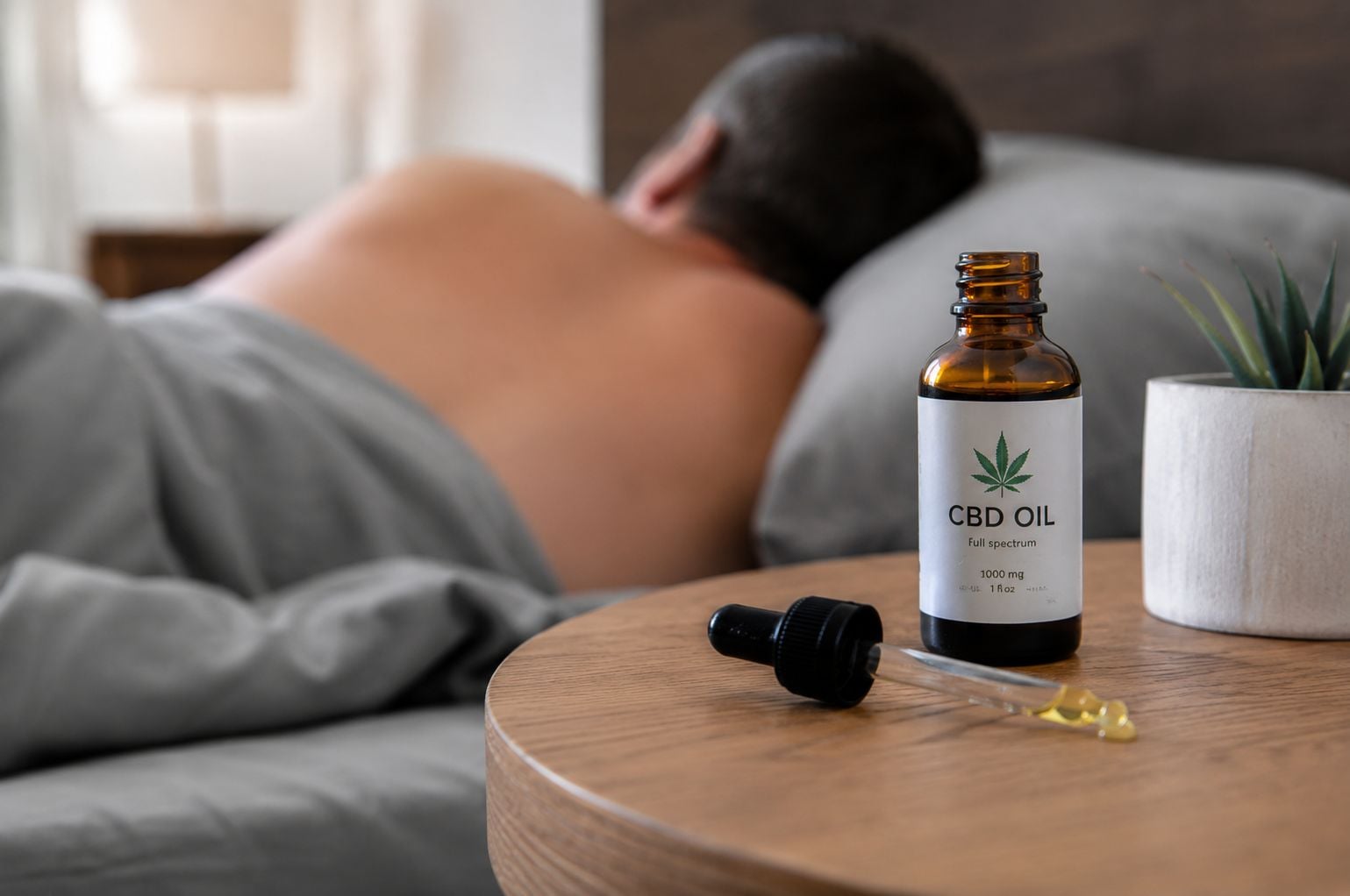
Does CBD help you sleep better with apnoea?
Some studies suggest that continued use of CBD may improve sleep onset, duration and maintenance (5). For this reason, some people who try it as a complement report subjective improvements in:
- Night-time anxiety
- Sleep quality
- Reduction of awakenings
- Relaxation before bed
This may improve the perception of rest, even if it does not change the clinical measure used to assess apnoea severity (the apnoea-hypopnoea index).
Bear in mind that over-the-counter CBD oils are not medicines and not regulated as such. If you have sleep apnoea or any other diagnosed disorder, it is always advisable to consult a specialist before adding CBD to your routine.
Does CBD treat sleep apnoea? The AASM position
It is important to be transparent with the evidence: there is currently no solid scientific evidence that CBD eliminates the breathing pauses that characterise apnoea.
The American Academy of Sleep Medicine (AASM) recommends not using CBD oil or other cannabis-derived products to treat sleep apnoea, due to:
- Insufficient evidence of efficacy
- Lack of long-term safety data
- Potential side effects (4)
In other words: CBD may help you sleep better in subjective terms, but it is not a treatment for sleep apnoea. Those two levels are not the same thing.
CBD and snoring: can it really help?
Snoring is caused by the vibration of the soft tissues of the upper airway when air struggles to pass through. In obstructive sleep apnoea, snoring is usually associated with partial collapses.
GW Pharma patent on CBD for snoring
There is a patent filed by GW Pharma Ltd claiming that cannabidiol can be used for the treatment of snoring in people receiving treatment for epilepsy (6).
However:
- There is no solid clinical evidence showing that CBD directly reduces snoring.
- CBD does not act as a decongestant.
- It does not correct anatomical abnormalities of the airway.
When CBD oil may reduce snoring
CBD could have an indirect influence if snoring is linked to:
- Stress
- Muscle tension
- Mild sleep disturbances
It is important not to confuse a subjective improvement in rest with an actual correction of the underlying breathing problem.
Does CBD worsen sleep apnoea or increase drowsiness?
There is no evidence that CBD directly worsens obstructive sleep apnoea. However:
- It may cause drowsiness in some people.
- It may interact with other medicines.
- It may affect the perception of daytime alertness.
Risk of daytime sleepiness in moderate or severe apnoea
In cases of moderate or severe sleep apnoea, daytime sleepiness is already a common symptom. Adding a substance with a mild sedative effect could:
- Increase the feeling of daytime tiredness.
- Mask symptoms without addressing the underlying breathing cause.
Is it safe to take CBD if I have sleep apnoea?
If you are considering taking CBD and you have been diagnosed with sleep apnoea, there are three basic rules:
- It does not replace CPAP or any other prescribed treatment.
- It should not be used as the main treatment for apnoea.
- It is essential to tell your doctor if you take medication, because of the potential drug interactions.
The biggest risk is not CBD itself, but abandoning effective treatments in the belief that cannabidiol can replace them.
CBD dosage for sleep apnoea: what we know today
There is currently no validated CBD dosage for sleep apnoea.
People who use CBD as a complement to their medical treatment tend to follow three general principles:
- Start with low doses and observe the individual response.
- Adjust gradually, not abruptly.
- Never abandon CPAP or any other prescribed treatment without medical supervision.
If you take medication, consult your doctor before adding CBD: there are known drug interactions and only a healthcare professional can assess your case.
CBD vs THC for sleep: is it the same in apnoea?
No. THC is psychoactive (it affects the mind and perception) and can affect sleep architecture differently from CBD.
In addition:
- Their legal status in Spain and Europe is different.
- It can have more sedative effects.
- It is not equivalent to CBD.
Some studies have investigated synthetic cannabinoids derived from THC (such as dronabinol) in sleep apnoea, but those results are not directly transferable to the use of commercial CBD.
Conclusion: what science says about CBD and sleep apnoea
Although CBD shows promise for promoting well-being, CBD does not cure obstructive sleep apnoea.
- It does not replace CPAP or medical treatments.
- It can help in a complementary way with aspects such as anxiety or subjective quality of rest.
- There is no solid evidence that it directly reduces apnoea episodes.
If you have sleep apnoea, the first step must always be proper medical diagnosis and follow-up. In some cases CBD may be considered as a complement, but never as a substitute for the main treatment.
Frequently asked questions about CBD and sleep apnoea
Can CBD and CPAP be combined?
Yes, some people use CBD as a complement while continuing with their CPAP treatment. However:
- It does not replace CPAP.
- It must not be used as an alternative to medical treatment.
- It is advisable to consult a specialist.
Does CBD worsen obstructive sleep apnoea?
There are no data showing that CBD directly worsens obstructive sleep apnoea. However, it may increase drowsiness in some cases.
If CBD makes me sleepy during the day, what should I do?
If you experience excessive daytime drowsiness:
- Reduce the dose.
- Change the timing of intake.
- Consult a healthcare professional.
Drowsiness is one of the most common side effects, especially at higher doses (7).
Is THC and apnoea different from CBD and apnoea?
Yes. THC is psychoactive and may affect sleep architecture differently from CBD. In addition:
- Their legal status in Spain and Europe is different.
- It can have more sedative effects.
- It is not equivalent to CBD.
Some studies have investigated synthetic cannabinoids in sleep apnoea, but they are not directly transferable to the use of commercial CBD.
References
- Motamedi, K. K., McClary, A. C., & Amedee, R. G. (2009). Obstructive sleep apnea: a growing problem. Ochsner journal, 9(3), 149–153.
- Lloberes, P., Durán-Cantolla, J., Martínez-García, M. Á., Marín, J. M., Ferrer, A., Corral, J., … Terán-Santos, J. (2011). Diagnosis and treatment of sleep apnea-hypopnea syndrome. Archivos de Bronconeumología (English Edition), 47(3), 143–156. https://doi.org/10.1016/j.arbres.2011.01.001
- Bouloukaki, I., Fabozzi, A., Schwarz, E. I., & Schiza, S. E. (2026). Advances in the Diagnosis and Treatment of Obstructive Sleep Apnea in Women. Pulmonary therapy. Advance online publication. https://doi.org/10.1007/s41030-026-00350-5
- Ramar, K., Rosen, I., Kirsch, D. et al. (2018). Medical Cannabis and the Treatment of Obstructive Sleep Apnea: An American Academy of Sleep Medicine Position Statement. J Clin Sleep Med 14, 679–681. https://doi.org/10.5664/jcsm.7070
- Aiewtrakoon, C. (2024). Efficacy and safety of cannabidiol oil on chronic insomnia: The first randomized, double-blind, placebo-controlled, crossover, pilot study in Thailand. Journal of the Medical Association of Thailand, 107(3), 160–170. https://doi.org/10.35755/jmedassocthai.2024.3.13952
- Guy, G., Wright, S., Mead, A., & Devinsky, O. (2016). Use of cannabidiol in the treatment of nocturnal snoring (WO Patent 2016059405A1). World Intellectual Property Organization. https://patents.google.com/patent/WO2016059405A1/en
- Kaufmann, R., Harris Bozer, A., Jotte, A. R. K., & Aqua, K. (2023). The Effects of Long-Term Self-Dosing of Cannabidiol on Drowsiness, Testosterone Levels, and Liver Function. Medical cannabis and cannabinoids, 6(1), 32–40. https://doi.org/10.1159/000529677
Notice
This article is for informational purposes only and does not constitute medical advice. The information provided here may complement, but never replace, the diagnosis or treatment from a healthcare professional. If you live with sleep apnoea or take medication, please consult your doctor before adding CBD to your routine. Cannactiva products are not medicines: they are sold in accordance with European regulations for external, aromatic or ornamental use. Research on CBD continues to evolve and new evidence may have emerged since this article was published.


