
Rolling a joint is easier than it looks: with four basic materials and a bit of practice, anyone can roll a joint that burns evenly. In this guide we show you how to roll a joint step by step, from the quick version to the detailed technique, the most common mistakes and even what science says about the perfect joint.
At Cannactiva we focus on CBD flowers: they are legal in Spain (with less than 0.2% THC) and have no psychoactive effect. As far as technique goes there is no difference: you roll them exactly like any other variety; the only thing that changes is the material.
And it all starts with choosing your raw material well: here is our selection of best CBD buds and, if you prefer resin, the best CBD hash options.
In 30 seconds
- The key to a good joint: grind well and spread the herb evenly.
- Not too tight (it won't draw) and not too loose (it burns up in seconds).
- Don't fancy rolling? With the Smoker's Kit you get all the gear in a single purchase.
How to roll a joint in 7 steps (quick guide)
In a hurry? These are the essential steps. We explain each one below.
- Grind the buds with the grinder until you get an even texture (neither powder nor big chunks).
- Make the filter: fold a strip of card into an accordion (zigzag) and roll it up.
- Place the paper with the adhesive strip facing up and put the filter at one end.
- Spread the buds evenly, with a little more towards the tip if you want it cone-shaped.
- Shape it into a cylinder with your fingers and roll with your thumbs from the inside out.
- Moisten the adhesive strip just enough and seal it.
- Pack the tip with a thin object and close the end. Ready to light.
What you need to roll a joint
Before you start, keep these four items handy. The quality of each one directly affects how the joint burns and tastes.
The rolling paper
It is what holds the buds together while you smoke. They come in different sizes (1¼ for smoking alone, King Size for sharing) and materials (cellulose, hemp, rice). To start out, choose a thin, slow-burning paper: it adds less flavour of its own and burns more cleanly. Our ultra-thin King Size rolling papers (12 g/m², among the thinnest on the market) are made for exactly that: they are strong and don't tear when you roll, glide nicely between your fingers, burn slowly and evenly, and leave a minimal paper presence so they don't mask the plant's natural flavour.
The filter or tip
The filter (also called a tip or «crutch») gives stability, stops material getting into your mouth and improves the draw. A tip: pay attention to the card. Many filters are chlorine-bleached and dyed, and that is exactly what ends up in contact with your mouth and the smoke. Better to choose unbleached natural cardboard filter tips: they keep the paper's colour, with no unnecessary treatments or inks, and being perforated they fold cleanly and evenly. If you prefer something reusable, the glass tip is the most convenient and long-lasting option.
The grinder (and why it matters)
Grinding the buds evenly is what allows an even burn. A grinder does it in seconds and gives the ideal texture. As you'll see in the science section, the size of the grind directly influences the joint's potency and how long it lasts.
The buds: why we use CBD
The raw material is what most affects the result. A good bud shouldn't be oxidised (dry, brown or scentless), shouldn't contain chemicals or pesticides, and has to be perfectly cured: neither too moist (it won't burn) nor too dry (it crumbles and burns up in seconds). If you're unsure, we explain how to tell if a bud is good quality. At Cannactiva we work with CBD flowers: legal in Spain, with no psychoactive effect and lab-tested in every batch.
How to roll a joint by hand (detailed step by step)
Now, slowly and in detail.
1. Grind the buds. Put them in the grinder and turn it until you get a fluffy texture, similar to a coarse loose-leaf tea. Neither powder (it clogs the draw) nor big chunks (they burn badly). Remove any stems and seeds.
2. Prepare the filter. Take a strip of thin card and make a couple of accordion folds (a W shape) at one end; then roll it up to a thickness of about 6-8 mm. That zigzag blocks particles and stops the filter from getting crushed.
3. Place the paper. Lay the rolling paper with the adhesive strip facing up and towards you. Insert the filter flush into one of the ends.
4. Spread the buds. Distribute the ground buds evenly along the paper. If you want a cone-shaped joint, put a bit less near the filter and a little more towards the tip.
5. Shape and roll (tuck & roll). Hold the paper between your thumbs and index fingers and rock it to pack the buds into a cylinder. Tuck the bottom edge of the paper under the buds and roll upwards, keeping even pressure.
6. Seal. Moisten the adhesive strip just enough (without soaking it) and press from the filter towards the tip. Take special care with the seal next to the filter, where air leaks usually occur.
7. Finish. Carefully pack the buds from the open end with a thin object (a pencil works) and close the tip by twisting the leftover paper. It's ready to light.
Your first joints won't come out perfect, and that's completely normal: rolling is practice. By the tenth one you'll already notice the difference.
Other ways to roll a joint
Once you've mastered the classic joint, you can try other techniques depending on the occasion.
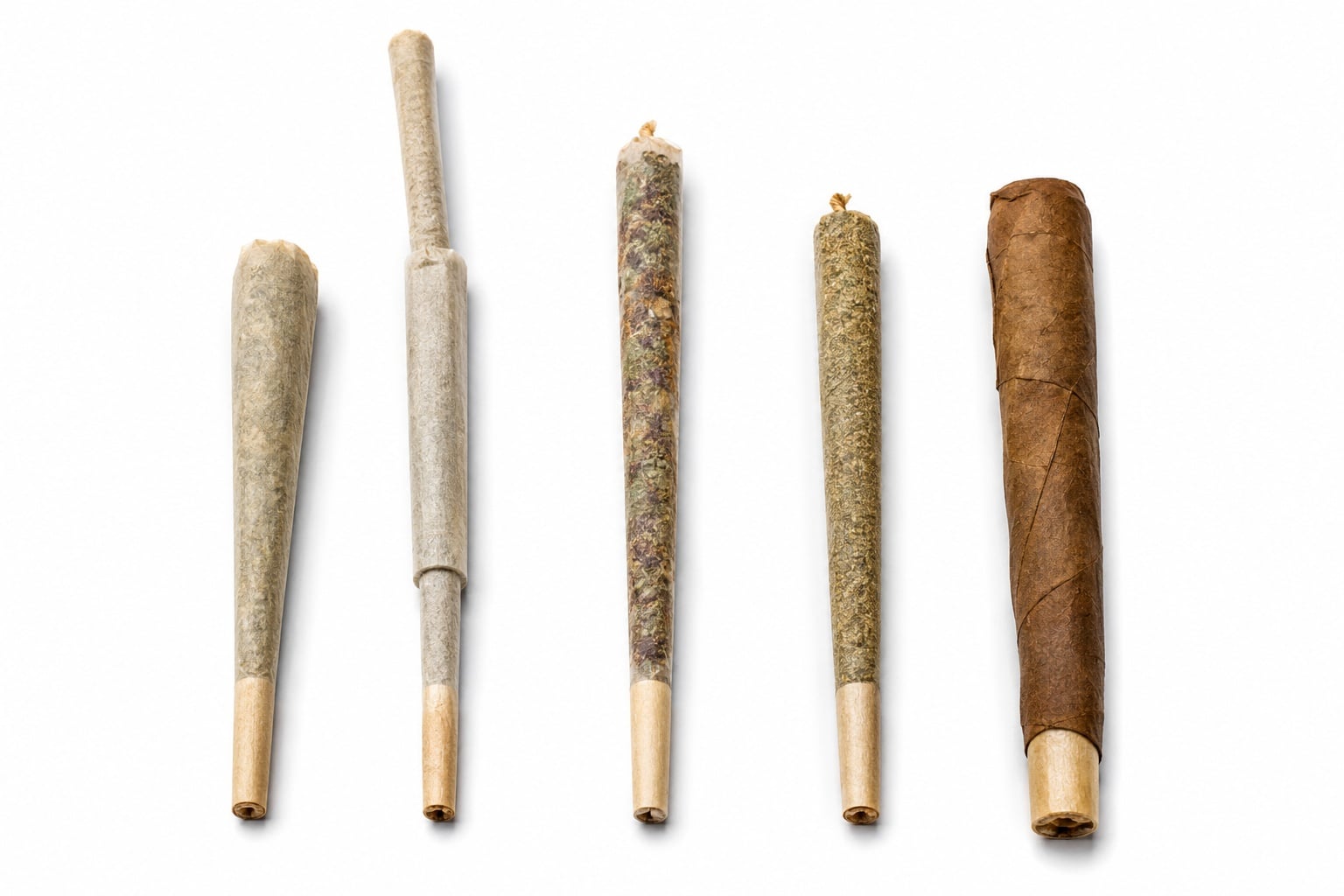
Cone joint
The most popular: wider at the tip and narrow at the filter. It burns progressively and is comfortable to share. The key is to spread more buds towards the tip.
L-joint
Made by joining two papers at an angle (an «L» shape) to get a longer joint. Ideal for groups. It's one of the most sought-after formats for anyone who wants a big joint.
Hash joint
Hash is dense and doesn't burn well on its own: you have to crumble it and mix it with ground buds so it lights evenly. A little heat softens it and makes it easier to spread. If you want to know which resin to choose, we explain it in the types of hashish and in our comparison of the best CBD hash.
Inside-out joint
It's rolled with the adhesive strip facing inwards and then the leftover paper is burnt off. The result: less paper, a slower burn and a cleaner flavour. It takes a bit of practice.
Blunt
Instead of rolling paper you use a wrap (traditionally tobacco). It takes more material and burns slowly, with the flavour and effect of tobacco.
Common mistakes when rolling a joint (and how to avoid them)
- It burns down one side (canoeing): almost always due to uneven filling. Spread the buds evenly and light it while turning the joint so it catches all the way round the edge.
- It won't draw: you've rolled it too tight or the buds are damp. Massage it gently between your fingers or, next time, roll a bit looser.
- It keeps going out: too little material or buds that are too damp. Use a bit more and make sure it's well cured.
- The filter slips out or gets crushed: fold the filter with a firmer crease (a W) and roll it nice and tight, a touch thicker than the diameter of the joint.
The science behind the perfect joint
It's not just about skill: there's chemistry behind it. A team at Delic Labs (Vancouver) used a smoking machine to measure the cannabinoids in each puff, and their findings are very useful when rolling (source: Scientific American).
The grind: potency starts in the grinder
The size of the particles changes the result. With very finely ground buds (≈1 mm) the joint releases more cannabinoids and is more potent, but it burns up fast. With a coarser grind (≈5 mm) it lasts longer and the effect is milder and more prolonged. That's why a good grinder makes the difference.
Which is the best part of the joint?
The composition of the smoke changes depending on the section. At the beginning more terpenes are released (better flavour, less effect); towards the end more cannabinoids concentrate (more effect, less aroma). In short: the flavour is at the start and the potency at the end.
Is it legal to roll a joint?
Legality depends on the country. As a general rule, marijuana joints (containing THC) are not legal, and in many places possessing and consuming them is prohibited. Even in countries where cannabis is regulated, consuming it in public can be penalised.
That's the case in Spain: consuming or possessing cannabis in public is penalised under the Citizen Safety Act, even when it's CBD, because at a glance it can't be told apart from marijuana with THC. In fact, carrying CBD flowers in the street can lead to a fine; we explain it in detail in the fine for carrying CBD in the street.
Remember: sold exclusively to adults over 18. CBD is not a medicine and our products are not intended to diagnose or treat any illness.
Frequently asked questions about how to roll a joint
How many buds do I put in a joint?
About 0.2 g of flower is enough for one joint. If you're starting out, go for a small amount and adjust from there.
Why does my joint keep going out?
It's usually down to damp buds or rolling it too loose or with too little material. Use well-cured buds and pack it a bit more.
Why won't the paper stick?
You've moistened the strip too much or too little. Run your tongue over it just enough and press straight away.
What's the best rolling paper?
For most people, a thin hemp or rice paper, slow-burning and unbleached.
Can you roll a joint without tobacco?
Yes. A pure joint is rolled with flower only; some people also mix it with tobacco or herbs. It's down to preference.
How do I make it burn slower?
Grind evenly, roll a little tighter (without overdoing it) and use thin paper. A coarser grind also lengthens the burn.


