Full Spectrum vs Broad Spectrum vs Isolate CBD: differences and how to choose

Europe's hemp market is now home to dozens of brands and formats of CBD oil, with strengths ranging from 2.5% to 30%. Although every one of these products shares the same star ingredient, cannabidiol (CBD), they don't all contain the same compounds: the presence or absence of THC, of other minor cannabinoids and of terpenes depends on the type of extract and changes both the experience and how the product behaves in the body.
In this comparison guide we walk you through the three main types of cannabidiol (CBD) oil you'll come across when choosing a CBD oil: full spectrum, broad spectrum and isolate. By the end you'll have a clear view of how they differ and which one fits best for you.
Three key ideas:
- Full Spectrum: complete plant extract. It contains CBD, other minor cannabinoids, terpenes and legal trace amounts of THC (below 0.2%). It offers the strongest entourage effect and the highest bioavailability.
- Broad Spectrum: extract with cannabinoids and terpenes but no detectable THC. It preserves part of the entourage effect.
- Isolate: pure CBD above 99%, with no other compounds. No entourage effect.
What is full spectrum CBD?
Full spectrum CBD is an extract that preserves the most complete composition of the hemp plant.
It contains:
- Hemp extract rich in cannabidiol (CBD)
- Minor cannabinoids (CBG, CBC, CBN, etc.)
- Terpenes (the aromatic compounds), all naturally present in the hemp plant.
- This extract also contains legal trace amounts of THC, which is the main difference compared to other types of CBD oil.
The amount of tetrahydrocannabinol (THC) contained in Full Spectrum CBD oils is minimal, and no intoxicating or psychoactive effect is to be expected from taking drops.
In the European Union, THC content is capped at very low levels (the THC limit is usually below 0.3%, although it varies by country).
The defining feature of full spectrum CBD is that it keeps the composition closest to the original plant, which is linked to what is known as the entourage effect.
What is the entourage effect?
The entourage effect describes the possible synergistic interaction between cannabinoids and other compounds of the plant (1). That is, the whole could act differently from CBD isolate.
Some research suggests that, when CBD is administered alongside THC, more CBD reaches the bloodstream and its effects increase (2, 3).
Scientifically, the presence of trace amounts of THC may improve oral CBD bioavailability, that is, the percentage of CBD that the gut actually absorbs. It has been suggested that THC may facilitate that absorption, so a greater portion of the CBD you take is utilised (2).
Who might full spectrum CBD suit?
- People looking for a more complete experience of the plant.
- Users interested in the entourage effect theory.
- Consumers who are not particularly concerned about minimal trace amounts of THC.
- People who want to maximise the bioavailability of CBD.
What is broad spectrum CBD?
Broad spectrum CBD is a middle-ground option between full spectrum and CBD isolate.
It contains hemp extract rich in CBD, minor cannabinoids and terpenes:
- CBD
- Other cannabinoids
- Terpenes
- No detectable THC
It is one of the options chosen by users who want to avoid THC.
Difference between broad spectrum and full spectrum
- Both contain multiple hemp compounds.
- Broad spectrum has no detectable THC.
- Full spectrum keeps legal trace amounts of THC.
Although some researchers indicate that CBD containing terpenes may behave differently from isolate (4), one comparative study found no relevant differences between CBD isolate and broad spectrum in terms of their effects on the body (2).
Who is broad spectrum CBD suitable for?
- People who want to avoid THC.
- Users worried about drug tests.
- Consumers looking for CBD without THC but with other cannabinoids present.
- People who want a balance between purity and a partial entourage effect.
What is CBD isolate?
CBD isolate is cannabidiol in its purest form, typically with a purity of ≥99%.
It does not contain:
- THC
- Other cannabinoids
- Terpenes
It is simply purified cannabidiol.
Advantages of CBD isolate
- Precise dosing.
- Neutral taste.
- THC-free.
- A defined, standardised profile.
- Ideal for formulations requiring exact milligrams.
Limitations of CBD isolate
- No entourage effect.
- It does not include other natural hemp constituents.
- One study found that CBD isolate showed lower oral bioavailability (i.e. the body utilises less of the CBD that is taken) than full spectrum when the latter contained 0.2% THC (2).
In addition, it has been suggested that the absence of terpenes and other plant components may reduce some of the potential benefits of CBD and that certain adverse effects may increase (5, 6).
Who is CBD isolate ideal for?
- People who want pure cannabidiol only.
- Users who are very sensitive to other compounds.
- Consumers who want to avoid any trace of THC altogether.
- People who undergo strict anti-doping testing.
Is CBD isolate more potent than full spectrum?
Not necessarily.
Isolate is purer (≥99% CBD), but full spectrum may have higher bioavailability (i.e. the body absorbs more of the CBD that is taken) due to the presence of THC and other compounds (2).
Comparison table: Full Spectrum vs Broad Spectrum vs Isolate CBD
Feature | Full Spectrum | Broad Spectrum | Isolate |
|---|---|---|---|
Other cannabinoids | Yes | Yes | No |
THC | Yes (0,2-1%) | Not detectable | No |
Terpenes | Yes | Yes | No |
Entourage effect | Potential | Partial | No |
CBD purity | High | High | above 99% |
What "no detectable THC" really means (LOQ)
In broad spectrum CBD, "no detectable THC" means that the THC sits below the limit of quantification (LOQ) indicated on the Certificate of Analysis (COA).
Example:
- THC: <0.01%
This means it sits below the precisely measurable limit, not that it is absolute zero.
That is why it is essential to always check the Certificate of Analysis (COA).
How to interpret a Certificate of Analysis (COA)
To identify whether an oil is full spectrum, broad spectrum or isolate, four pieces of data on the Certificate of Analysis are worth reviewing: the actual total CBD content in mg (distinguishing between hemp extract and pure CBD), the exact THC value and its limit of quantification (LOQ) to confirm legal compliance (below 0.2-0.3% depending on the country), the presence or absence of other cannabinoids such as CBG or CBC (they appear in full and broad spectrum, while isolate only contains CBD) and, lastly, the batch number and date of the analysis, signed by an independent laboratory.
How to choose: full spectrum, broad spectrum or isolate CBD?
There is no universally better option.
It depends on your priorities:
- Look for the complete composition of the plant → Full spectrum
- Avoid THC completely → Broad spectrum or isolate
- Want maximum purity (above 99%) → Isolate
- Worried about drug tests → Broad spectrum or isolate
- Maximise bioavailability → Full spectrum
Can full spectrum CBD trigger a positive drug test?
Full spectrum CBD contains legal trace amounts of THC.
Although they sit within the European legal framework, there is a theoretical possibility of build-up in very specific cases.
If your priority is to minimise risk in testing, broad spectrum or isolate are usually considered the more conservative options.
Is CBD legal in Spain and Europe?
CBD derived from industrial hemp is legal under certain conditions, but regulation may vary by country. It is important to check the rules in force.
Why prioritise full spectrum CBD? What the evidence says
As we've seen, full spectrum CBD preserves the composition closest to the original plant: cannabidiol accompanied by minor cannabinoids (CBG, CBC, CBN), terpenes and legal trace amounts of THC. That biochemical integrity is the basis of the entourage effect, the possible synergy between compounds that CBD isolate, by its very nature, cannot replicate.
The scientific literature suggests several reasons why this category stands out:
- Some research points to a higher oral bioavailability of CBD (i.e. a greater amount of CBD reaching the bloodstream) when it is administered together with legal trace amounts of THC (2).
- It has been suggested that the absence of terpenes and other plant components in isolate may reduce some of the potential benefits of CBD, while certain adverse effects may increase (5, 6).
- One study observed that repeated administration of a full spectrum product, but not CBD isolate, reversed behaviours associated with subchronic inflammation in an animal model (3).
For these reasons, Cannactiva CBD oils are always full spectrum.
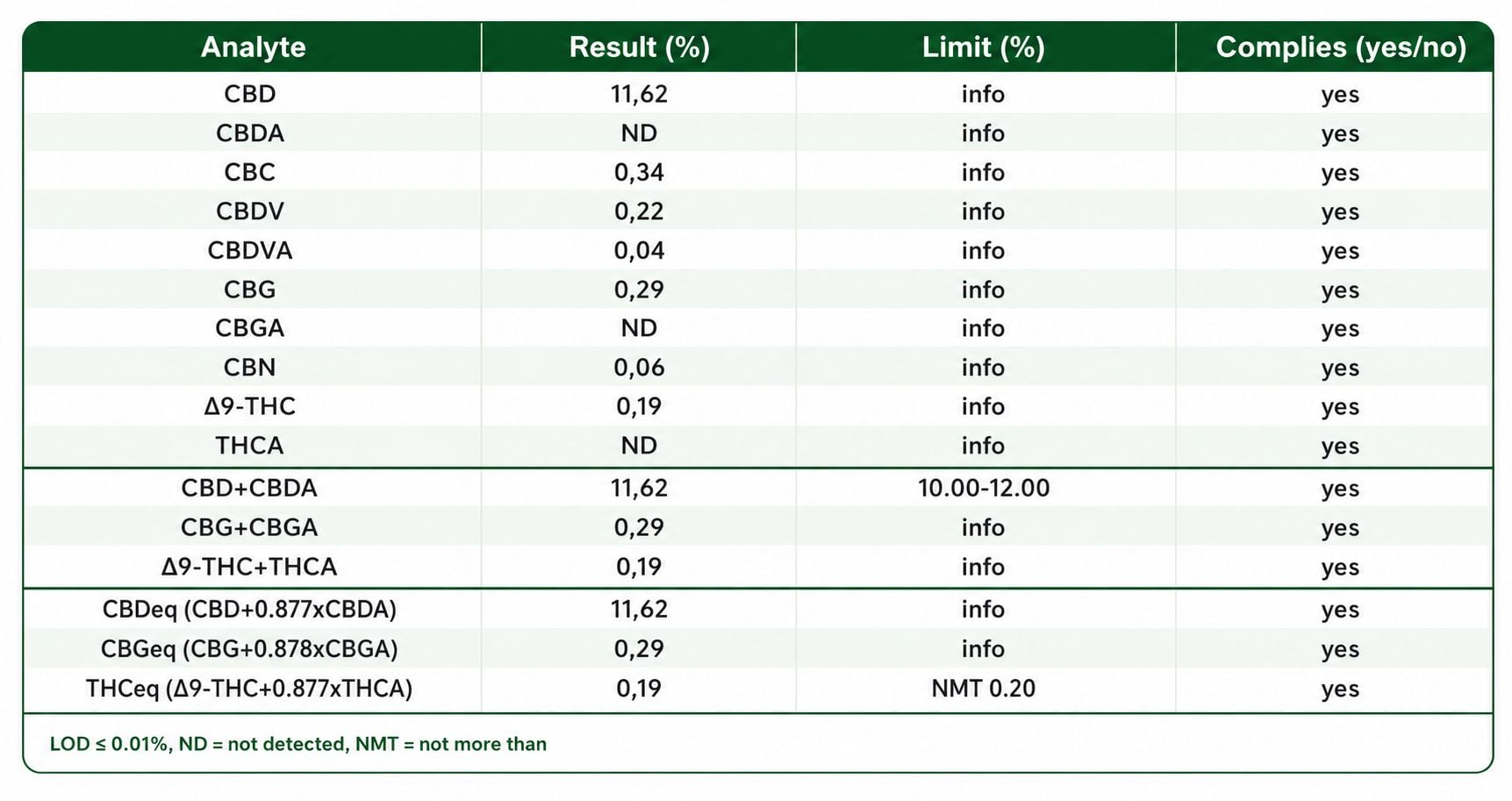
As a real-world example, this is the cannabinoid analysis of a 10% Full Spectrum CBD oil from Cannactiva. You can see the minor cannabinoids (CBC, CBDV, CBG, CBN) alongside cannabidiol.
Conclusion: why we choose full spectrum at Cannactiva
At Cannactiva we consider full spectrum CBD to be the most complete option and the one most faithful to the nature of the plant: it preserves the minor cannabinoids, the terpenes and the legal traces of THC that underpin the entourage effect, and the available evidence points to greater oral bioavailability of cannabidiol compared with isolate.
For this reason, every CBD oil we make at Cannactiva is full spectrum. It is the only format we offer because it is the one that, in light of the current scientific literature, we believe delivers the most value to those who use it.
Disclaimer
This article is for informational purposes only and does not constitute medical advice. The information here can complement, but never replace, the diagnosis or treatment of a healthcare professional. If you are considering adding CBD to your routine or you are on medication, please consult your doctor. Cannactiva products are not medicines: they are marketed in line with European regulations for external, aromatic or ornamental use. CBD research continues to evolve and new evidence may emerge after the publication date.
References
- Cox-Georgian, D., Ramadoss, N., Dona, C., Basu, C. (2019). Therapeutic and Medicinal Uses of Terpenes. In: Joshee, N., Dhekney, S., Parajuli, P. (eds) Medicinal Plants. Springer, Cham. https://doi.org/10.1007/978-3-030-31269-5_15
- Berthold, E. C., Kamble, S. H., Kanumuri, S. R. R., Kuntz, M. A., Senetra, A. S., Chiang, Y. H., McMahon, L. R., McCurdy, C. R., & Sharma, A. (2023). Comparative Pharmacokinetics of Commercially Available Cannabidiol Isolate, Broad-Spectrum, and Full-Spectrum Products. European journal of drug metabolism and pharmacokinetics, 48(4), 427–435. https://doi.org/10.1007/s13318-023-00839-3
- Ribeiro de Novais Júnior, L., Vicente da Silva, T., da Silva, L. M., Metzker de Andrade, F., da Silva, A. R., Meneguzzo, V., de Souza Ramos, S., Michielin Lopes, C., Bernardo Saturnino, A., Inserra, A., & de Bitencourt, R. M. (2025). Repeated Administration of a Full-Spectrum Cannabidiol Product, Not a Cannabidiol Isolate, Reverses the Lipopolysaccharide-Induced Depressive-Like Behavior and Hypolocomotion in a Rat Model of Low-Grade Subchronic Inflammation. Cannabis and cannabinoid research, 10(2), 236–246. https://doi.org/10.1089/can.2024.0086
- Liktor-Busa, E., Keresztes, A., LaVigne, J., Streicher, J. M., & Largent-Milnes, T. M. (2021). Analgesic Potential of Terpenes Derived from Cannabis sativa. Pharmacological reviews, 73(4), 98–126. https://doi.org/10.1124/pharmrev.120.000046
- Pamplona, F. A., da Silva, L. R., & Coan, A. C. (2018). Potential Clinical Benefits of CBD-Rich Cannabis Extracts Over Purified CBD in Treatment-Resistant Epilepsy: Observational Data Meta-analysis. Frontiers in neurology, 9, 759. https://doi.org/10.3389/fneur.2018.00759
- Ferreira, L. L., Gomes, F. S., Nascimento, B. G., Corsini, W., Dos Reis, L. F. C., Oliveira-Silva, J. M., da Silva, J. R. T., da Silva, M. L., Gamero, A. M. C., & Hermes, T. A. (2025). Treatment With Full-Spectrum Cannabidiol Oil Improved the Pathological Findings of Dystrophic Mutant Mice. Muscle & nerve, 71(4), 651–661. https://doi.org/10.1002/mus.28337


