
Pain shows up without warning: a migraine, a muscle knot, a difficult period. That is why ibuprofen, naproxen and diclofenac (Voltaren) are within reach in almost any medicine cabinet. At the same time, CBD oil and other hemp-derived products have carved out a place in many people's daily routine.
Today on the Cannactiva blog we answer the question: can you take CBD with ibuprofen safely? In this article we review the possible interactions between CBD and non-steroidal anti-inflammatory drugs (NSAIDs) — ibuprofen, naproxen, diclofenac/Voltaren, ketoprofen and others — and what is worth bearing in mind before combining them.
What NSAIDs are: ibuprofen, naproxen and other anti-inflammatories
Non-steroidal anti-inflammatory drugs (NSAIDs) are the medicine-cabinet classics: ibuprofen, naproxen, diclofenac (Voltaren), ketoprofen and dexketoprofen (Enantyum). They are used to reduce pain (migraine, muscle pain, dental, menstrual), to bring down the inflammation of an injury or arthritis, and to lower fever.
All NSAIDs work in the same way. When something hurts or becomes inflamed, it is because the body releases substances called prostaglandins, which are responsible for both pain and inflammation. NSAIDs block the enzymes that produce them — the COX (cyclooxygenases) — and, by cutting off that production, pain and inflammation come down (3).
Does CBD oil interact with NSAIDs?
When we talk about CBD interactions with medications, we mean how one substance can change the effect of another inside the body (1). This can happen because:
- The absorption of one of the compounds is altered.
- The liver metabolism is changed.
- The drug concentration in the blood goes up or down.
- The side effects are amplified.
Cannabidiol (CBD) and NSAIDs such as ibuprofen, naproxen and diclofenac are all metabolised in the liver, where they share part of the same enzyme system: cytochrome P450 (CYP450) (2). That is why, when taken together, they can interact with each other.
What is known so far? Most of the evidence comes from preclinical studies (in animal models and in cells); human trials are still scarce. In those studies CBD does not react directly with NSAIDs in the sense of forming a new compound. In fact, it has been proposed as a possible adjuvant in conditions where NSAIDs are the standard treatment (4), with some signs of an additive or synergistic effect on pain reduction (5).
The potential problem lies elsewhere: CBD may partially inhibit liver enzymes such as CYP2C9 and CYP2C19, the very ones the body uses to metabolise ibuprofen, naproxen and diclofenac. If those enzymes work more slowly, the drug stays longer in the bloodstream, so combining it with CBD may raise the risk of adverse effects.
This does not mean the combination is always dangerous, but it is worth weighing each case and consulting a healthcare professional, especially in long-term treatments.
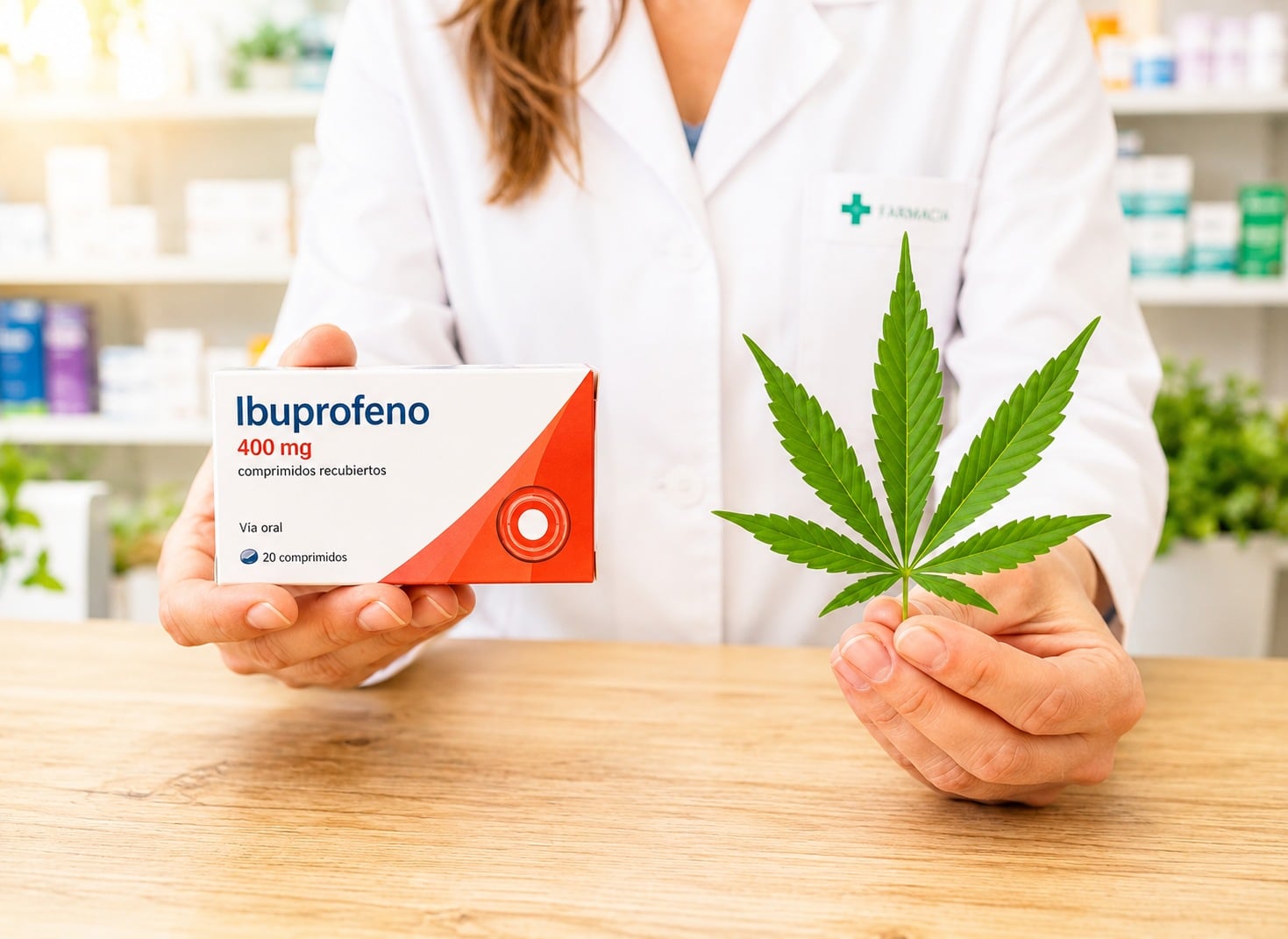
CBD and ibuprofen: can they be taken together?
In long-term use, at high doses or if you have liver problems, it is advisable to consult a doctor before combining them. The reason is the one we saw above: both go through the same liver enzyme system, which means CBD can slow down ibuprofen's metabolism and keep it longer in the blood. As a result, what gets amplified is not the painkilling effect but the possible adverse effects of ibuprofen.
A clinical study that assessed pain relief by combining CBD (vaporised and as a cream) with ibuprofen reported positive results in pain control (6), although long-term liver safety was not measured.
In general, the recommendation is to avoid taking CBD and ibuprofen together without professional advice, especially if you need ibuprofen for more than a few days in a row, if you are taking other medication, or if you have liver disease.
CBD vs ibuprofen: can it replace it?
CBD and ibuprofen work in different ways. Ibuprofen blocks the production of prostaglandins (via COX), while CBD has a broader mechanism (the endocannabinoid system). For mild or chronic pain, some people report improvement with CBD, but it does not automatically replace NSAIDs, especially in acute conditions, fever or significant injuries.
CBD has shown anti-inflammatory and analgesic properties in preclinical studies and in some human trials.
The key points:
- CBD's effect on pain and inflammation is different from ibuprofen's. Although CBD may affect COX enzymes, it does not alter prostaglandin production in the same way NSAIDs do (12).
- CBD does not act as quickly as NSAIDs on acute inflammatory processes.
- For mild pain, some people report improvement with CBD.
- For acute inflammation, high fever or significant injuries, NSAIDs remain more potent and faster-acting.
Therefore, CBD should not be considered an automatic substitute for a prescribed medication or for an over-the-counter NSAID when there is an acute condition. It may, however, make sense as complementary support in chronic or low-intensity pain, ideally under professional supervision.
If you are looking for local relief without going through the liver, a common option is topical application with CBD creams on the affected area.
CBD and naproxen: is there an interaction risk?
There are no human clinical studies on the combination of CBD and naproxen. What we do know is that naproxen stays longer in the body than ibuprofen (7), and that CBD slows down the same liver enzymes responsible for clearing it (8). If those enzymes work more slowly, naproxen accumulates and the risk of adverse effects rises. Better to consult a doctor before combining them, especially in long-term treatments.
CBD and diclofenac (Voltaren): is there a real risk?
Combining CBD and diclofenac — including under the brand name Voltaren — raises frequent questions among people who already use both products.
Both share similar liver metabolic pathways, so joint use by mouth should be done under medical supervision.
Oral diclofenac vs topical diclofenac (Voltaren)
- Oral diclofenac: greater systemic impact, so the potential liver interaction is more relevant.
- Topical diclofenac (Voltaren gel): more limited absorption, so the risk of systemic interaction is lower.
CBD with paracetamol or metamizole (dipyrone): is there an interaction?
Paracetamol and metamizole/dipyrone (Nolotil) are not NSAIDs but pure painkillers (their anti-inflammatory effect is almost negligible). However, both are also metabolised in the liver, so they share that same pathway with CBD.
The evidence on specific interactions between CBD and paracetamol or metamizole is limited and comes mostly from preclinical studies. If you take any of these painkillers regularly or as part of long-term treatment, it is advisable to consult a healthcare professional before adding CBD. For a complete overview of CBD interactions with all kinds of medications, see our CBD and medications guide.
Do the dose and type of CBD matter if you take NSAIDs?
Yes, higher CBD doses may have a greater impact on liver enzymes (10, 11).
The factors that matter most are:
- the concentration of the oil (2.5%, 5%, 10%, 20%)
- the total amount taken per day
- the type of extract (isolate or full spectrum)
- and, above all, the route of use.
The key difference is that when CBD is taken orally (drops, sublingual CBD oil, capsules), it passes through the liver and can interfere with NSAID metabolism.
By contrast, creams and massage oils barely reach the bloodstream, so the risk of interaction is much lower.
The dose of the drug itself, as well as how often it is taken, should also be considered. The higher the dose and frequency, the greater the demand on the liver. It is best to stick to the dose recommended in the patient information leaflet (or to your doctor's instructions) and to space out doses as indicated. Sticking to the recommended posology for each product separately significantly lowers the risk associated with the combination.
Interactions between CBD and NSAIDs
CBD does not react directly with NSAIDs, but both share liver metabolism. If they are taken together and CBD slows down the metabolism of an NSAID, the drug may stay longer in the bloodstream and raise the risk of adverse effects (gastrointestinal, bleeding).
Occasional use at moderate doses is usually low theoretical risk, but in long-term treatments, at high doses or in people with liver problems, it is advisable to consult a doctor.
The liver uses CYP450 enzymes to metabolise many substances. CYP2C9 and CYP2C19 enzymes are essential both for NSAIDs and for CBD (2, 13).
If two compounds compete for the same enzyme, what can happen is:
- Accumulation of one of them (when it does not metabolise at the usual rate)
- Higher risk of side effects
- Increased plasma concentration
This is particularly relevant in:
- Older adults (liver function changes with age)
- Patients with liver disease
- People taking several medications at the same time (polypharmacy)
Risks of combining CBD with NSAIDs: bleeding and gastrointestinal effects
NSAIDs can cause on their own, without any need to combine them with CBD:
- Gastric irritation
- Ulcers
- Risk of gastrointestinal bleeding in long-term use (14)
CBD is not known to cause these effects directly, but if it raises the NSAID's plasma concentration in the blood, the gastrointestinal risk associated with the drug may go up.
Consult a healthcare professional if you experience:
- Persistent abdominal pain
- Dark stools or stools with blood
- Severe nausea
- Frequent dizziness
Practical tips if you want to combine CBD and NSAIDs
If you are considering combining CBD oil with ibuprofen, naproxen or diclofenac, keep in mind:
- Do not stop prescribed medications without consulting first.
- Tell your doctor or pharmacist that you are taking CBD.
- Start with low doses of CBD and watch how you feel.
- Avoid long combinations (weeks in a row) without supervision.
- Take extra care if you are on anticoagulants or have liver problems.
- Wherever possible, prioritise topical routes of CBD if you are already taking NSAIDs by mouth.
- Bear in mind that over-the-counter CBD oils are not medicines or food supplements. While Novel Food approval is pending, these products are sold across Europe for external use.
Conclusion: is it safe to combine CBD and NSAIDs?
Combining CBD with ibuprofen, naproxen or diclofenac is not necessarily dangerous, but it is not something to do without thought either.
The key is that both compounds share liver metabolism, so joint use can raise the risk of adverse effects, particularly in long-term treatments or high doses. CBD may complement pain management, but it may not replace ibuprofen or other NSAIDs in acute conditions.
When you are looking for an anti-inflammatory effect, the best strategy is always to inform yourself and seek the advice of a healthcare professional.
If you want to dig deeper into the role of CBD as an anti-inflammatory (how it works, in which conditions it has been studied and what the science says), see our guide: CBD as an anti-inflammatory: properties, mechanism and uses.
Editorial notice
This article is for informational purposes only and does not constitute medical advice. The information collected here may complement, but should never replace, the diagnosis or treatment of a healthcare professional. Cannactiva products are not medicines: in the European Union, over-the-counter CBD oils are marketed for external use while their approval as Novel Food is being resolved. If you take medication regularly or live with a diagnosed condition, consult your doctor before adding CBD to your routine. Research on CBD continues to evolve and new evidence may have emerged since the date of publication.
References
- Kim, R. E., Morningstar-Kywi, N., & Haworth, I. S. (2021). Integration of Clinical and Scientific Principles in the Teaching of Drug-Drug Interactions. Medical Science Educator, 31(6), 2169-2176. https://doi.org/10.1007/s40670-021-01395-8
- Stout, S. M., & Cimino, N. M. (2014). Exogenous cannabinoids as substrates, inhibitors, and inducers of human drug metabolizing enzymes: a systematic review. Drug Metabolism Reviews, 46(1), 86-95. https://doi.org/10.3109/03602532.2013.849268
- Brune, K., & Patrignani, P. (2015). New insights into the use of currently available non-steroidal anti-inflammatory drugs. Journal of Pain Research, 8, 105-118. https://doi.org/10.2147/JPR.S75160
- Malfait, A. M., Gallily, R., Sumariwalla, P. F., Malik, A. S., Andreakos, E., Mechoulam, R., & Feldmann, M. (2000). The nonpsychoactive cannabis constituent cannabidiol is an oral anti-arthritic therapeutic in murine collagen-induced arthritis. PNAS, 97(17), 9561-9566. https://doi.org/10.1073/pnas.160105897
- Burstein, S. (2015). Cannabidiol (CBD) and its analogs: a review of their effects on inflammation. Bioorganic & Medicinal Chemistry, 23(7), 1377-1385. https://doi.org/10.1016/j.bmc.2015.01.059
- Martinez, F. M. et al. (2024). Clinical Study of Analgesic and Anti-inflammatory Properties of Cannabis Derivatives in Patients with Temporomandibular Joint Pathology: Preliminary Study. Indian Journal of Dental Sciences, 16(2), 80-87. https://doi.org/10.4103/ijds.ijds_17_24
- Runkel, R. et al. (1972). Absorption, distribution, metabolism, and excretion of naproxen in various laboratory animals and human subjects. Journal of Pharmaceutical Sciences, 61(5), 703-708. https://doi.org/10.1002/jps.2600610507
- Yamaori, S. et al. (2012). Comparison in the in vitro inhibitory effects of major phytocannabinoids and polycyclic aromatic hydrocarbons contained in marijuana smoke on cytochrome P450 2C9 activity. Drug Metabolism and Pharmacokinetics, 27(3), 294-300. https://doi.org/10.2133/dmpk.dmpk-11-rg-107
- Aldossary, S. A. (2021). Ameliorative Effect of Cannabidiol against Gastric Ulcer Induced by Diclofenac in Rats. Journal of Pharmaceutical Research International, 33(60B), 836-844. https://doi.org/10.9734/jpri/2021/v33i60B34686
- Talsma, B. et al. (2024). Evaluation of the effect of cannabidiol administration with and without nonsteroidal anti-inflammatory drugs in dogs with mobility disorders. Frontiers in Veterinary Science, 11, 1449343. https://doi.org/10.3389/fvets.2024.1449343
- Papakyriakopoulou, P., Valsami, G., & Ismailos, G. (2026). Cannabinoids and drug-drug pharmacokinetic interactions: Deciphering the risks. British Journal of Clinical Pharmacology. https://doi.org/10.1002/bcp.70430
- Cosentino, M. et al. (2023). Effect of Cannabidiol on Cyclooxygenase Type 1 and 2 Expression and Function in Human Neutrophils. Cannabis and Cannabinoid Research, 8(6), 999-1007. https://doi.org/10.1089/can.2022.0008
- Balachandran, P., Elsohly, M., & Hill, K. P. (2021). Cannabidiol Interactions with Medications, Illicit Substances, and Alcohol: a Comprehensive Review. J Gen Intern Med, 36, 2074-2084. https://doi.org/10.1007/s11606-020-06504-8
- Bindu, S., Mazumder, S., & Bandyopadhyay, U. (2020). Non-steroidal anti-inflammatory drugs (NSAIDs) and organ damage: A current perspective. Biochemical Pharmacology, 180, 114147. https://doi.org/10.1016/j.bcp.2020.114147


