Biphasic Effect of CBD: What It Is and Why It Happens

Today on the Cannactiva blog we present a research article on the components of cannabis, one of the most complex plants in existence and one that never stops surprising science.
Today we focus on the biphasic effect, a dose-dependent response pattern —the so-called bell-shaped curve— that is observed not only with CBD, but with cannabinoids in general (including THC) and even with those produced by our own body.
In essence, the biphasic effect involves something counterintuitive: it appears that the effect of cannabinoids increases with the dose up to an optimal point and, from there, declines. For example, did you know that in studies on anxiety a 300 mg dose of CBD reduced stress, while neither 150 mg nor 600 mg achieved the same effect? Stay with us and discover more.
If you are interested in a more practical approach to CBD dosing (drops, mg, by goal), you'll find it in our guide to the optimal CBD dose.
What is the biphasic effect (or bell-shaped effect) of CBD?
Cannabidiol (CBD) has earned a place among those looking for natural alternatives for relaxation and wellbeing. There is an idea that “the more CBD, the more relaxation or effect”, but with cannabinoids the reality is far more interesting.
One of the best-described phenomena in the response to cannabinoids is the biphasic effect, also called the bell-shaped effect or inverted U-shaped curve. Understanding it is key to getting the most out of CBD, because it explains why a moderate dose can work better than a very high dose.
Definition of the biphasic effect
The bell-shaped effect of CBD, also known as the biphasic effect or inverted “U”-shaped curve, is a dose-dependent response pattern: the effectiveness of CBD increases as the dose rises, but only up to a certain point. Beyond that point, continuing to raise the dose leads to a decrease in effects.
In other words: depending on the dose, you can get two types of response. A positive response (when we are close to the optimal dose) and a null or diminished response (when we fall short or, above all, when we overdo it).
The bell-shaped dose-response curve
If we plotted the effect of CBD against the dose, we would not get a line that rises endlessly, but a bell: the benefit grows, reaches a maximum (the optimal dose) and then falls. Both falling below and going above reduce effectiveness.
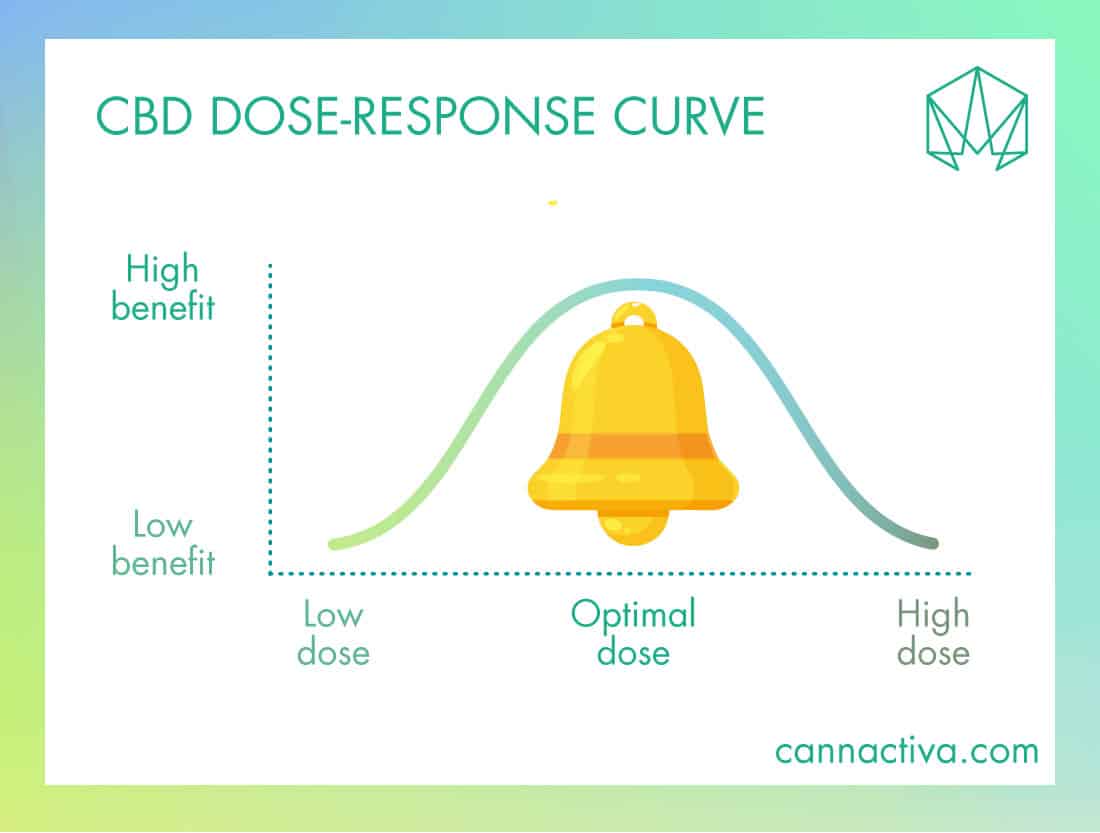
Positive response versus null response
It is worth clarifying what “negative response” means in this context. In the case of CBD, a “negative” response does not usually imply a harmful effect, but rather a null response or diminished effectiveness: the body simply stops responding as it would with the right dose.
Why does CBD produce this biphasic effect?
The bell-shaped effect of cannabinoids occurs because of the complex interactions between cannabinoids and their receptors within the endocannabinoid system.
How cannabinoids interact with their receptors
The endocannabinoid system regulates the body's balance (homeostasis) through various receptors, mainly CB1 and CB2.
The response to a cannabinoid is not linear because, depending on the dose, different circuits are activated or modulated. In the case of anxiety, for example, it has been proposed that the balance between excitatory and inhibitory neurotransmission (with the involvement of CB1 and GABA-B receptors) helps to explain why an intermediate or moderate dose may be more effective than a high one (10).
It also happens with THC and anandamide
The biphasic effect has been described above all for CBD and THC or tetrahydrocannabinol (1, 2, 3), although it has been suggested to appear also with other cannabinoids.
What's more: this phenomenon seems to extend to the endocannabinoids —the cannabinoids produced by our own body—, since anandamide can show a bell-shaped response when administered from synthetic sources (4). All of this suggests that the biphasic effect is a fairly general feature of how the body responds to cannabinoids.
The biphasic effect of cannabinoids as an example of hormesis
The bell-shaped effect of CBD fits into a broader principle of pharmacology and toxicology: hormesis. Hormesis describes precisely this kind of biphasic response, in which low or moderate doses of a substance produce a beneficial or stimulating effect, while high doses reduce or reverse it. It is no coincidence that part of the research on the biphasic effect of cannabinoids comes from leading authors in the field of hormesis (1).
This idea connects with a classic principle: what counts is not only the substance, but the dose. For CBD, that translates into something very concrete: finding the optimal point matters more than seeking the highest possible dose.
Why does it matter to understand the bell-shaped curve when using CBD?
Understanding the biphasic effect is crucial to making the most of CBD's potential. A dose that is too high can lead to a lack of response, when relief would very likely have been found with a lower dose.
In addition, the biphasic effect underlines the importance of personalised doses: factors such as metabolism, weight or certain individual conditions mean that the response varies from one person to another. A dose that is “low” for one person may be the optimal one for another, and vice versa.
A very clear example comes from research on anxiety: in a public-speaking test, a 300 mg dose of CBD reduced stress, but the same effect was not observed with 150 mg or with 600 mg (7, 8). In other words: neither too little nor too much — the middle point was the most effective.
If what you're looking for is the practical side —how many drops, how many mg and how to adjust the dose according to your goal—, we develop it step by step in our guide on the optimal CBD dose.
Bear in mind, too, that the way you consume CBD influences the dose needed and how quickly you notice its effects: it is not absorbed in the same way sublingually as topically or inhaled. We review all the options in our guide on how to consume CBD.
What happens if you take too much CBD?
According to the World Health Organization (WHO), CBD is, in general, safe and well tolerated. But excessive consumption can lead to unwanted effects, such as:
- Fatigue or excessive drowsiness
- Changes in appetite
- Dry mouth
- Gastrointestinal discomfort
- A slight drop in blood pressure
Beyond the efficacy curve, this is another reason not to overdo it. If you're wondering how far that excess goes, we address it in our article on CBD overdose.
Conclusion
The biphasic effect of CBD reminds us that, with cannabinoids, a higher dose does not equal greater benefits. Effectiveness follows a bell-shaped curve: there is an optimal point, and both falling short and overdoing it cause the effect to diminish.
The practical lesson is simple: start with low or moderate doses and adjust until you find the amount that works best for each person. As science continues to study cannabinoids, CBD continues to show itself as an interesting ally for wellbeing. Remember to always consult a healthcare professional before adding it to your routine.
This is an informative article that does not aim to prevent, diagnose or treat any disease. Its content may complement, but never replace, the diagnosis or treatment of any condition. Cannactiva products are not medicines and are intended for external use. Consult your doctor before using CBD.
Scientific references
- Calabrese, E. J., & Rubio-Casillas, A. (2018). Biphasic effects of THC in memory and cognition. European Journal of Clinical Investigation, 48(5), e12920.
- Taylor, D. A., & Fennessy, M. R. (1977). Biphasic nature of the effects of delta9-tetrahydrocannabinol on body temperature and brain amines of the rat. European Journal of Pharmacology, 46(2), 93–99.
- Katsidoni, V., Kastellakis, A., & Panagis, G. (2013). Biphasic effects of Δ9-tetrahydrocannabinol on brain stimulation reward and motor activity. The International Journal of Neuropsychopharmacology, 16(10), 2273–2284.
- Sulcova, E., Mechoulam, R., & Fride, E. (1998). Biphasic effects of anandamide. Pharmacology, Biochemistry, and Behavior, 59(2), 347–352.
- Jan, T. R., & Kaminski, N. E. (2001). Role of mitogen-activated protein kinases in the differential regulation of interleukin-2 by cannabinol. Journal of Leukocyte Biology, 69(5), 841–849.
- Chen, W., Kaplan, B. L., Pike, S. T., et al. (2012). Magnitude of stimulation dictates the cannabinoid-mediated differential T cell response to HIVgp120. Journal of Leukocyte Biology, 92(5), 1093–1102.
- Linares, I. M., Zuardi, A. W., Pereira, L. C., et al. (2019). Cannabidiol presents an inverted U-shaped dose-response curve in a simulated public speaking test. Revista Brasileira de Psiquiatria, 41(1), 9–14.
- Zuardi, A. W., Rodrigues, N. P., Silva, A. L., et al. (2017). Inverted U-Shaped Dose-Response Curve of the Anxiolytic Effect of Cannabidiol during Public Speaking in Real Life. Frontiers in Pharmacology, 8, 259.
- Zhornitsky, S., & Potvin, S. (2012). Cannabidiol in humans—the quest for therapeutic targets. Pharmaceuticals (Basel), 5(5), 529–552.
- Rey, A. A., Purrio, M., Viveros, M. P., & Lutz, B. (2012). Biphasic effects of cannabinoids in anxiety responses: CB1 and GABA(B) receptors in the balance of GABAergic and glutamatergic neurotransmission. Neuropsychopharmacology, 37(12), 2624–2634.


